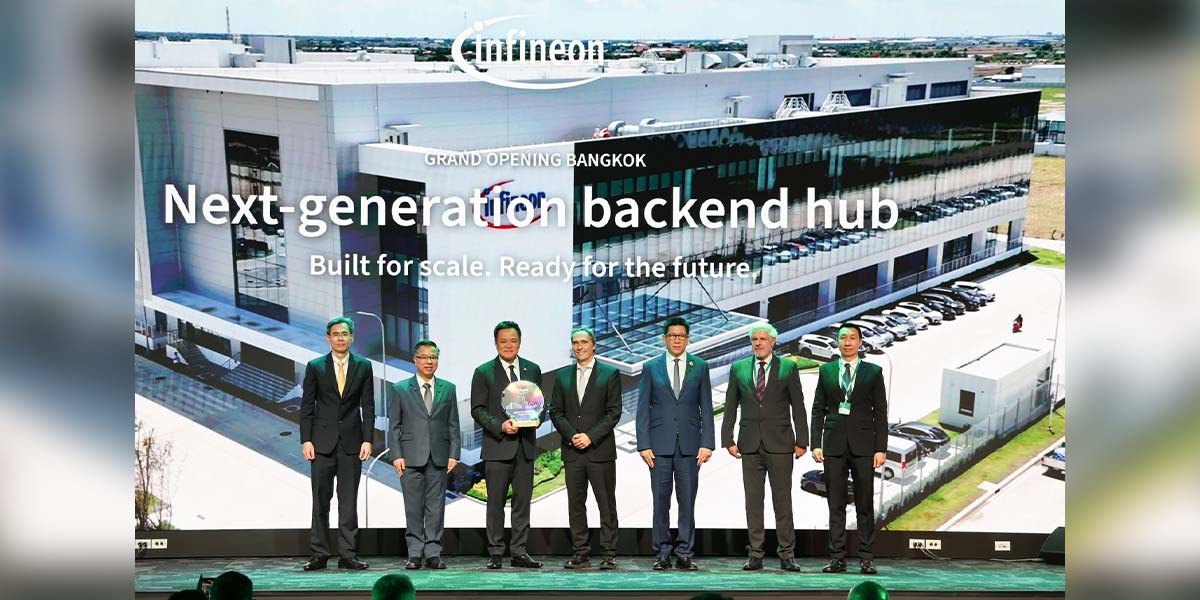
Infineon Technologies AG has inaugurated a $1.4 billion (48 billion baht) power semiconductor manufacturing complex in Thailand, a major investment, promoted by the Thailand Board of Investment (BOI), that strengthens the country’s position in global semiconductor supply chains and supports rising demand from artificial intelligence, electric vehicles and advanced industrial applications.
The first facility, Module A, is located in Samut Prakan and becomes Infineon’s third power module production hub, alongside sites in Germany and China. Upon completion of all five planned modules, the complex is expected to become the company’s largest back-end assembly and testing center worldwide.
The BOI-promoted investment highlights Thailand’s push to move beyond traditional automotive manufacturing and electronics assembly into higher-value semiconductor production and as Thailand and the BOI have successfully launched Thailand’s National Semiconductor Strategy. It also comes as global chipmakers diversify manufacturing networks across Southeast Asia to strengthen supply-chain resilience and serve growing demand from AI data centers, next-generation mobility and industrial automation.
Prime Minister Anutin Charnvirakul presided over the inauguration, joined by Deputy Prime Minister and Finance Minister Ekniti Nitithanprapas, Secretary General of the Thailand Board of Investment Narit Therdsteerasukdi, and German Ambassador to Thailand Michael Reiffenstuel. Anutin described the investment as a key step in Thailand’s ambition to build a competitive high-technology economy.
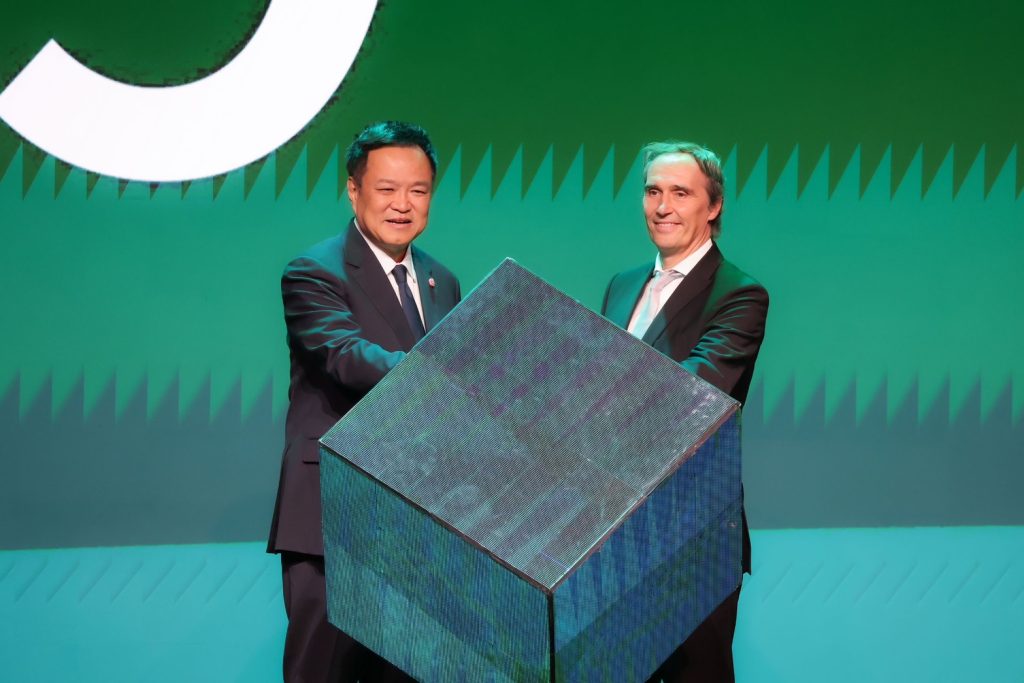
“The semiconductor ecosystem is deeply interconnected, and Thailand is stepping up to play an increasingly important role in the global supply chain,” Anutin said. “Thailand’s National Semiconductor Strategy, launched last week, sets a clear direction for building a competitive and resilient chip industry. Through the Thailand FastPass framework, the government is coordinating the Board of Investment and other key agencies to accelerate approvals and facilitate strategic projects, providing sustained support for Infineon’s expansion in Thailand.”
“Today marks another important step in Thailand’s transition from a digital economy to an intelligence economy,” Eknitisaid. “Thailand must advance on two fronts simultaneously: ‘AI in All,’ applying AI to raise productivity across every sector of the economy, and ‘All in AI,’ building the infrastructure and ecosystem that the AI economy requires. Infineon’s investment is a major contribution to All in AI, anchoring the semiconductor capabilities needed for AI, electric vehicles, clean energy, data centers and industrial automation. Our goal is to turn investments of this scale into technology transfer, high-skilled jobs and stronger local supply chains, building an ecosystem that creates lasting opportunities for Thai people, businesses and industries.”
For Infineon, the Thailand hub provides greater geographic diversification and direct access to fast-growing Asian markets.
“Infineon chose Thailand for its mature industrial ecosystem, strong automotive and electronics base, and established semiconductor cluster,” said Alexander Gorski, chief operating officer of Infineon Technologies AG. “This manufacturing hub will help Infineon balance its regional production network, strengthen supply-chain resilience and capture growing demand across Asia.”
The complex begins operations with Phase 1, or Module A, which includes 30,000 square meters of cleanroom space and a dedicated prototype research and development center. Across five planned phases, Modules A through E, the site is expected to expand to 150,000 square meters of cleanroom space — about twice the footprint of Infineon’s current largest back-end plant.
Designed as a highly automated smart factory, the site uses robotics, automated material handling and end-to-end digital production systems. It is Infineon’s first integrated plant to combine front-end wafer testing, back-end power module assembly and integrated circuit testing at one location.
Demand for power semiconductors — specialized chips that regulate and convert electrical power while limiting energy loss and heat — is growing alongside investment in data centers, robotics, electric and autonomous vehicles, and industrial systems. The global power semiconductor market is projected to grow from about $60 billion in 2025 to more than $107 billion by 2035.
Thailand has identified power semiconductors, including next-generation wide-bandgap materials such as silicon carbide (SiC) and gallium nitride (GaN), as priority areas under its national semiconductor roadmap. Infineon’s investment aligns with the country’s strengths in automotive manufacturing, industrial automation, electronics and energy.
Under an investment package approved by the Thailand Board of Investment (BOI), Infineon is expected to create more than 5,000 skilled local jobs, or about 1,000 positions in each planned phase. The company also plans to develop Thai science and technology talent, including research and development engineers, with overseas training in areas such as wafer design, automated testing and module packaging.
Infineon is also working with the Thai Semiconductor Industry Association and local universities to develop at least 60 specialized semiconductor courses, train 1,100 undergraduate students and support 18 joint research and development projects in process automation, big data and materials engineering.
“Our strategy goes far beyond attracting capital or adding production capacity; it is about building technological capability in Thailand,” said Narit Therdsteerasukdi, secretary general of the BOI. “Attracting the world’s leading power semiconductor company demonstrates Thailand’s readiness to supply critical components for global trends such as digitalization and the energy transition, and advances our long-term vision of chips engineered and made in Thailand.”