PTT Public Company Limited (SET: PTT) has demonstrated the resilience of its dual mandate—safeguarding national energy security while maximizing long-term shareholder value—delivering a net profit of THB 118,816 million for the first nine months of 2026, an 83.8% increase year-on-year.
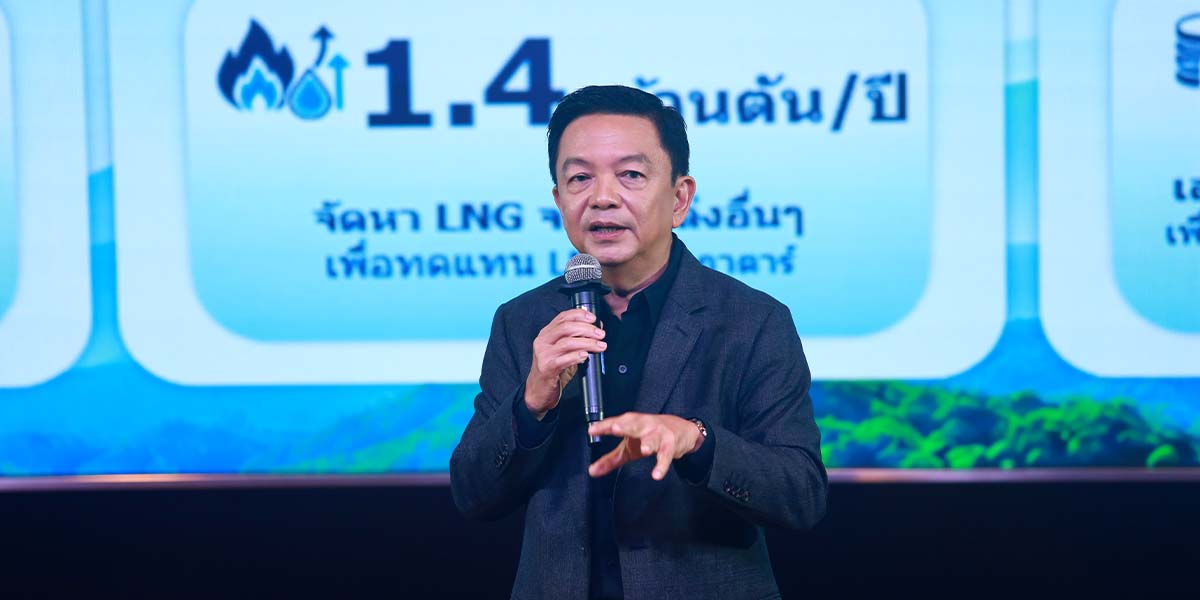
Speaking at the quarterly executive briefing, Dr. Kongkrapan Intarajang, Chief Executive Officer and President of PTT, emphasized that the company successfully navigated severe global energy market volatility, geopolitical conflicts, and supply chain disruptions through disciplined capital allocation, global trading networks, and structural portfolio optimization.
Despite ongoing global economic pressures and inflation, PTT’s performance was bolstered by proactive risk management and supply-chain flexibility. Dr. Kongkrapan noted a structural divergence in global energy markets: while crude oil flows through the Strait of Hormuz have recovered to approximately 10 million barrels per day (bpd) (nearing pre-war levels of 13 million bpd), global refined product supply remains severely constrained at roughly 50% of pre-war output due to refinery damage and extended repair cycles in Russia and the Middle East. Concurrently, spot LNG prices remain elevated at 27-28 per MMBtu, compared to pre-crisis levels of around $10 per MMBtu.
To insulate Thailand from these disruptions, PTT leveraged past investments of over THB 111,000 million across its group refineries to enhance crude intake flexibility. This enabled PTT to rapidly reduce its reliance on Middle Eastern crude from 70% to 30% during peak disruption windows.
Supported by a global trading network across Singapore, London, Houston, and Dubai, PTT maintained uninterrupted fuel and gas supplies nationwide without experiencing domestic shortages. To absorb market price shocks and maintain national liquidity, PTT maintained over THB 200,000 million in supplementary liquidity buffers and absorbed more than THB 26,000 million in cumulative national energy price stabilization burdens, including NGV subsidies and liquidity interest costs.
PTT’s financial strength stems from its three-year Refocus Hydrocarbon strategy, which prioritizes core strengths across Upstream E&P, Natural Gas, International Trading, Refining, and Petrochemicals. Complementing this is PTT’s Smart Exit framework, designed to systematically divest or scale back non-core and underperforming assets.
Under its Smart Exit framework, PTT has defined clear operational boundaries. The group has completely exited EV vehicle manufacturing, non-core rail logistics—retaining only essential pipeline and tank storage assets—and electronics ventures exposed to international trade barriers. Conversely, PTT retained its high-margin EV charging infrastructure under PTT Oil and Retail Business (OR) while repositioning Innobic in the life sciences sector strictly as a disciplined financial investor.
Over the past three years, these portfolio rationalization measures have preserved over THB 28,500 million in capital, unlocked more than THB 14,000 million in cash returns, and avoided structural losses exceeding THB 1,500 million annually. Concurrently, internal Profit Enhancement Initiatives—including MissionX, P1&D1, and group-wide digital transformations—generated over THB 70,000 million in cumulative value creation.
To strengthen long-term competitiveness, PTT is advancing several major structural initiatives across its downstream and trading segments. In petrochemicals, PTT Global Chemical (GC) and SCG Chemicals (SCGC) are consolidating their domestic olefins and polyolefins assets.
This joint venture is projected to generate hundreds of millions of dollars in cost and operational synergies, establishing a national petrochemical champion capable of competing internationally without distorting domestic pricing.
Under Project Genesis, PTT is actively pursuing strategic partnership discussions to sell minor equity stakes—roughly 10% to 20%—in refining, petrochemical, and tank terminal assets to global strategic partners, optimizing capital efficiency while preserving operational control and national energy security.
Meanwhile, Thai Oil is advancing its Clean Fuel Project (CFP) to enhance refining complexity and expand high-value output. In global trading, PTT is scaling its LNG portfolio to reach 10 million metric tons per year by 2030—up from 2.6 million tons two years ago and approximately 4 million tons today—enhancing arbitrage capabilities while ensuring physical supply security during global energy crises.
For the first nine months of 2026, PTT recorded a net profit of THB 118,816 million (+83.8% YoY). For Q3 2026, net profit stood at THB 40,553 million, down 22.8% quarter-on-quarter due to seasonal market adjustments and non-recurring items.
Maintaining its Investment Grade credit rating, PTT delivered an interim dividend of THB 1.40 per share and canceled 238.7 million repurchased treasury shares to enhance earnings per share. Under the Stock Exchange of Thailand’s SET JUMP+ initiative, PTT has formally committed to guaranteeing a minimum total shareholder return of 57% over the next three years through dividends, capital management, and value-accretive growth. Executive leadership reiterated its commitment to maintaining transparent investor communication and positive shareholder returns while balancing capital requirements for ongoing investments.