In the volatile landscape of the Thai-Cambodian border, a new and dangerous element has emerged: the weaponised diplomacy of Donald Trump.
Trump has recently made the groundless assertion that Thailand was the aggressor in the current conflict. This narrative flatly ignores the reality on the ground, where Thai officials, including Prime Minister Anutin, maintain that Thailand was the party being invaded and only responded to protect its sovereignty after being attacked.
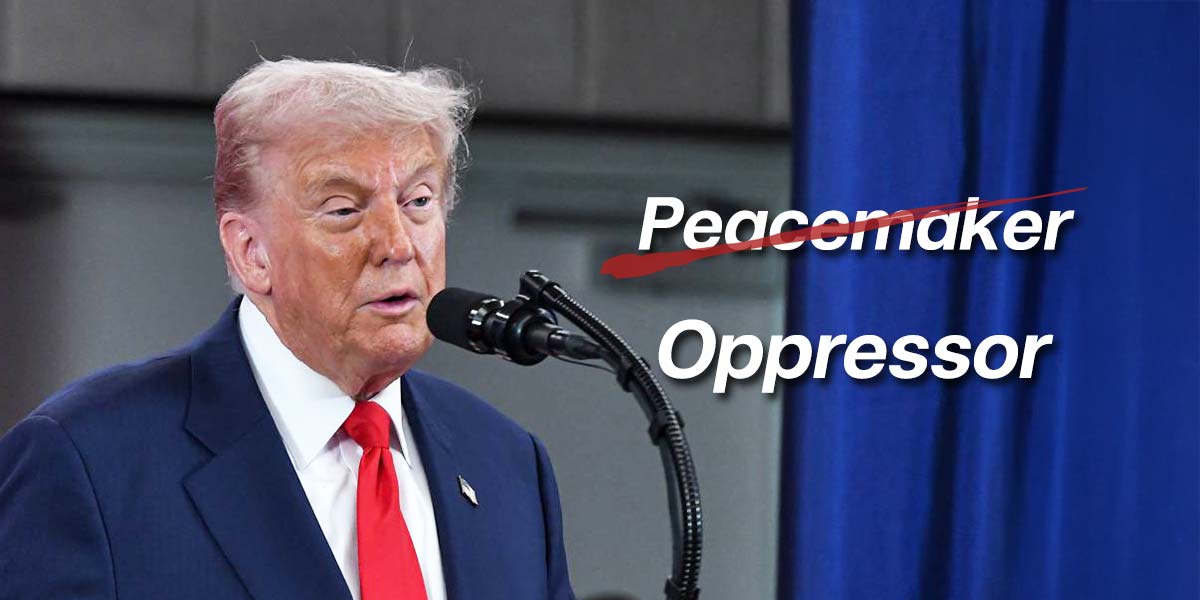
By mischaracterising Thailand’s defensive actions as the “start of a war,” Trump appears to be engaging in a calculated performance to “look good” on the international stage. By leaning toward Cambodia—whom he seemingly views as an inferior party in this bilateral struggle—he attempts to frame himself as a “peacemaker.” However, this is not the patient work of mediation; it is the posture of a “self-centered ruler” asserting dominion through oppression. This dismissive attitude is most evident in Trump’s callous description of the death of Thai soldiers as a mere “accident,” a sharp contrast to the “swift and strong retaliation” promised for American casualties in other incidents.
The primary motivation for this oppression could be seen as a clear economic move. Trump has explicitly threatened to “break the trade deal” and impose heavy tariffs on Thailand (and Cambodia) if the conflict does not cease. However, it is well noted that Thailand’s export volume to the United States is significantly larger than Cambodia’s. It is possible that Trump views Thailand as a lucrative target for his “tariff extortion.” He believes he can “exhaust” more concessions and benefits from Thailand by using its economic dependence on the U.S. as a bargaining chip.
This “mafia-like” approach transforms trade agreements—meant to foster mutual prosperity—into blunt instruments of economic coercion. When the world’s leading democracy demands obedience through financial threats and false accusations, it undermines the very principles of global cooperation. By prioritising leverage over truth, Trump is not settling a dispute; he is creating a volatile landscape where power, rather than principle, dictates the terms of peace.
Trump’s strategy is like a heavy-handed debt collector who chooses to harass the more successful neighbour not because they are at fault, but because they have more to lose.