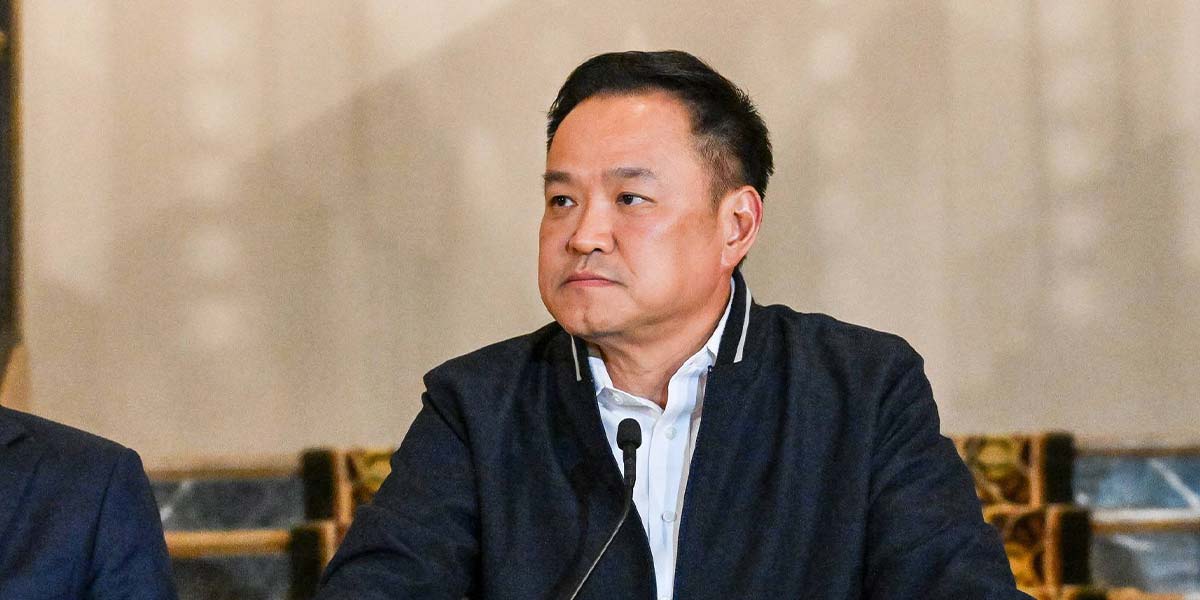
Mr. Anutin Charnvirakul, the Prime Minister of Thailand, addressed the issue regarding the Financial Times (FT), a foreign economic media outlet, describing the economic situation in Thailand using the term “The Sick Man of Asia.” He stated that such terms have been used since the previous administrations.
The term “Sick Man” refers to a country or region experiencing economic, social, or political decline. It is often used to describe a nation that was once considered a major power. The term was first used in the 19th century to describe the Ottoman Empire, as the once-feared power was in decline and increasingly targeted by other European nations.
The Prime Minister stated that after the election was completed, there were multiple articles from various foreign outlets reflecting positive perspectives on the future direction of Thailand. The new government has implemented policies aimed at the collective benefit, not favoring any individual, and adhered to fiscal discipline to strengthen the country’s economic fundamentals.
Mr. Anutin added that the actions which proved credibility to international credit rating agencies included those of Dr. Ekniti Nitithanprapas, Deputy Prime Minister and Minister of Finance, who allocated the remaining budget towards repaying debt to the Bank for Agriculture and Agricultural Cooperatives (BAAC), instead of spending it on populist schemes. This reflected fiscal discipline, resulting in Thailand’s credit rating not being downgraded and remaining at BBB+, demonstrating the nation’s credibility and its appeal for foreign investment.
On the issue of political stability, the Prime Minister stated that the preliminary election results indicate emerging political stability. Political conflicts have not intensified. Even though there was rhetoric or debate during the campaign period, everything proceeded within legal frameworks after the election. This is a positive sign for the strength of the new House of Representatives.
When asked about the role of the “economic team” in confidence building, including the case of the “Four-Packs”–external individuals involved in economic policies–and whether they will remain in the new Cabinet, Mr. Anutin stated there are several interrelated factors, and he would not yet reveal details concerning government formation or additional personnel at this time. He affirmed that political conduct is straightforward, with no interference or manipulation.
Regarding the election process, the Prime Minister emphasized confidence in the performance of the Election Commission (EC) as the election organizer. Decisions on whether to recount votes rest at the EC’s discretion. He noted that he was unaware if considerations would reach the courts, since some time has passed and ballot boxes have already been moved.
Under the legal framework, the EC has 60 days to officially certify the election results. In the 2019 election, all 60 days were used, while the 2023 election took more than 30 days. Currently, just three days have passed. Mr. Anutin believes that no one should interfere with the EC’s work, as it could create pressure and complicate the process, possibly delaying the official announcement of results.