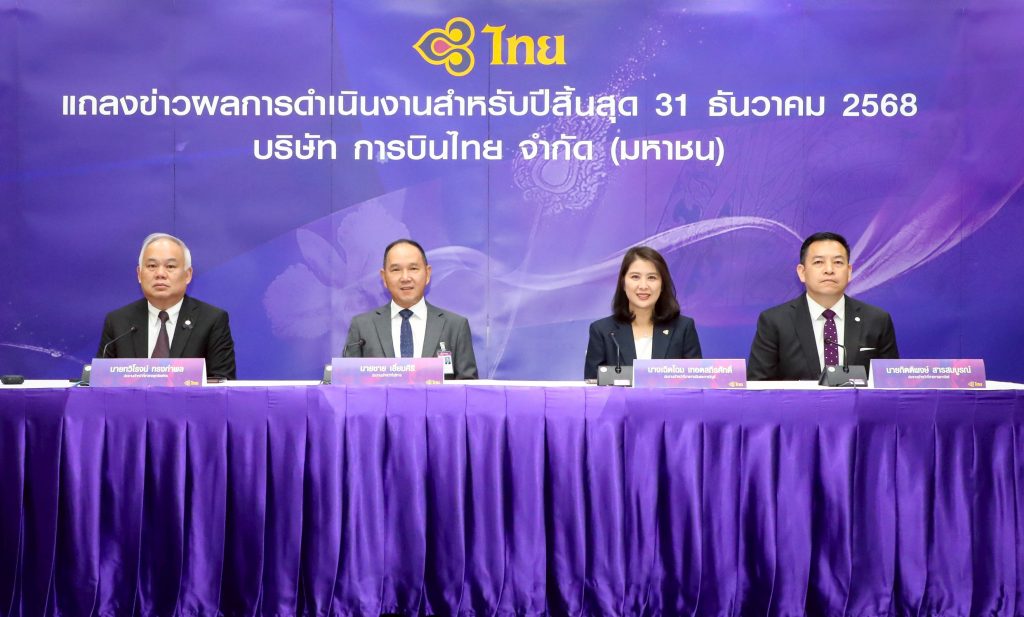
Thai Airways International Public Company Limited (SET: THAI) reported operational performance results for the year ended 31 December 2025, with total revenues excluding one-time items of 190,277 million baht, representing an increase of 1.2% from 2024 and accounting for 103.4% of the 2019 pre-COVID-19. The growth was mainly driven by passenger revenue, which expanded by 0.5%.
In 2025, expenses excluding one-time items totaled 149,438 million baht, increasing 2.0% from 2024 in line with higher production and/or traffic volumes, including increased flight frequencies and passenger numbers. This was despite lower jet fuel expenses following a decline in the average fuel price. As a result, THAI and its subsidiaries recorded EBIT (excluding one-off items) of 40,839 million baht, a decrease of 676 million baht from the previous year, while EBITDA amounted to 53,880 million baht.
THAI and its subsidiaries recorded net one-time items as income totalling 782 million baht. These were mainly attributable to gain on termination of aircraft lease agreements, gain on foreign exchange rates-net, impairment loss on assets, loss on measurement derivatives, revision of the estimate of expiring miles and loss on impairment in accordance with TFRS 9. In addition, finance costs recognized under TFRS 9 amounted to 13,154 million baht. Consequently, THAI and its subsidiaries reported a net profit of 30,940 million baht, equivalent to earnings per share of 1.09 baht, compared with a loss per share of 6.26 baht in 2024.
As of 31 December 2025, compared with as of 31 December 2024, THAI and its subsidiaries reported total assets of 304,059 million baht, an increase of 3.9%. Total liabilities amounted to 228,147 million baht, decreasing by 7.6%, while shareholders’ equity totaled 75,912 million baht, increasing by 30,323 million baht. Supported by improved operating performance and profitability, THAI held cash and cash equivalents, including bills of exchange with the right to be redeemed and fixed deposits with maturity period more than 3 months and not over 1 year, totaling 123,560 million baht, an increase of 8,571 million baht.
THAI and its subsidiaries recorded an increase by 8.3% of the Revenue Passenger Kilometers (RPK), compared with the previous year. The average cabin factor was 79.2%, higher than the 78.8% recorded in 2024. Total passengers carried reached 16.46 million, representing an increase of 2.0% from the previous year. Cargo production, measured in Available Dead Tonne Kilometers (ADTK), increased by 9.7% from the previous year, while Revenue Freight Tonne Kilometers (RFTK) rose by 8.3%, with an average freight load factor of 51.3%.
Currently, THAI operates a fleet of 80 aircraft, comprising 59 wide-body aircraft and 21 narrow-body aircraft, including 1 Airbus A321neo aircraft equipped with next-generation engines that enhance sustainability by reducing carbon dioxide emissions and supporting the use of Sustainable Aviation Fuel (SAF).
For the Summer 2026 schedule, THAI is set to operate flights to 62 destinations worldwide, including the resumption of the Bangkok–Amsterdam route, starting from July 2026. THAI also plans to increase flight frequencies to destinations in China and India to accommodate growing passenger demand and support future business growth.