
As geopolitical tensions escalate, oil prices are no longer the sole dominant threat to global markets. Increasingly, it is the bond markets—specifically the U.S. 10-year Treasury Note yield—that are dictating both market sentiment and the room for maneuver in President Donald Trump’s approach to the ongoing war in Iran.
Since the conflict reignited on February 28th of this year, the yield on the 10-year Note has jumped approximately 45 basis points, a move that closely mirrors the rapid surge seen during the so-called “Liberation Day” in April 2025. During that period, yields soared past the 4.50% threshold, prompting President Trump to hint at a possible pause in his administration’s reciprocal tariffs—a policy eventually formalized with a 90-day suspension once yields crossed the 4.60% mark on April 9th, 2025.
As of now, the 10-year Treasury yield hovers near 4.40%. Market analysts interpret this level as highly significant, with many pointing to the 4.50%–4.60% range as a critical level. Crossing this threshold could again trigger policy shifts from the Trump administration, given the pressures that higher yields place on borrowing costs and overall economic stability.
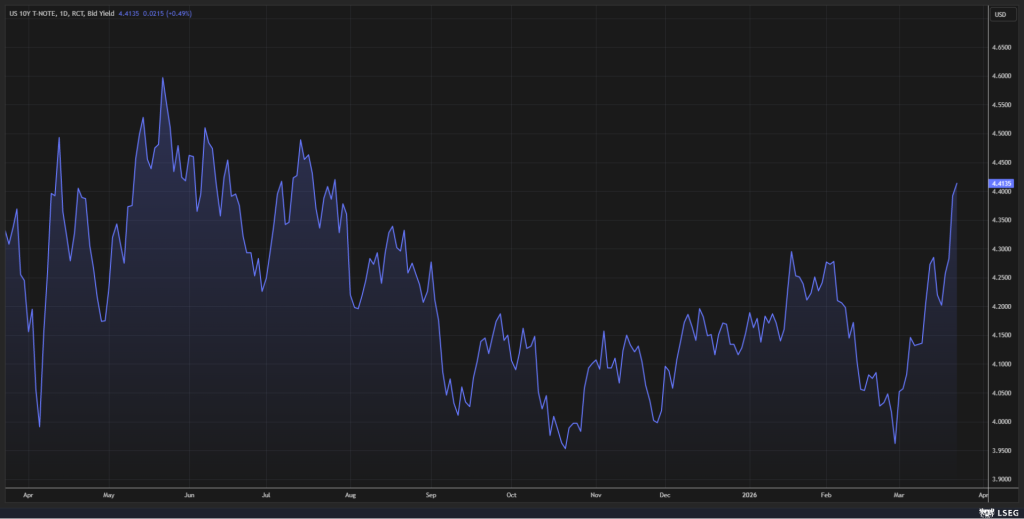
The underlying message from market participants is clear: the U.S. economy is unlikely to withstand a 10-year yield of 5% without severe consequences. Bond market movements have thus become a barometer for both investor sentiment and future government policy, overshadowing even volatile oil prices as the principal concern for financial markets.
Apparently, several reports have said that Trump’s Board of Peace has drafted Iran with a proposal for a peace talk.