Bangkok Expressway and Metro Public Company Limited (SET: BEM) closed unchanged at THB6.20 on Wednesday, July 1, on a below-average volume of 0.9 times its daily norm, holding near its 14-day high, according to data analyzed by LSEG.
The stock has been on a strong run, gaining 4.2% over the past week on volume more than double its average, outperforming the SET100 Index in three of five sessions. Over the past month, BEM rose 19.2%, placing it in the top 7% of Thai market performers, while its 18.1% quarterly gain put it in the top tier of the Transportation & Logistics sector.
Sentiment has been boosted by news that Thailand’s Cabinet approved a unified ticketing policy for the country’s mass rapid transit system, setting fares between THB17 and THB45 across all eight railway lines. Slated for a January 2027 rollout, the scheme will initially be funded through the Mass Rapid Transit Authority (MRTA), with a roughly THB200 billion infrastructure fund expected within 1.5 to 2 years to buy back railway concessions.
Kasikorn Securities holds a favorable view on BEM, along with BTS, PLANB, and VGI, expecting the policy to lift both core rail operations and related businesses such as advertising and rental income as ridership grows.
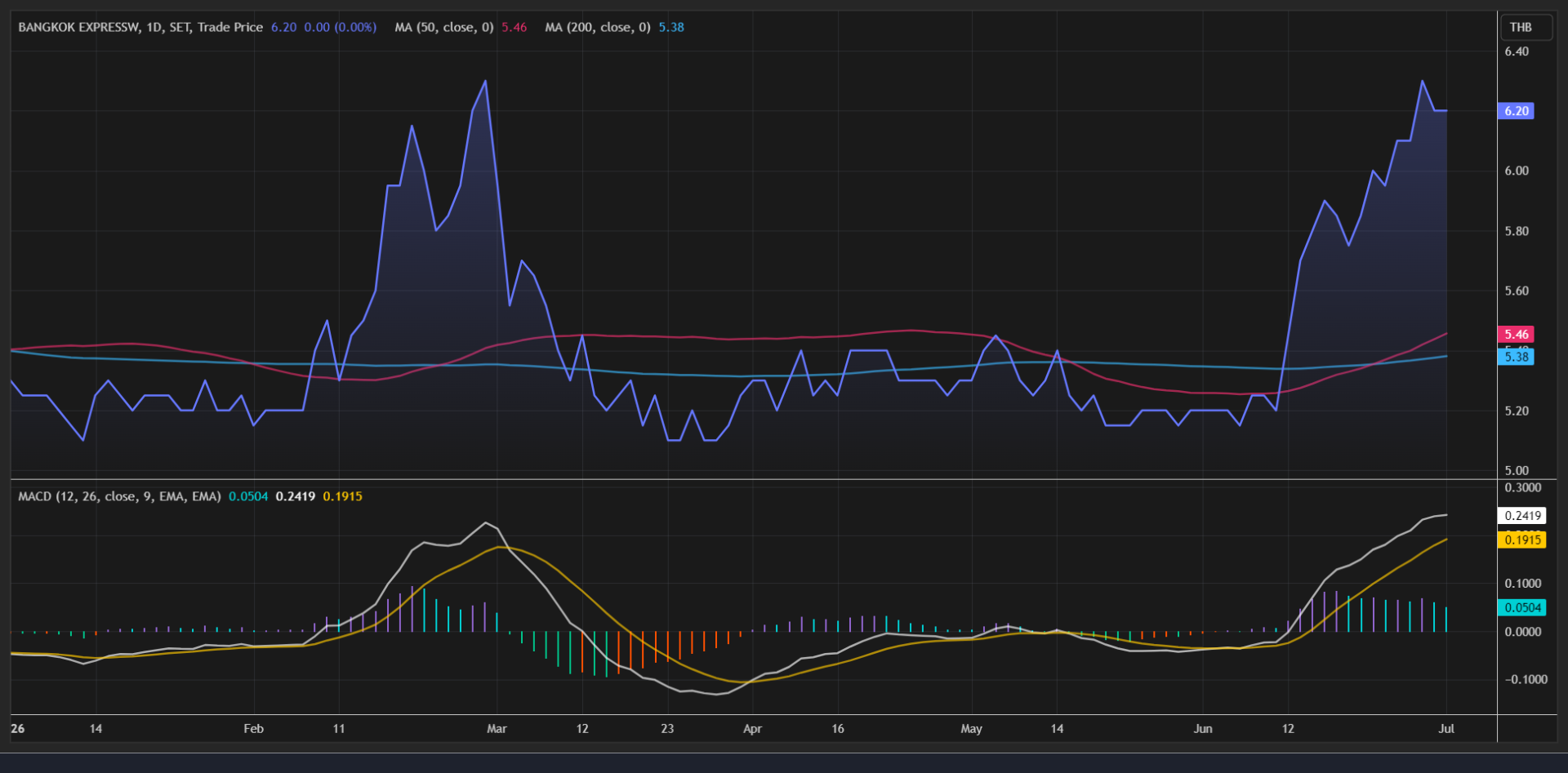
Technically, BEM shows multiple bullish signals: it trades above both its 50-day and 200-day moving averages, with a positive MACD and rising EMAs, based on LSEG data. However, the stock is now firmly overbought, with an RSI of 81.2, Stochastic reading of 92.5, and Money Flow Index of 84.7 — all pointing to elevated near-term reversal risk.
Valuation remains a concern. BEM trades at a P/E of 24.8 and Price/Book of 13.7, both well above sector averages, placing it in the bottom 1% for relative valuation in the Thai market. Gearing is also a weak spot, with debt-to-equity at 219%, among the highest in the market and rising steadily since 2021.
Despite these bearish valuation and leverage signals, BEM’s improving margins, strong price momentum, and favorable policy backdrop continue to support its long-term fundamental ranking of 4 out of 5.