
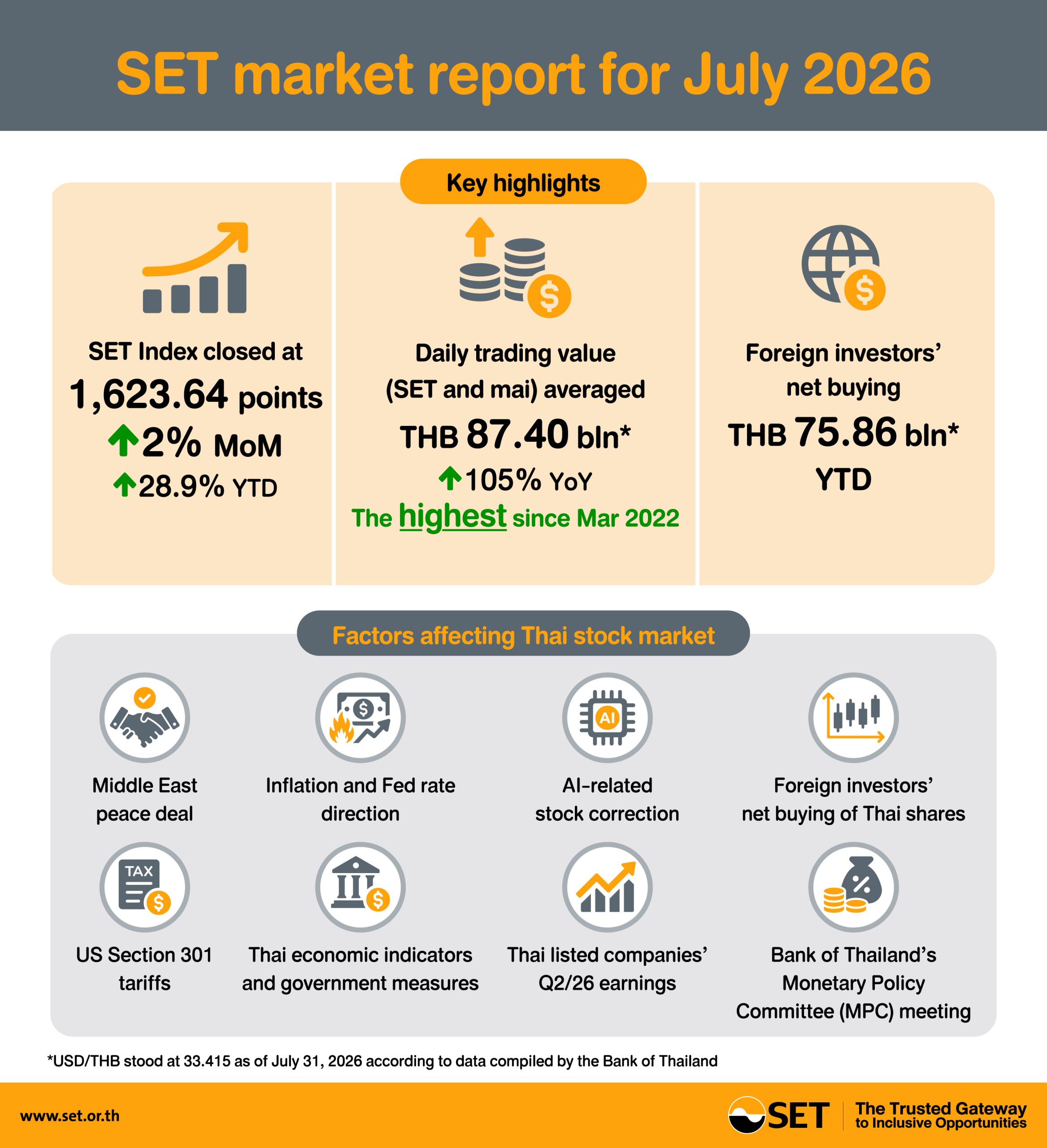
Thai stock market finished July 2026 on a positive note, with SET Index up 2 percent from the previous month and 28.9 percent from the end of 2025, underpinned by continued foreign fund inflows. However, escalating conflict in the Middle East, which led to another closure of the Strait of Hormuz, strained global spare production capacity and pushing oil prices to USD 100 per barrel.
The Fed Chair flagged concerns over inflation risks hovering above target, adding upward pressure on U.S. Treasury yields. Meanwhile, global technology stocks underwent a correction following their recent rally on stellar earnings expectations, compounded by growing concerns over the cost-effectiveness of AI investments, which weighed on demand for computing infrastructure.
The Stock Exchange of Thailand (SET) Executive Vice President and Head of Research Department Chatchai Thisadoldilok, CFA, FRM said that the impact of the global AI sector correction on the Thai bourse was limited, supported by its diverse sector composition and multiple robust underlying fundamentals.
The Ministry of Finance revised Thailand’s 2026 GDP growth forecast upward from 1.6 percent to 2.5 percent, while analysts have continuously raised forward earnings estimates for Thai-listed companies since the beginning of 2026. The Thai stock market’s average daily trading value in July marked its highest level since March 2022.
Key highlights for July 2026
- SET Index ended July at 1,623.64 points, up 2 percent from the previous month and 28.9 percent from the end of 2025.
- Resources and Financials industry groups outperformed others in July, while Technology and Industrials continued to be the top gainers year-to-date.
- The combined SET and Market for Alternative Investment (mai) average daily trading value surged 105 percent year-on-year to THB 87.40 billion (approx. USD 2.62 billion). For the first seven months of 2026, the total average daily trading value rose 64.8 percent from a year earlier to THB 69.17 billion.
- Foreign investors were net buyers for three consecutive months in July 2026, totaling THB 48.86 billion. Their net inflow for the January-July period stood at THB 75.86 billion.
- Foreign investors led trading activity at 54.3 percent of total trading value, followed by retail investors at 31.3 percent, local institutional investors at 7.3 percent, and proprietary trading by securities companies at 7.1 percent.
- SET’s forward P/E ratio at the end of July 2026 was 15.7 times, above the Asian stock market average of 13 times. The historical P/E ratio stood at 17.1 times, higher than the Asian stock market average of 16.4 times.
- SET’s dividend yield at the end of July 2026 was 4.1 percent, higher than the Asian stock market average of 2.8 percent.
Derivatives Market for July 2026
- Thailand Futures Exchange’s (TFEX) average daily trading volume totaled 563,065 contracts, down 10.7 percent from the previous month, primarily driven by the decline in trading volume of SET50 Index Futures, Gold Online Futures, and Currency Futures. For the first seven months of 2026, TFEX average daily trading volume rose 30.2 percent year-on-year to 554,436