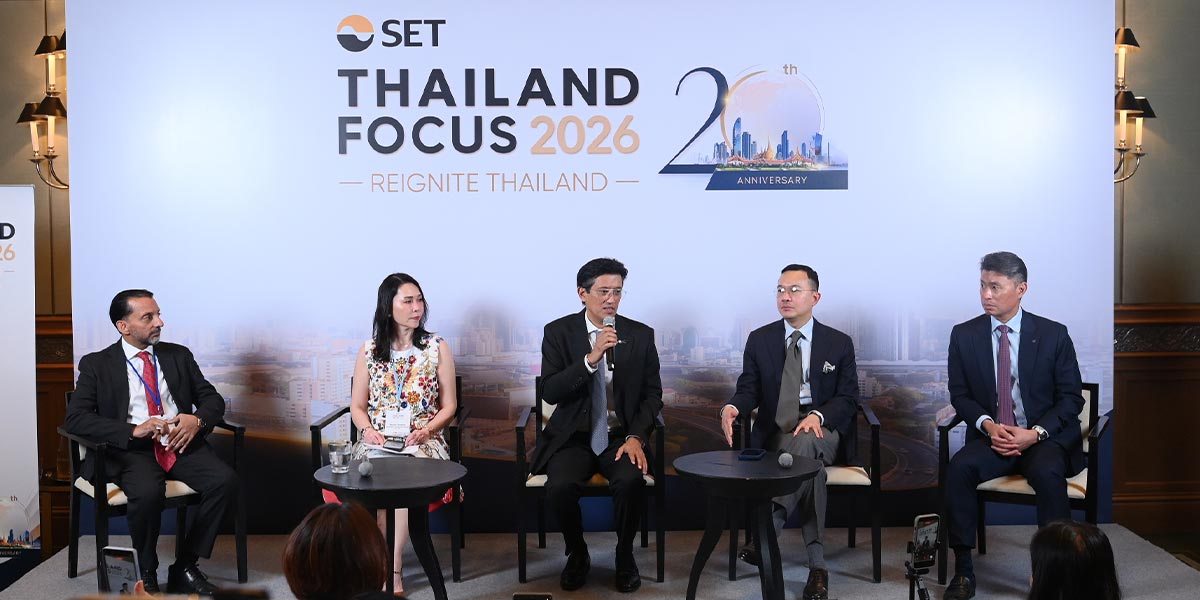
At the landmark 20th anniversary of the Thailand Focus conference, capital market leaders and financial executives agreed that a combination of political stability, attractive valuations, and emerging growth engines has placed Thailand in a unique “sweet spot” for global investment. However, they emphasized that the long-term sustainability of this momentum will depend heavily on the concrete execution of government policies.
The panel discussion of discussion includes Mr. Asadej Kongsiri – President, The Stock Exchange of Thailand, together with Mr. Samir Kogar, Country Head, CLSA Securities (Thailand), Mrs. Narisara Viseskosin, Executive Director, DBS Vickers Securities (Thailand), Mr. Supachoke Supabundit, President, Kiatnakin Phatra Securities and Mr. Pornchai Prasertsintanah, Vice Chairman – Investment Bank, Southeast Asia and Country Head Thailand, UBS Securities (Thailand).
The panel highlighted the exceptionally lively atmosphere of this year’s event. The conference drew a strong crowd of 220 institutional investors representing 74 funds globally. Notably, the number of international participants increased year-on-year, with foreign fund representatives rising from around 40 to over 50, showcasing renewed global interest in studying Thai market opportunities.
The panel congratulated the SET on its 20th anniversary and pointed out the stark positive turnaround in market performance. With the SET Index demonstrating significant year-on-year improvements—up approximately 27% year-to-date—Thailand stands out as the only market in Asia where foreign investors have returned as net buyers, reversing two consecutive years of net selling.
“Anything bad that could have happened, happened over the past few years,” the panel noted, adding that post-election political stability has provided a critical boost of confidence, positioning Thailand well despite global geopolitical uncertainties.
However, they noted that investors remain highly selective. “They aren’t buying across the board…They are focusing on companies with clear earning visibility, strong competitiveness, and those positioned to benefit from structural growth, particularly in Foreign Direct Investment (FDI), digital infrastructure, data centers, and AI”.
The panel also highlighted the Energy Transition as a crucial link, noting that data centers and AI investments cannot happen without stable energy policies. In this regard, the development of the Power Development Plan (PDP) over the next 12 to 24 months is expected to be a major driver for the market’s next level of growth.
During the Q&A session, a question was raised regarding how to increase analyst coverage for smaller stocks outside of the SET100, which would allow foreign investors to discover these hidden opportunities. Mr. Asadej explained that if a stock is small and has low trading volume, it would be difficult for the brokerage to employ dedicated analysts.
To bridge this gap, the panel explained that this is viewed as a key duty of the exchange, which is actively exploring supportive mechanisms such as utilizing the Capital Market Development Fund (CMDF) to help sponsor analyst coverage.
Furthermore, the panel pointed out that emerging technologies like AI can help lower analytical costs, making it more feasible to produce research on smaller stocks. It was emphasized that this should be a collective “whole village” effort across local and foreign brokerages to support visibility for lesser-known stocks. At the same time, listed companies must also drive their own growth; ecosystem initiatives like the “Jump+” project are designed to build capability and help smaller companies attract wider investor interest.
Attractive Valuations
The panel noted that many global institutional investors who had not attended Thailand Focus in years returned this year, signaling a strong recovery in confidence.
The panel pointed out that Thailand’s market valuations remain highly attractive. Excluding Delta, the SET’s Price-to-Earnings (PE) ratio sits at approximately 12x, compared to the regional average of 15x, indicating room for further upside. They also shared that foreign investors expressed appreciation for the SET’s recent measures to support and restore market liquidity.
The panel stressed the importance of local institutional funds acting as the “first wave” of investment to build solid confidence for long-only foreign funds to follow.
Key Risks and Market Horizons
While sentiment is overwhelmingly positive, the panel addressed several key concerns and potential headwinds:
- The Execution Challenge: While strategic speeches by government officials were well-received as strategic, practical, and forward-looking, investors are closely watching the “next stage of execution”. Significant, “needle-moving” capital inflows are expected to be medium-to-long term, aligned with actual policy delivery on energy and infrastructure projects.
- Global Liquidity Shifting: The panel flagged concerns raised by domestic funds regarding changes in global market dynamics, such as NASDAQ moving toward 23-hour trading, which could potentially drain liquidity and impact trading turnover in Asian markets.
Year-End SET Index Targets
When asked for their research houses’ index targets, the panel shared positive outlooks from their respective firms:
- DBS Vickers set a target of 1,720, representing a forward PE of 16.7x, which aligns with its five-year average.
- Kiatnakin Phatra, CLSA and UBS all projected a year-end target of 1,680. UBS’ target extends to the end of 2026, with Q4 serving as a major watchpoint as analysts roll over valuations into 2027.