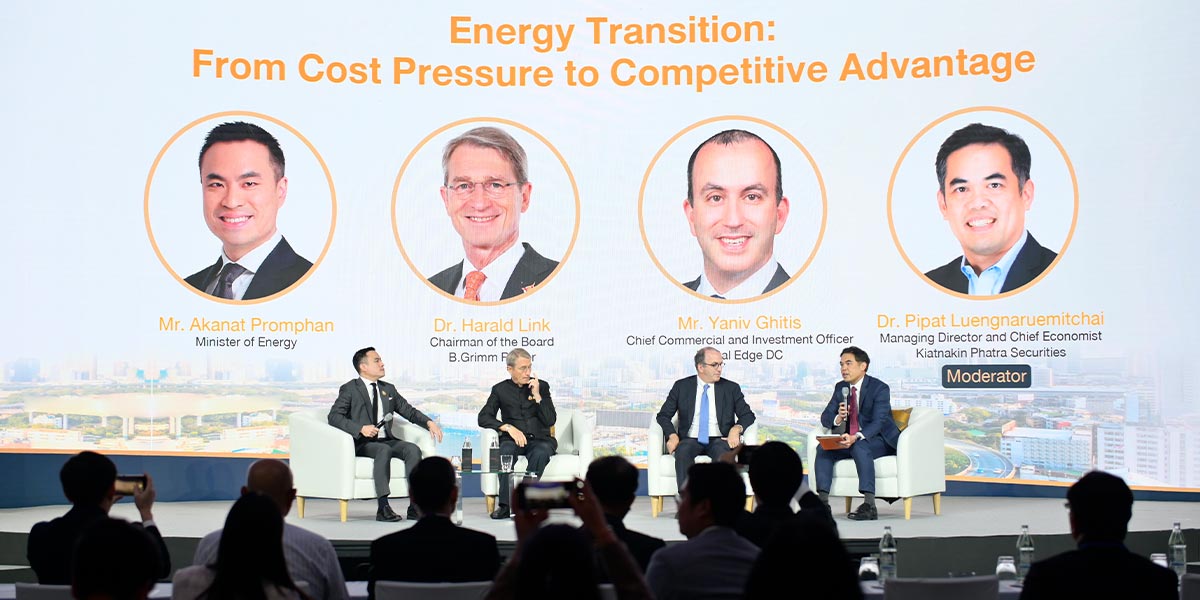
At the Thailand Focus 2026 symposium, leading policymakers and executives reviewed the nation’s rapid energy transformation in the context of booming digital infrastructure investment. The panel, “Energy Transition: From Cost Pressure to Competitive Advantage,” featured Energy Minister Akanat Promphan, B.Grimm Power PCL (SET: BGRIM) Chairman Dr. Harald Link, and Digital Edge DC’s Yaniv Ghitis. The group addressed Thailand’s shift away from fossil fuels towards a clean energy mix designed to power the needs of expanding AI and data center activity.
Decades of reliance on natural gas from the Gulf of Thailand are now giving way to increased dependence on imported liquefied natural gas (LNG), due to declining domestic production. This has rendered Thailand more vulnerable to international price movements. Simultaneously, the country is seeing surging investment from data centers, which present significant demand for stable and affordable clean electricity.
Energy Minister Akanat addressed concerns over rising household electricity costs, noting that upcoming regulations will require data center developers to shoulder the marginal costs of gas imports related to their energy usage. The government is also rolling out a “dual-market” system alongside its current enhanced single-buyer model. A new direct Power Purchase Agreement (Direct PPA) market will allow high-demand industries like data centers to procure renewable energy directly from suppliers, without the previous 2,000-megawatt cap—now expanded to all industries keen on clean power.
Akanat highlighted the importance of clear regulatory direction and indicated that the long-anticipated Power Development Plan (PDP 2026) is in its final stages. Scheduled for launch next month, the 25-year plan will guide Thailand’s transition to net-zero by 2050. The PDP sets an ambitious target of at least 60% renewables in the energy mix, potentially rising to 80 – 90% if costs for carbon capture remain high. Other priorities include modernizing the grid, expanding energy storage, and facilitating financing for household-level solar and community energy projects, with state funds dedicated to public benefit.
Addressing environmental issues, Dr. Link assured that water supply for data centers in industrial areas would not impact locals, thanks to existing infrastructure and the potential use of desalination if needed. Ghitis detailed Digital Edge’s use of closed-loop and air-cooling systems that minimize water consumption and avoid burdening municipal resources.
Both executives underscored the economic benefits of local data centers—not only enhancing data sovereignty and encouraging chip manufacturing but also nurturing Thailand’s knowledge-based economy. BGRIM and Digital Edge’s joint ventures are already employing thousands and planning further regional expansion. However, panelists stressed that educational reform is essential for developing high-skilled careers in AI and cloud computing, suggesting public-private mandates and a dedicated data center industry association to streamline sector-wide collaboration.
With policy reforms, public-private investment, and the upcoming PDP, the panelists concluded that Thailand is on course to convert the global energy transition into a robust competitive advantage.