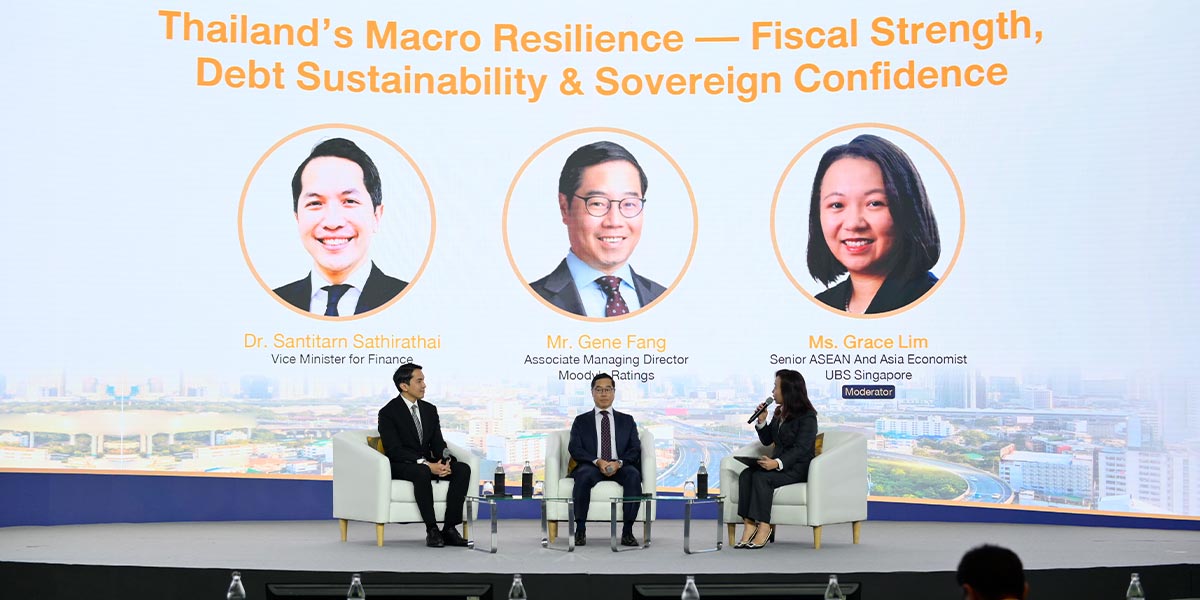
At the ‘Thailand Focus 2026’ event, Thailand’s ability to withstand economic shocks and foster sustainable growth was the focus of a high-level panel featuring Dr. Santitarn Sathirathai, Vice Minister of Finance of Thailand, and Mr. Gene Fang, Associate Managing Director at Moody’s Ratings.
The session, titled ‘Thailand’s Macro Resilience — Fiscal Strength, Debt Sustainability & Sovereign Confidence’, provided in-depth perspectives from both the policymaker and international ratings agency, emphasizing Thailand’s fiscal capacity and medium-term growth prospects.
A core theme was the distinction between statutory debt limits and actual fiscal space. Dr. Santitarn highlighted that while the legal debt-to-GDP ceiling—currently set at 70%—serves to instill fiscal discipline, it does not necessarily reflect Thailand’s real financial flexibility. He stressed the importance of channeling expenditure toward high-return investments that drive long-term economic growth, leveraging digitalization and data-driven policymaking.
Moody’s view, as presented by Mr. Fang, echoed this wider perspective on fiscal strength. He underscored Moody’s recent reaffirmation of Thailand’s ‘Baa’ rating, returning the outlook to ‘Stable’ after a period of global turbulence. Despite a rise in the debt-to-GDP ratio from 35% pre-pandemic to an estimated 60%, Thailand’s debt metrics remain consistent with peers at the same rating level.
Notably, Moody’s finds Thailand’s debt affordability—measured by interest payments relative to revenue—especially reassuring, with a significantly lower ratio compared with regional counterparts.
Both speakers pointed to growth as the real challenge—and opportunity—for Thailand. Dr. Santitarn identified structural growth constraints, primarily an aging population and stagnant investment, as key concerns. He advocated for an increase in Thailand’s investment-to-GDP ratio, aiming for 30% to secure sustainable growth above 3%. Central to this strategy is mobilizing private investment, facilitated by deregulation, infrastructure upgrades, and industry-specific policy support.
Mr. Fang highlighted recent improvements in foreign direct investment flows, especially in high-tech sectors such as data centers, electronics, and renewable energy infrastructure, enhancing Thailand’s regional competitiveness.
Both panelists emphasized that effective execution, not just budgetary allocation, will determine success. Public investments that crowd in private capital and foster inclusive, sustainable growth are particularly vital.
Looking ahead, Thailand’s roadmap involves locking in higher growth, greater investment, and competitiveness improvements. Moody’s says a rating upgrade will depend on the country’s ability to sustain nominal growth, consolidate public debt, and maintain stable policy execution.