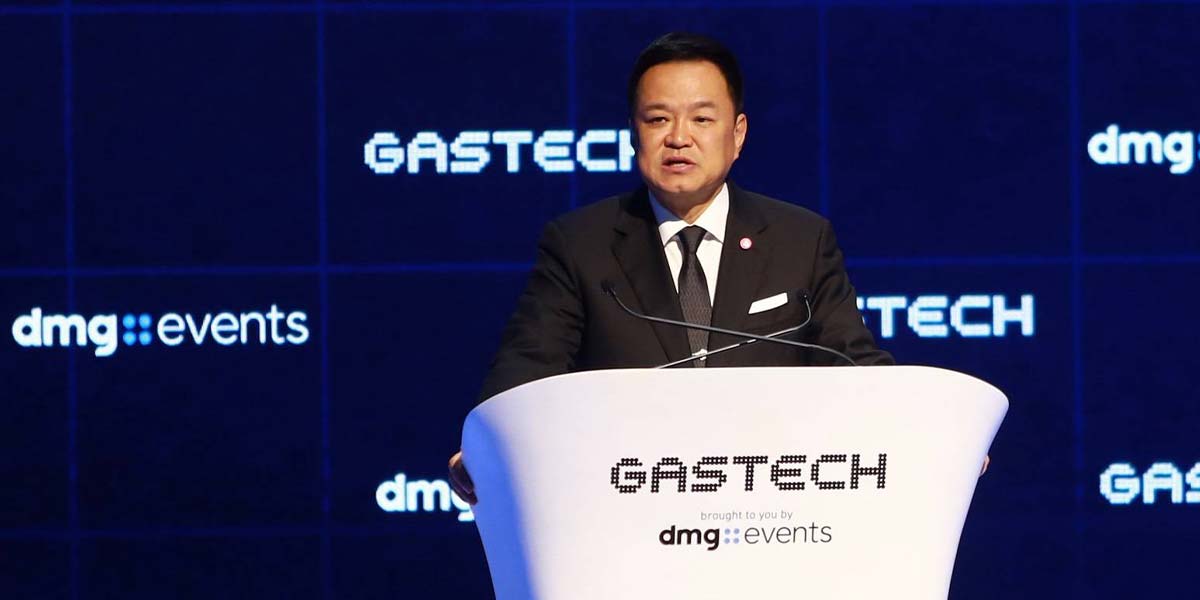
The Gastech 2026 conference officially commenced in Bangkok, assembling global energy leaders, policymakers, and industry executives to address pressing questions surrounding energy security, expanding infrastructure, and technological pathways toward net-zero emissions.
Opening the conference, Mr. Christopher Hudson, President of dmg events, framed energy access as both a vital market opportunity and a core global responsibility. Pointing to demographic and technological shifts, Hudson highlighted that the global population is projected to expand from 8.2 billion today to 9.7 billion by 2050, while data center power demand is set to double by 2030. Asia is expected to deliver more than a quarter of all global energy growth.
Despite this growth, 660 million people still live without electricity and 2 billion lack clean cooking fuel. Citing former US Energy Secretary Chris Wright, Hudson noted that the current landscape represents an “age of energy addition” rather than a simple transition, requiring every available source, technology, molecule, and electron. Within this paradigm, natural gas and LNG serve as essential baseload power to back up renewables and critical feedstock for global food production.
Hudson expressed gratitude to host nation Thailand, its Prime Minister Anutin Charnvirakul, Energy Minister Mr. Akanat Promphant, national consortia partners (including EGAT, PTT, Gulf, Ratch, EGCO, and the Energy Regulatory Commission of Thailand), and lead co-hosts Chevron, ExxonMobil, and Shell.
Thailand’s Energy Vision: Upstream Bidding and Regional LNG Expansion
Following Hudson, Thailand’s Energy Minister, Mr. Akanat Promphant, detailed Thailand’s strategy to position itself as a central energy gateway and interconnecting market for East Asia. Referencing International Energy Agency (IEA) outlooks showing resilient global natural gas demand at approximately 4,080 million cubic meters per year, Minister Akanat underscored that natural gas remains a foundational pillar of global energy infrastructure.
To support regional energy resilience and tap into domestic resource opportunities, Minister Akanat announced the launch of Thailand’s 26th petroleum exploration bidding round, offering over 60,200 square kilometres of high-potential acreage in the deepwater Andaman Sea.
Mr Akanat invited foreign partnerships across the LNG value chain, encompassing joint procurement, innovative supply models, commercial collaboration, and co-investment as Thailand is actively expanding its LNG handling capacity.
Addressing long-term sustainability, Minister Akanat reaffirmed Thailand’s commitment to achieving net-zero greenhouse gas emissions by 2050. Reaching this goal will require a combination of renewables, electrification, and low-carbon fuels such as hydrogen and ammonia to decarbonise heavy industries.
A key milestone highlighted was Thailand’s deployment of Carbon Capture and Storage (CCS). The Arthit CCS project, Thailand’s first carbon capture and storage initiative, led by PTT Exploration and Production Public Company Limited (PTTEP) at the offshore Arthit gas field in the Gulf of Thailand, officially reached a Final Investment Decision (FID), establishing Thailand as a regional pioneer in CCS development. This project serves as the anchor for the Eastern Hub, creating shared CCS infrastructure designed to capture emissions from multiple industrial sources in the future.
Minister Akanat concluded by reiterating that energy security and sustainability require continuous investment, innovation, and international cooperation to convert shared challenges into long-term opportunities.
Addressing delegates at Gastech 2026, Mr. Anutin Charnvirakul, Thailand Prime Minister, outlined national energy framework aimed at balancing energy security, economic affordability, and a practical green transition. Driven by rapid industrial expansion, artificial intelligence, cloud services, and data centers, Thailand’s surging power demand requires a balanced strategy to ensure long-term grid stability and investor confidence.
The national energy policy is defined by three core pillars:
Energy Security and Grid Reliability: Natural gas and Liquefied Natural Gas (LNG) serve as the foundation of the national power grid. They provide the necessary flexibility to balance the system as renewable power expands, shielding households and businesses from global market volatility while maintaining economic competitiveness.
A Practical Energy Transition: Thailand is advancing pragmatic, scalable initiatives rather than theoretical targets. In mid-October, the government will launch a 15 billion Baht program supporting residential rooftop solar installations, featuring tax exemptions on select imported solar components. Modernization of the national grid and energy storage are underway, alongside bioenergy projects that convert agricultural residuals into biodiesel and biomethane to support local farming communities.
Aligning Policy to Economic Direction: Energy policy is being leveraged as a primary engine for economic growth. In the first half of the year, Thailand’s Board of Investment (BOI) registered 1.4 trillion Baht ($43.6 billion USD) in investment applications—a 37% year-on-year increase projected to create over 82,000 job opportunities in digital infrastructure, clean energy, and advanced manufacturing.
By positioning itself as a trusted regional platform for energy innovation, Thailand is actively inviting international partnerships across natural gas infrastructure, energy storage, carbon management, hydrogen, and bioenergy.