

The U.S. midterm election has historically been a source of uncertainty for investors, but data compiled by LSEG point to a striking pattern: the S&P 500 has delivered a positive return in every one of the past 10 midterm election cycles, with the index gaining an average of 13.18% in the 52 weeks following Election Day.
The historical record covers midterm elections from 1986 through 2022. According to LSEG data,the median return over the 10 periods was 12.98%, broadly in line with the 13.18% average. That narrow gap suggests the historical pattern was not simply the result of one or two exceptionally strong rallies. Even excluding the three strongest performances of more than 20% in the 1990s, the post-election record remained overwhelmingly positive.
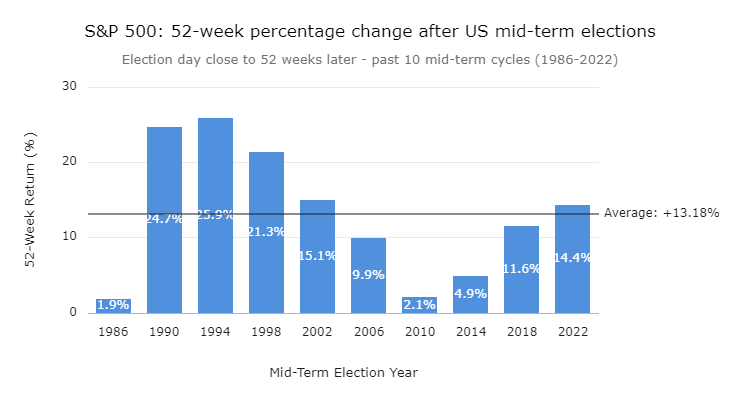
The weakest performances came after the 1986 and 2010 elections, when the S&P 500 gained just 1.88% and 2.07%, respectively. The 1986 period is particularly notable because its 52-week measurement window extended into the October 1987 market crash, meaning that a major market shock near the end of the period substantially reduced the measured return.
After the 1986 midterms, Democrats regained control of the Senate while retaining the House, leaving President Ronald Reagan facing a Democratic-controlled Congress. The following year, however, the U.S. equity market was hit by the October 1987 stock-market crash, which was still in the 52-week window on this analysis. The S&P 500 plunged about 20% on October 19 alone, according to the Federal Reserve, which described the episode as a major systemic shock.
The 1994 midterm election provides an almost opposite example. Republicans swept both chambers of Congress, taking control of the House and Senate for the first time in 40 years, while Democrat Bill Clinton remained in the White House. The result was divided government, followed by major political clashes over spending and taxation and two government shutdowns.
Despite the political confrontation, the S&P 500 gained 25.92% in the following 52 weeks — the second-strongest performance in the LSEG dataset. The broader economic and monetary backdrop was more important for markets. After initially tightening policy, the Federal Reserve cut interest rates in July and December 1995 as inflationary pressures eased. The Fed later reported that major equity indexes rose 30% to 40% during 1995, helped by lower interest rates and favorable earnings.
The 2010 midterms offer another reminder that divided government does not automatically translate into strong or weak equity performance. Republicans captured the House while Democrats retained the Senate, leaving President Barack Obama facing a divided Congress. The following period was marked by difficult negotiations over government spending and the U.S. debt ceiling.
The S&P 500 gained just 2.07% in LSEG’s 52-week window. Federal Reserve minutes from August 2011 show that markets were being driven by concerns over the U.S. debt ceiling and potential sovereign downgrade, alongside the European sovereign-debt crisis and weaker economic data.
Why 2026 Midterms Matter
The historical record makes the upcoming U.S. midterm election on November 3, 2026, an important event for global investors, particularly because control of Congress can influence the direction of fiscal policy, regulation, government spending and other policies that affect corporate earnings and investment.
JPMorgan has similarly argued that the equity impact of the 2026 midterms is likely to be more nuanced than a simple bullish-or-bearish political trade. Its recent analysis examines different outcomes, including congressional gridlock, a Democratic “Blue Wave” and continued Republican control, and suggests that the result could create different opportunities across sectors and investment themes.
JPMorgan notes that investor concern about the midterms has largely centered on how quickly the AI and datacenter buildout can continue. It views a comprehensive federal AI regulatory bill as unlikely to win Congressional approval in the near term, since lawmakers are focused on affordability. Despite this, JPMorgan expects AI capex momentum to stay intact after the midterms and possibly strengthen in 2027 and 2028, as companies try to meet AI demand and push ahead with investment before political risks rise around the next presidential cycle.
For global investors, therefore, the key question is not simply who wins the midterms. It is what the result means for the policy environment underpinning the world’s largest equity market.
The LSEG record offers an encouraging historical precedent: 10 consecutive midterm cycles produced positive S&P 500 returns over the following 52 weeks. But the experiences of 1986, 1994 and 2010 show that politics alone cannot explain those returns. A market crash, monetary easing, economic growth or a fiscal crisis can ultimately prove far more powerful.