
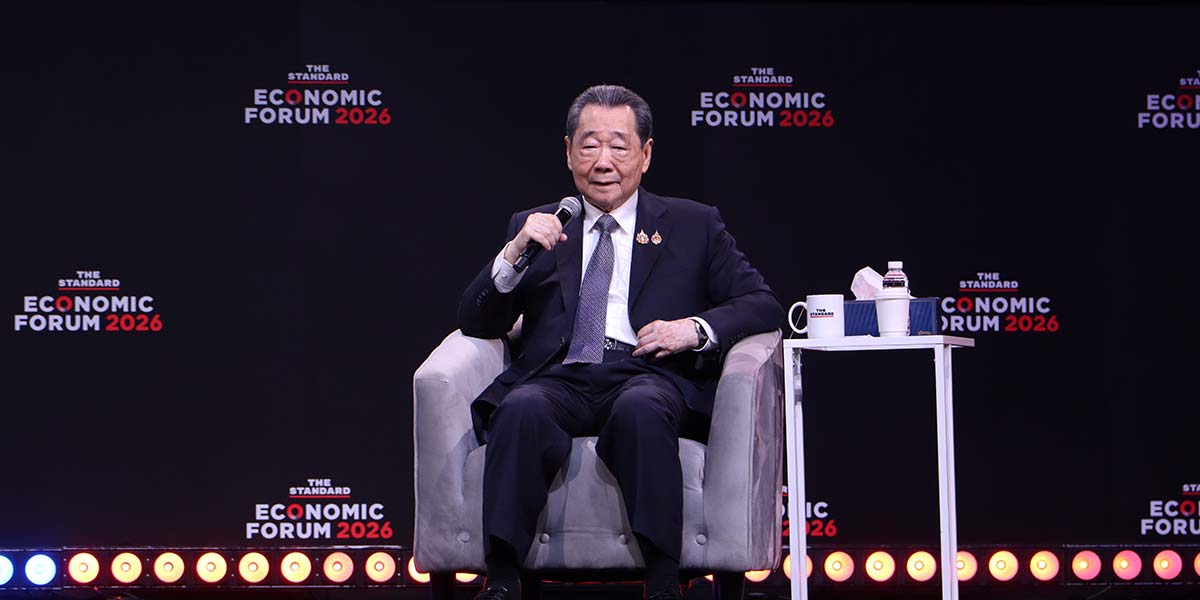
Dhanin Chearavanont, Senior Chairman of Charoen Pokphand Group (CP Group), said artificial intelligence and robotics are driving a major transformation in the global economy, reshaping production, investment and labor markets.
Speaking at THE STANDARD ECONOMIC FORUM 2026 in a session on global trends and Thailand’s direction from the perspective of a business leader shaping the future, Dhanin said Thailand could use this transition to strengthen its competitiveness and move into higher-value industries—provided it restructures its economy and develops a workforce that can keep pace with technology.
CP Group is expanding investment in industries of the future, particularly humanoid robots, AI and energy, to improve productivity, reduce costs and create new sources of growth, while making its existing businesses more competitive globally.
Humanoid Robotics as a New Business
Dhanin said CP Group has invested alongside Chinese technology partners to develop humanoid robots. Less than a year after work began, the venture has developed robots capable of performing some tasks, although further improvements are needed for more complex work.
The investment is not intended solely to supply robots for use within CP Group. The group also plans to sell them to external customers, opening a new market and creating a potential future revenue stream. The initial focus is on deploying robots across three core sectors: agriculture, industry and commerce. Priority applications include food factories, distribution centers and retail businesses, where demand for automation continues to grow.
Dhanin said food production requires stringent quality and safety controls because mistakes in the manufacturing process can affect consumers. Robots can therefore improve precision, reduce risks and lower production costs over the long term.
Advances in AI are also allowing robots to learn and improve their capabilities more quickly, particularly for round-the-clock operations, night shifts and tasks requiring a high degree of precision.
Dhanin sees potential for service robots in retail outlets such as 7-Eleven, Makro and Lotus’s. However, making robots look exactly like humans may not be the most important objective. What matters is their ability to perform tasks and serve customers efficiently.
Smart Factories to Cut Costs and Deliver Quality
Dhanin said the adoption of AI and robotics in manufacturing would drive the shift toward automated facilities, or lights-out factories, that require fewer human workers and can reduce some operating costs.
For example, factories that rely primarily on robots may not need to maintain the same level of lighting as conventional plants throughout their operations, helping reduce energy consumption and keep production running continuously.
The strategy aligns with CP Group’s aim of using technology to lower costs across the supply chain, from cultivation and production to processing, transport and distribution, while improving product quality and reducing selling prices.
“We must make good products at low prices, not good products at high prices,” Dhanin said. He added that effective technology should reduce costs and benefit consumers rather than increase the prices they pay.
Addressing concerns that robots and AI will displace workers, Dhanin acknowledged that employment could be affected during the transition. However, he believes technology will create new businesses and occupations over the long term, as previous major technological shifts have done.
AI, in particular, can help small business owners lower the costs of administration, marketing and professional services, enabling more people to start their own businesses. Existing workers, meanwhile, will need to develop skills for new occupations.
More Power Generation to Support Data Centers and Robotics
Dhanin said electricity demand would become one of the factors shaping the global economy, as data centers, AI, robotics and electric vehicles all require substantial amounts of power. Thailand therefore needs to prepare its generating capacity and energy infrastructure to support the expansion of technology industries and an expected increase in foreign investment.
For CP Group, Dhanin said the group needs an adequate electricity supply to support its growing use of technology, including its data center business and new industrial ventures. He sees a need to expand power generation for the group’s own use, either through existing businesses or new ventures.
On energy sources, Dhanin said Thailand may initially need to continue relying on natural gas before considering small-scale nuclear power technology, which he believes could help meet long-term electricity demand.
He estimated that the technology could be more mature around 2030. However, this was his assessment of technological developments, not an announcement of a CP Group investment plan for nuclear power.
Agricultural Reform to Lift Output Fivefold
Dhanin said agriculture remains a major pillar of Thailand’s economy, but inadequate irrigation and small farm holdings prevent many farmers from making full use of modern technology to improve productivity.
He urged the government to take a systematic approach to water management, including developing water storage facilities, dredging rivers and expanding irrigation networks. These measures would provide farmers with a reliable year-round water supply and reduce losses from floods and drought.
Dhanin estimated that adequate water management, combined with modern farming technology, could raise agricultural output to at least five times its current level and significantly increase farmers’ incomes.
Another key proposal is to consolidate small farm plots into larger operating units, with farmers contributing their land in return for proportionate shareholdings. This would make machinery, robots and smart farming systems more economical to use. Farmers could also earn returns from their shares while freeing up time to pursue other work.
To finance irrigation, Dhanin proposed allowing Thai and foreign private investors to develop infrastructure under terms that provide appropriate returns while safeguarding national interests, rather than relying entirely on government funding.
The government should also amend laws that hinder water resource development and embrace cultivation and crop-breeding technologies to raise yields and improve the quality of agricultural products.
Dhanin also sees significant opportunities for Thai farmers in fruit and other high-value agricultural products, particularly durian and fruits in demand overseas, provided water supplies, product quality and costs are managed effectively.
Attract 5 Million Talents and Build Technology Hub
Dhanin urged the government to adopt a strategy to attract highly skilled people from around the world to work, invest and establish businesses in Thailand, with a long-term target of about five million people.
The aim would be to build the workforce needed for new industries and address labor shortages caused by declining birth rates.
The proposal focuses on attracting scientists, engineers, researchers, technology specialists and promising entrepreneurs to strengthen the investment ecosystem and transfer knowledge to Thai workers.
Dhanin cited Shanghai, which uses funding support, housing assistance and other incentives to attract highly skilled people. According to information he received in discussions with local officials, attracting about 40,000 skilled people helped create roughly 250,000 additional jobs.
He said Thailand should design incentives that can compete with leading destinations such as Singapore, covering benefits, business opportunities and quality of life to encourage skilled people from around the world to settle in the country for the long term.
Dhanin stressed that attracting talented foreigners would not take jobs away from Thai people. Rather, it would generate investment, new businesses and additional employment, helping expand the economy over time.
He said changes to regulations and investment conditions that support advanced technology industries would benefit Thailand. Future competition for capital will depend not only on labor costs, but also on the availability of skilled workers, infrastructure readiness and government efficiency.
“I believe Thailand has opportunities. But please don’t take that to mean I’m cheering on the government. I think this government is in office at a time of exceptional opportunity because the world is changing and Thailand is attracting investor interest, particularly in high-tech industries, where substantial investment is coming in.
“I believe Prime Minister Anutin Charnvirakul, Deputy Prime Minister Yodchanan Wongsawat and the economic team—including the deputy prime ministers, the Bank of Thailand and the Finance Ministry—have the knowledge and understanding. But the key question is: do they have the courage to act?”
Dhanin concluded that business is entering an era in which past success is no guarantee of future performance. Organizations must therefore remain ready for new competition and challenges. AI, he said, will be an important tool that allows people to achieve more with less manual effort and greater efficiency.
That outlook reflects CP Group’s strategy of using AI and robotics to upgrade existing businesses while pursuing growth in new industries. Dhanin’s proposals on agriculture, energy, skilled workers and public administration are measures he believes could strengthen Thailand’s competitiveness and support long-term economic growth.