
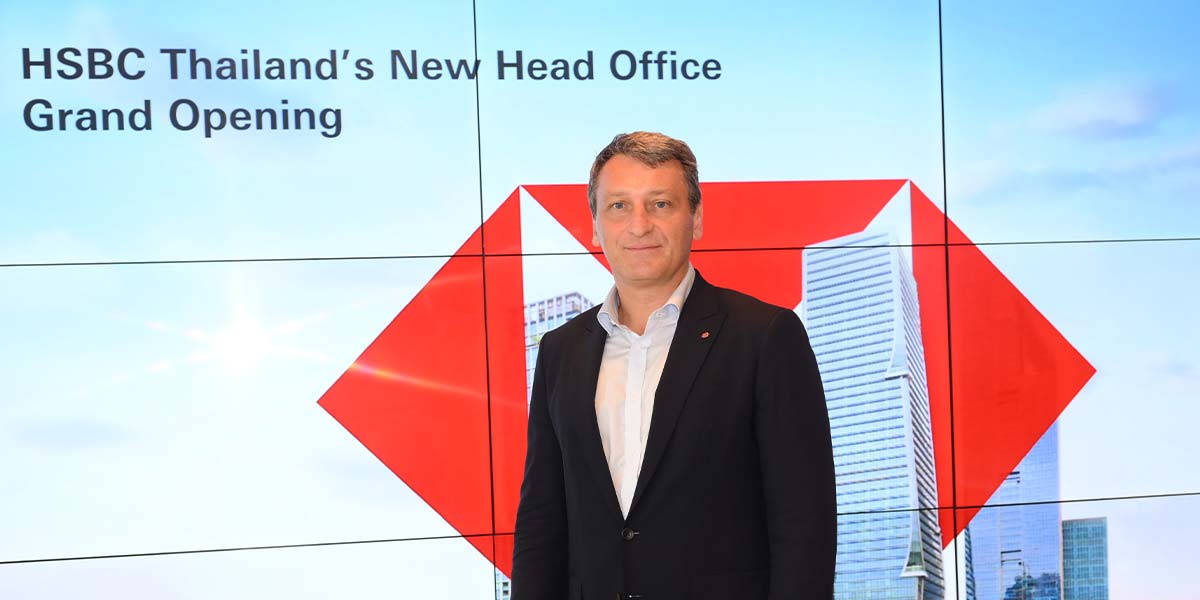
Following the ceremonial ribbon-cutting and grand opening of HSBC’s new Thailand headquarters at One Bangkok, Chief Executive Officer and Head of Banking Giorgio Gamba addressed members of the media to outline the bank’s strategic vision, regional macroeconomic perspectives, and corporate banking trajectory. The CEO reaffirmed HSBC’s long-term commitment to Thailand—a partnership spanning 138 years since the institution established Thailand’s first commercial bank in 1888.
The media briefing followed high-level bilateral discussions between Group CEO Georges Elhedery, Prime Minister H.E. Anutin Charnvirakul, and Deputy Prime Minister and Minister of Finance Ekniti Nitithanprapas. The dialogue focused on aligning financial services infrastructure with national economic priorities, enhancing Southeast Asian cross-border integration, and leveraging Thailand’s strategic position within the US$4.5 trillion ASEAN economic block.
Operating from Levels 40 through 42 of One Bangkok Tower 4 after 26 years at its former head office, HSBC’s new facilities serve as a modernized hub designed to connect domestic enterprises with global trade flows while facilitating foreign capital entry into Thailand.
Investor Sentiment and Macroeconomic Resilience
Addressing direct press inquiries regarding whether international investors have expressed structural concerns that might deter capital deployment in Thailand, Gamba stated definitively that no systemic impediments exist. While acknowledging that every sovereign market presents unique regulatory and operational nuances, he emphasized that foreign investors evaluate Thailand through the lens of concrete macroeconomic metrics and proven infrastructure readiness rather than localized sentiment.
The data released by the Board of Investment (BOI) underscores this sustained capital inflow. Foreign direct investment (FDI) applications in Thailand reached THB 1,550,784 million across 1,309 approved projects during the first nine months of 2026, marking a 62 percent year-on-year surge in total investment value. Gamba attributed this acceleration to global supply chain diversification strategies driven by technological evolution and geopolitical shifts, noting that international firms prioritize Thailand for its fiscal discipline, robust supply chain networks, developed logistics, and ready pool of skilled labor.
Thai Enterprises Expanding Globally
A key focal point of the session was the accelerating international footprint of Thai commercial enterprises. Gamba shared key findings from HSBC’s global Trade Pulse Survey, an extensive study examining corporate decision-makers across 27 major trading nations in businesses generating annual revenues between US 50 million and US 2 billion.
The survey findings indicate that Thai corporate leaders rank second globally in their intent to execute Outward Direct Investment (ODI). Rather than confining their regional growth to neighboring ASEAN markets such as Malaysia, Thai enterprises are actively deploying capital into long-haul international jurisdictions, including China, Turkey, and Brazil. Gamba noted that Thai corporate boards exhibit world-class operational resilience and strategic agility when expanding overseas, especially on artificial intelligence deployment, supply chain reorientation and energy management.
Growth Sectors and HSBC Enablement
In response to questions regarding specific high-growth industries driving Thailand’s economic reinvention, Gamba identified four core pillars attracting the heaviest concentration of foreign capital:
- Digital Infrastructure: Data center developments, cloud computing hubs, and submarine fiber network expansion required to support ASEAN’s expanding digital footprint.
- Semiconductors and Advanced Electronics: Microelectronics packaging, testing, and component manufacturing facilities benefiting from supply chain relocation.
- Renewable Energy and Power Grid Expansion: Clean energy generation and grid modernization projects aligned with international corporate sustainability targets.
- Digital Economy Ecosystems: High-growth digital platforms and content creation infrastructure driving broader economic productivity.
To support capital deployment across these sectors, HSBC provides an integrated suite of commercial banking capabilities, including project finance, trade services, cash management, and foreign exchange (FX) and interest rate risk management. Gamba highlighted HSBC’s role as an “international superconnector,” serving domestic corporate clients expanding across 38 international markets while managing banking operations for multinational corporations entering Thailand from 39 overseas jurisdictions. Foreign investors benefit from seamless onboarding in Thailand by leveraging existing banking relationships established with HSBC in major hubs like Singapore, Malaysia, London, or Hong Kong.
Modern Workspace Design and Cyber Governance
The move to One Bangkok Tower 4 represents a deliberate shift toward post-pandemic workspace architecture. Accommodating over 400 staff across three interconnected floors, the facility is designed to eliminate functional silos and accelerate corporate decision-making:
- Fluid Desking & Mobility: Unassigned seating allows employees to transition dynamically between open collaborative zones, focus pods, and meeting spaces based on project requirements.
- Silo Deconstruction: Commercial banking, trade finance, cash management, FX, and risk management teams are co-located across floors linked by internal staircases to speed up cross-functional execution.
- Organizational Transparency: Executive leadership operates from a central glass-enclosed office surrounded by open-plan desks, reinforcing accessibility and open communication.
Alongside modern collaboration booths and focus pods, the facility preserves HSBC’s 138-year heritage by displaying historic financial ledgers and housing the institution’s iconic bronze lions, transported from the former headquarters.
Addressing media questions on operational risk, Gamba highlighted cyber security as a top governance priority. HSBC manages cyber threats through multi-layered security protocols designed to detect, monitor, and neutralize risks. Gamba commended the Thai government’s active focus on national cyber resilience, noting that safeguarding client data and maintaining institutional trust remain central to HSBC’s strategic mission.