
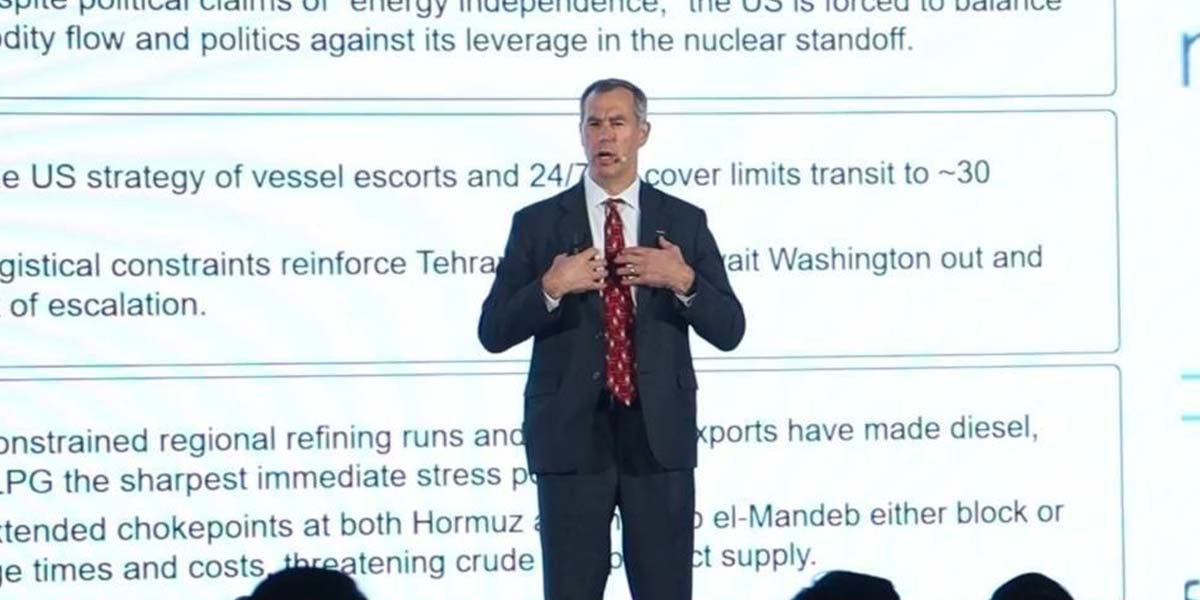
Global energy markets face structural volatility as Middle East conflict continues to shape oil prices and supply security, according to Kurt Barrow, vice president of oil, fuels and chemicals research at S&P Global Energy.
Speaking at the 2026 Annual Petroleum Outlook Forum, organized by PTT Group and the Federation of Thai Industries’ Petroleum Refining Industry Group, Barrow said easing tensions around the Strait of Hormuz had not restored normal shipping. Refined fuels, petrochemical feedstocks and LPG remain particularly constrained.
S&P Global Energy’s base case assumes the US-Iran conflict could continue through end-2027, alternating between escalation and easing tensions. This is an analytical assumption, not a definitive forecast.
Normal energy shipments through Hormuz would require an agreement or ceasefire, as military action alone may not guarantee safe passage. Middle Eastern crude exports have recovered to approximately 70–80% of pre-conflict levels through rerouting, ship-to-ship transfers and alternative transport arrangements.
Crude prices are expected to decline gradually over the next two years. A rapid restoration of normal Hormuz shipping could push prices toward $60 a barrel as additional supply reaches markets. Further export disruptions, however, could drive prices higher.
Refined product markets remain tighter than crude markets. Damage and shutdowns have affected around 1.5 million barrels per day of Russian refining capacity, while another 2.5 million barrels per day in the Middle East cannot produce or export normally.
S&P Global Energy expects elevated refining margins to persist into 2027. Tanker freight rates could remain relatively high for another six to nine months.
Barrow recommended diversifying supply sources, expanding reserves and storage, developing flexible logistics, integrating supply chains and using technology to manage risks.
EVs now represent roughly one-quarter of global new-car sales and nearly 70% in China. They have displaced about 2 million barrels per day of gasoline and diesel demand worldwide, an impact expected to double by 2030.
Meanwhile, global data center power demand could rise 150%, from approximately 100 gigawatts to 250 gigawatts by 2030.
Oil and gas will remain important, Barrow said, while electricity consumption continues growing.