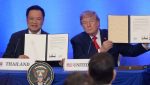

Kasikorn Securities said the initial market effect from a joint U.S.-Thailand trade statement is likely to be limited, as key product-level terms remain undisclosed. The brokerage maintained a neutral view, noting that the agreement has not yet taken effect and still requires legal and domestic approval procedures in both countries.
The statement covers a proposed reciprocal trade arrangement between the United States and Thailand. However, Kasikorn said the absence of detailed tariff schedules and product classifications means the impact on individual industries cannot yet be properly assessed.
Thailand is preparing to review the removal of import duties on several categories of U.S. goods, according to the statement. Kasikorn also noted that there is still no clear explanation of how the referenced 19% tariff will be applied.
The agreement also includes Thailand increasing purchases of U.S. goods by $2.6 billion. In addition, both sides aim to address non-tariff barriers affecting several product groups, including automobiles, medical equipment, pharmaceuticals, ethanol and poultry meat.
For now, Kasikorn left its macroeconomic projections unchanged. The brokerage maintained its 2026 GDP growth estimate at 2.6%, with export and import growth forecasts at 20.5% and 34%, respectively.
On equities, Kasikorn expects the overall effect on the Thai stock market to remain modest. If import duties on some U.S. goods are reduced, the brokerage said potential beneficiaries could include companies exposed to corn-related costs, such as CPF, BTG and GFPT, with estimated earnings upside of 1% to 3%.
Medical equipment and pharmaceuticals are another area to monitor. Kasikorn said about half of medical-device and drug imports come from the U.S., which could be positive for KLINIQ and hospital operators such as BH, BDMS and PR9 through lower imported medicine costs. Thailand currently imports around 11% of its pharmaceutical products from the US market, while medicine expenses account for about 20% of total costs.
Still, Kasikorn said investors should watch for possible effects on domestic production and select locally made goods if Thailand proceeds with broader liberalisation of imports from the U.S.