
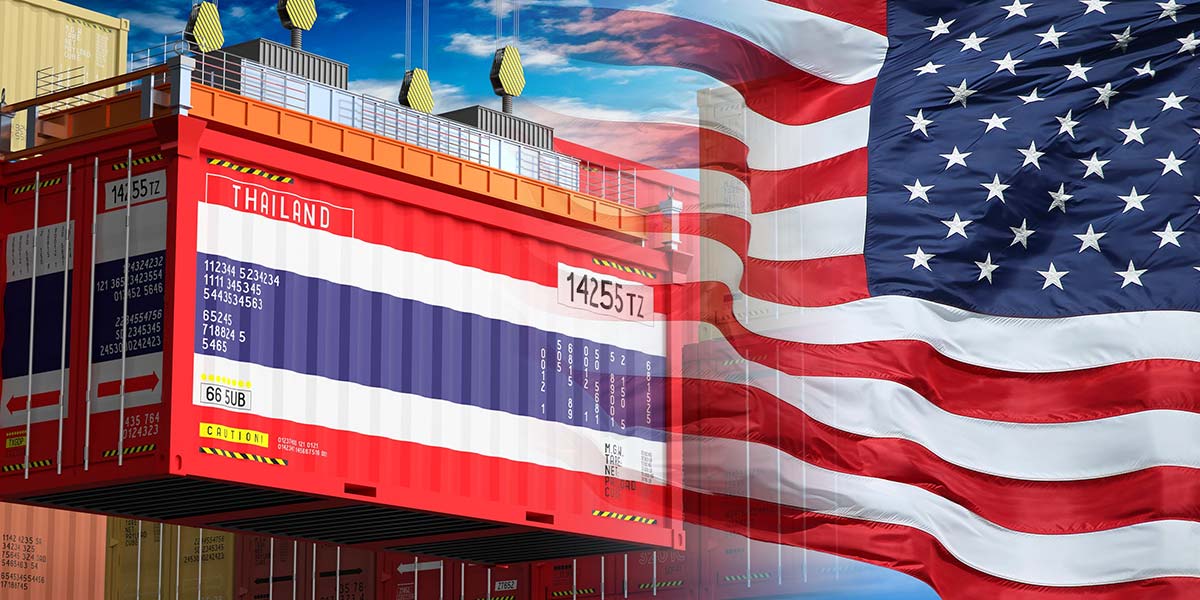
Thailand’s Commerce Ministry said a preliminary U.S. tariff proposal targeting excess manufacturing capacity across 16 economies, including Thailand, will not immediately affect exporters, as the rates are not yet final or enforceable. The government expects Washington to take the recently concluded substantive negotiations on the Thailand-U.S. Agreement on Reciprocal Trade (ART) into account when determining the final tariff burden.
The United States is expected to release its preliminary findings under Section 301 of the Trade Act of 1974 as early as November 26, or by the end of this week, covering China, the European Union, Thailand and 13 other economies, according to a statement issued by the Commerce Ministry on Wednesday.
The ministry stressed that the initial figures will represent proposed tariff rates rather than final duties. Although the preliminary rates could be relatively high, they remain subject to revision during the subsequent review process and will not trigger actual collections at this stage.
Thailand aims to secure a final combined tariff rate that remains competitive with regional trading partners. The ART is expected to serve as an important consideration in Washington’s determination of the final rates.
Following the preliminary announcement, the U.S. is expected to hold a public hearing, allowing businesses and other stakeholders from both the United States and the economies under investigation to submit additional information and responses. These submissions will be considered before the final rates are established.
Under the Section 301 process, the investigation must be concluded within 12 months of its commencement on March 11, 2026, setting March 11, 2027, as the deadline. However, the U.S. could complete the process earlier.
In the meantime, Thai exporters will continue paying the existing 12.5% tariff under the separate Section 301 investigation concerning forced labor, applicable to products that are not exempt. The ministry said it remains unclear whether any duties arising from the excess-capacity investigation will be added to the existing rate, as well as which products will be covered or excluded. Those details will depend on Washington’s final announcement.
The ministry also highlighted the November 17 Joint Statement signed by Prime Minister Anutin Charnvirakul and U.S. President Donald Trump, following the substantial conclusion of ART negotiations, as a positive factor in Thailand’s efforts to obtain favourable final tariff treatment.
However, the ART has not yet been formally signed. Both governments must first complete a legal review of the agreement, followed by consideration by Thailand’s Cabinet, public consultation and parliamentary approval before the necessary legislative adjustments and ratification can take place.
Meanwhile, the Commerce Ministry has coordinated with private-sector organizations, including the Thai Chamber of Commerce and the Federation of Thai Industries, to prepare for potential trade impacts. Measures under consideration include developing new export markets and providing financial support to help businesses adapt and strengthen domestic manufacturing capabilities.
The Department of Foreign Trade has also prepared supporting information and legal documentation to present Thailand’s position to U.S. authorities, addressing both excess manufacturing capacity and forced-labour allegations.
The ministry urged Thai businesses not to interpret the preliminary tariff figures as their actual tax obligations, reiterating that no additional duties have taken effect.