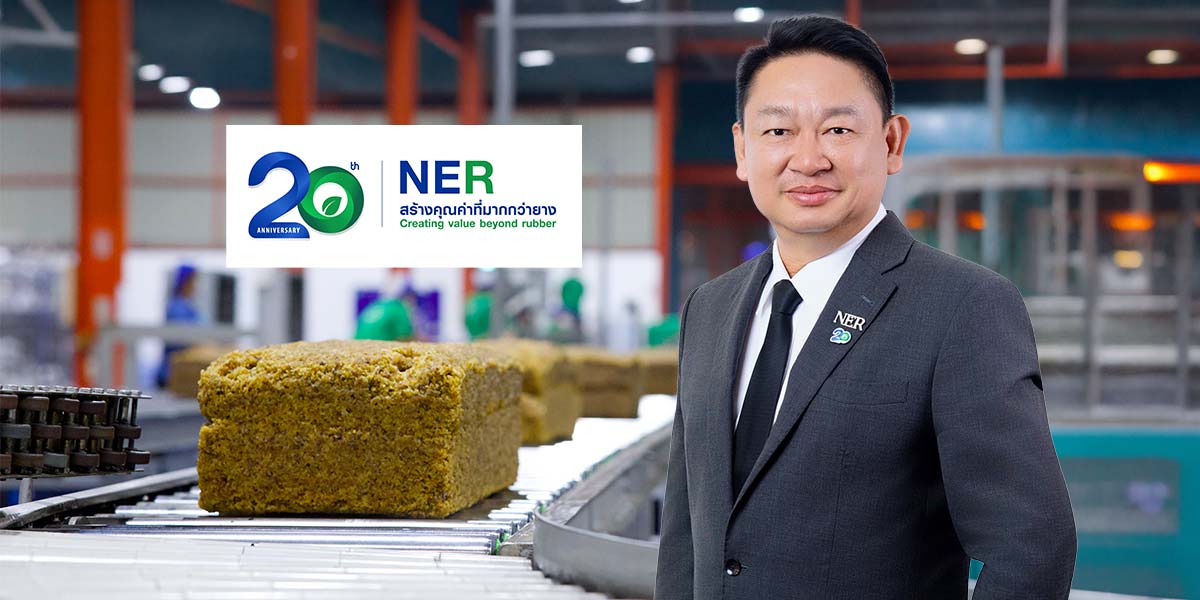
North East Rubber Public Company Limited (SET: NER) expects its 2027 earnings to remain at least in line with 2026, supported by forward orders, firm rubber demand and higher production efficiency.
Chuwit Jungtanasomboon, Chief Executive Officer of NER, said on “Kaohoon” that the company’s operating performance in the first nine months of 2026 showed a positive trend, supported by a steady increase in rubber prices in line with the company’s earlier outlook.
He noted that NER’s third-quarter 2026 results exceeded both the company’s target and market expectations, driven by rubber demand that remained higher than market supply. This reduced customers’ bargaining power, while many customers accelerated forward purchase contracts after seeing signs of rising rubber prices.
Chuwit said NER also benefited from its ability to secure raw materials, which remains a competitive advantage over other domestic operators.
For the remainder of 2026, the company expects to meet its announced targets, with a possibility of slightly exceeding them. NER currently has forward sales for product delivery through March 2027, while production capacity for December 2026 delivery has been fully booked.
Looking ahead to 2027, NER expects another strong year for the rubber industry. The company expressed confidence in its first-half performance, supported by products already scheduled for delivery to customers, and expects full-year 2027 earnings to be no lower than 2026.
NER is currently operating at around 85% capacity utilization. The company has upgraded machinery and production lines while adopting artificial intelligence and SCADA systems to improve efficiency and production capability. These efforts are expected to increase production capacity by around 10% in 2027, with the company targeting sales volume as close as possible to 500,000 tons.
The company plans to disclose details of its 2027 business plan and budget in December 2026.
NER is also preparing for the European Union’s rubber-related requirements under EUDR by using an internally developed program to compile mapping data for farmers’ plantation areas. The company has completed around 120,000 rai, which is expected to support approximately 50,000 tons of rubber output, or about 10% of its 2027 sales volume target.
Chuwit said Thailand’s vehicle excise tax measures could support growth in the domestic automotive and tire industries, particularly as Chinese automakers expand production bases in Thailand. Around 7-8 major Chinese automakers are already operating in the country, and most continue to use tire products from Chinese tire manufacturers with production bases in Thailand.
As NER has long maintained a key customer base among Chinese operators, the company expects to benefit directly from further Chinese investment expansion in Thailand, which could support its business in 2027.
However, NER has delayed investment in a third factory, previously planned to support demand from Indian customers, due to concerns over possible rubber raw material shortages over the next 2-3 years and uncertainty surrounding the severity and duration of El Niño impacts.
On rubber prices, Chuwit said recent increases were mainly supported by lower production, particularly in Indonesia, where rubber tree diseases have affected output for the past 3 – 4 years, as well as disease outbreaks in Thailand’s lower southern region.
NER continues to focus on securing and stockpiling raw materials in advance, even before customer orders are received, to maintain production continuity.
Regarding dividends, NER maintains its policy of paying 40% of net profit. If earnings grow, shareholders could receive higher dividends per share, as the company’s share count remains unchanged.
On foreign exchange volatility, the company said the impact is currently limited, as exports account for no more than 30% of sales. Changes in its foreign exchange risk management policy over the past 4 – 5 years have reduced annual forex gains or losses to around THB10 – 20 million, compared with previous losses in the hundreds of millions of baht.
Chuwit added that NER does not focus on speculation from rubber price volatility. While long-term raw material stockpiling increases financial costs, it is part of the company’s risk management approach to reduce losses and maintain consistent performance.