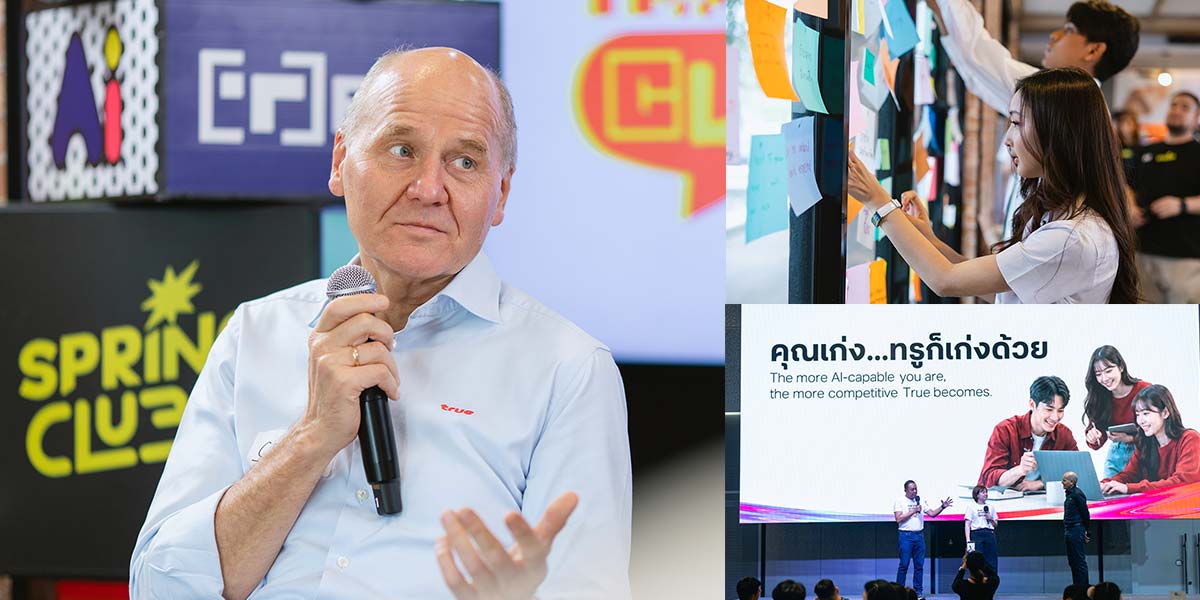
A few weeks ago, I had the opportunity to sit down with a group of bright students from Kasetsart University, said Sigve Brekke, Group CEO of True Corporation Public Company Limited (SET: TRUE). They had joined Hope Club, an initiative that fosters open dialogue between young people and myself on topics such as change, opportunity, and the future.
I opened the discussion with a slightly awkward question: Do you consider yourselves talented?, he asked. The room fell silent for a moment. Before anyone could answer, one student asked me in return: “So, what is your definition of talent?”
His question turned the conversation inward, not only toward what talent means, but toward how quickly that meaning is being rewritten by a world that no longer waits. What followed were three answers, none of them mine, Brekke continued.
One student said she didn’t consider herself talented; she simply came to learn every day out of a desire to improve. Another said that the moment he walked into a room feeling like the smartest person there, he knew he was in the wrong room. A third compared gaining experience to filling a glass with water: she always chooses to pour some out to make room for what’s new.
Those explanations still linger in my mind, because they point to something larger: the milestones that once defined growing up, such as good grades, a certain university, or a stable first job, were never proof of what a person is. They were only proof of what a person, at one point, was willing to do, he commented.
Those are just snapshots, static images from a specific moment in time. They tell us what someone accomplished yesterday, under controlled conditions. They tell us nothing about how that person will perform when conditions when conditions change.
After more than thirty years in leadership, I have come to understand something that I now share with every young person I meet: the most dangerous trap for for all of us is the illusion of “arrival”, the belief that what one has achieved today will be sufficient for what tomorrow demands. And tomorrow, for this generation, is arriving faster than most are prepared to meet it, he added.
Building a Workforce, Not Just a Technology Strategy
At True Corporation, we are taking concrete steps to address this challenge. Our goal is to become an “AI First” organization by 2028, not by replacing people with AI, but by equipping them to work alongside it, Brekke explained.
The AI Practice Day initiative reflects that commitment: hands-on, in-depth, collaborative learning designed to move employees from mere awareness of AI to genuine capability. What we emphasize isn’t certification, but practical tools, real confidence, and the ability to manage one’s own work with AI as a partner, not a threat.
Our aim is not to produce AI engineers, he elaborated. It is to build a workforce that isn’t afraid of the future, one that sees AI as a tool to streamline processes and expand capability in a world where change is accelerating, rather than as a catastrophe threatening working life. That mindset shift is precisely what the Kasetsart students demonstrated that day, even without a shred of technical jargon between them.
My dialogue with these purpose-driven young people connects directly to the World Economic Forum’s 2025 white paper, Four Futures for the New Economy: Geoeconomics and Technology in 2030, he remarked.
Shaped by two forces currently pulling at every economic system, geopolitical stability and the pace of technology adoption, the report maps four possible scenarios for the decade ahead.
The most optimistic, Digitalized Order, sees the global economy return to growth and expand into new frontiers, but only if international geopolitics stabilizes and AI adoption becomes both rapid and equitable. Even here, challenges persist: wage polarization and political instability within countries are likely to worsen, driven by a new form of digital divide rooted in uneven AI adoption.
At the other extreme, Geotech Spheres describes a fractured world: nations grow isolated even as technology advances, declining trust stalls growth, supply chains fragment, and smaller economies face the sharpest risks in isolation. Countries that fail to build their own digital ecosystems and human capital strategies would suffer the most.
The remaining two scenarios, Cautious Stability and Tech-Based Survival, most closely resemble the world many of us are living in today: technological progress concentrated unevenly, against a backdrop of geopolitical volatility.
Across all four, the WEF’s “no-regret” strategies converge on the same principle: strengthen governance, invest in supply chain resilience, build foresight capability, and critically, invest in technology and human capital simultaneously. Neither can substitute for the other.
The Question Thailand Cannot Avoid
For Thailand, this trajectory is not abstract. In a world where AI adoption drives economic advantage and geopolitical extremes shape multinational strategy, the question is not whether Thailand will be affected, it already is. The real question is whether Thailand will help shape its own future in a rapidly changing world, or remain reactive as these forces continue to reshape it.
The question of talent that day was, in essence, the same question facing every economy in the region: are we developing people who can adapt, collaborate, and lead through change or people who can only hope the wave of disruption passes them by?
The student who asked me to define “talent” before she would answer my question understood something many organizations overlook: definition is not a formality. It dictates behavior, and it determines what we build.
So this is the question I’d like to leave with you. As Thailand navigates these four possible futures, we must ask what “talent” truly means for this country, and whether we have built an environment today that allows that talent to actually grow, Brekke concluded.