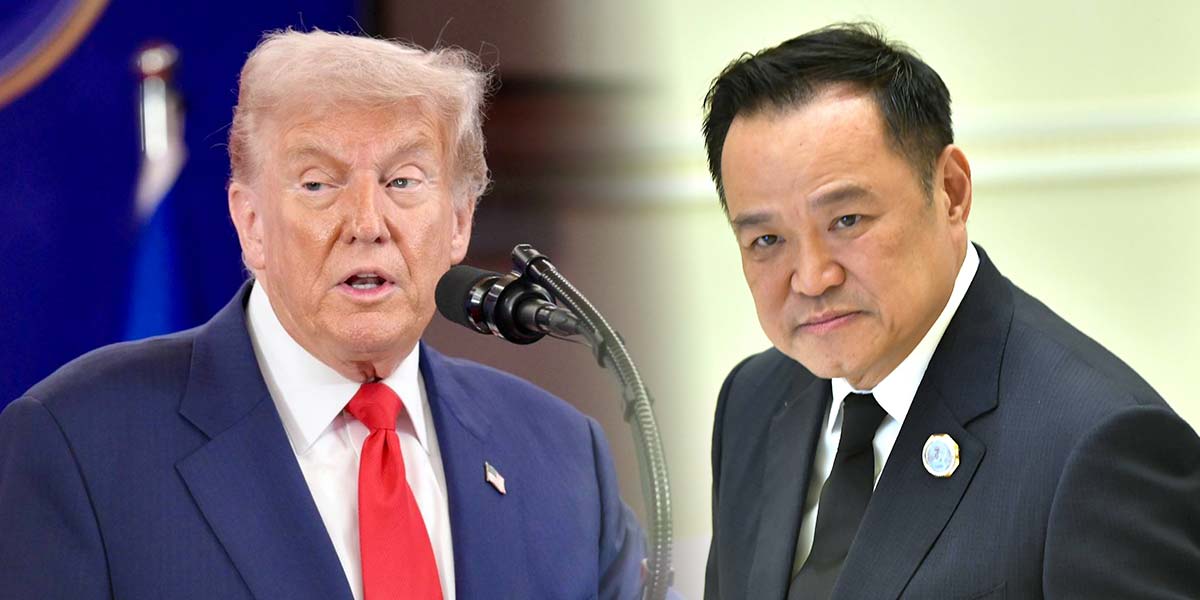
Thailand expects to conclude its Agreement on Reciprocal Trade with the United States during President Donald Trump’s next Asian visit, Prime Minister Anutin Charnvirakul said on Wednesday. Negotiators are working on the remaining clause, he told business leaders in Singapore.
Anutin discussed the agreement at the Forbes Global CEO Conference’s gala dinner, held at the Shangri-La Singapore hotel. He said Trump had asked him to ensure Thai officials and the U.S. Trade Representative completed the outstanding provision. According to Anutin, Trump also indicated in a letter that he expected the agreement could be signed when he next travelled to Asia.
Two summit locations are possible settings for the signing. Manila will host ASEAN leaders from November 16 to 18, while the Asia Pacific Economic Cooperation summit is scheduled for November 18 and 19 in Shenzhen.
For Thailand, the negotiations involve its biggest overseas market: the U.S. has taken 24% of Thai exports so far this year. At the same time, rising purchases of capital goods, raw materials and energy have pushed Thailand’s overall trade deficit to historic levels. Kasikorn Research Center estimates the shortfall could reach $50 billion in 2026, exceeding every annual deficit recorded since the series began in 1991.
The bilateral trade figures show a different picture. Data from the Office of the U.S. Trade Representative put Thailand’s 2025 goods surplus with the United States at $71.7 billion, a 59.1% increase over the previous year. Services trade moved in Washington’s favour, producing a $15 million American surplus in 2025 after a $5 million deficit in 2024.
Several trade issues remain between the two governments. A U.S. tariff of 12.5% took effect in July on Thai imports without exemptions, following American findings that Thailand’s efforts against forced labour were insufficient. U.S. authorities are also investigating production overcapacity; that inquiry remains open and could affect the eventual tariff level.
Another Washington demand concerns Chinese goods passing through Thailand to avoid American trade restrictions. Bangkok keeps a list of Chinese products frequently involved in such transshipment for closer examination, a measure requested by U.S. authorities.