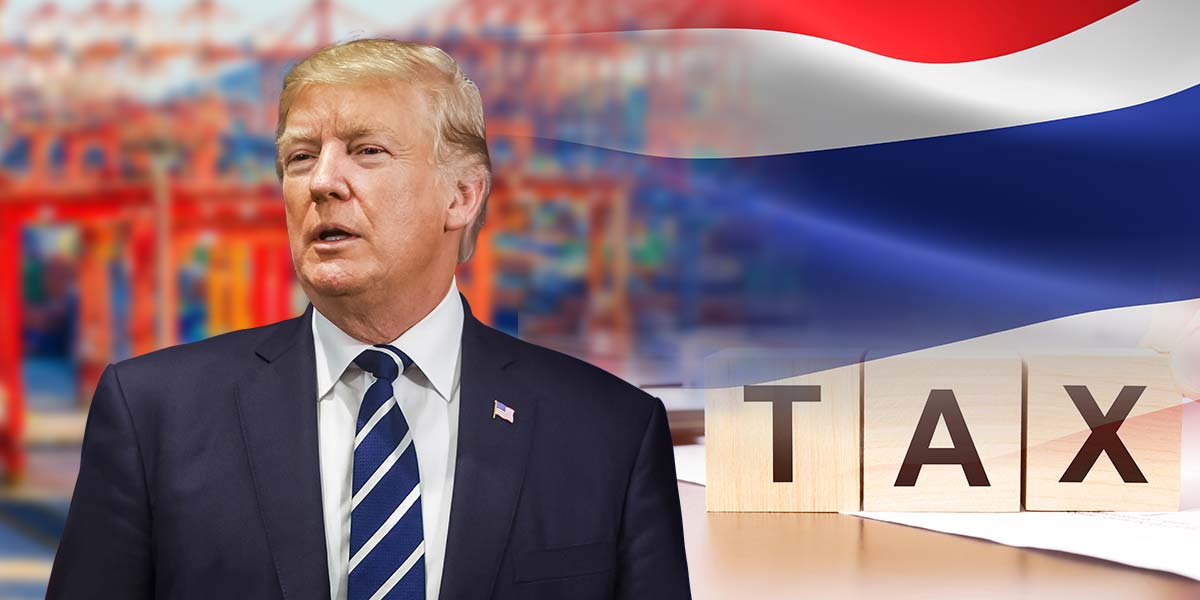
Thailand is among 16 economies that could face additional U.S. tariffs as the Trump administration prepares to take action against countries accused of supporting excess manufacturing capacity through government subsidies and industrial policies. The proposed measures could add to existing duties, creating another trade challenge for Thai exporters as Bangkok seeks more favourable tariff treatment from Washington.
U.S. Trade Representative Jamieson Greer is expected to announce the findings of a months-long investigation into industrial subsidies involving China, the European Union and 14 other economies, including Thailand, as early as this week, The Wall Street Journal reported on November 24, citing people familiar with the administration’s plans.
The investigation, initiated in March under Section 301 of the Trade Act of 1974, examines whether foreign government policies have contributed to excess production and enabled manufacturers to sell goods at prices that undermine American competitors. The USTR argues that subsidised industrial output has displaced domestic U.S. production and weakened the competitiveness of American manufacturers.
Although the final tariff rates have not been determined, the administration is expected to take existing trade arrangements into account. The European Union, Japan and South Korea could face overall rates of 15% or lower, while Vietnam and India may encounter higher duties. China is expected to receive comparatively heavier treatment due to the scale of its industrial subsidies.
Products already covered by separate national-security tariffs, including steel, aluminium and automobiles, could be excluded from the new measures. The proposed duties may also apply alongside existing tariffs linked to forced-labour concerns. Washington is reportedly considering retaining the option to increase rates if affected economies fail to address the issues through negotiations.
U.S-Thailand Agreement
The latest development comes after Prime Minister Anutin Charnvirakul and U.S. President Donald Trump signed a joint statement on November 17 in Manila, confirming that negotiations on the Thailand-U.S. Agreement on Reciprocal Trade (ART) had reached a substantial conclusion.
However, the document was not the final ART agreement. According to the White House, both governments must complete their respective internal procedures before preparing the pact for formal signature and entry into force.
The following day, Deputy Prime Minister and Commerce Minister Suphajee Suthumpun discussed tariff issues with U.S. Deputy Trade Representative Rick Switzer on the sidelines of the APEC Economic Leaders’ Meeting in Shenzhen, China.
Suphajee said Thailand had reiterated its request to reduce an additional tariff associated with forced-labour measures from 12.5% to 10%. The U.S. side indicated it would proceed with the reduction process, although the lower rate had not yet taken effect.
Thailand also asked Washington to provide the lowest possible tariff rate under the separate measures targeting industrial overcapacity, with Suphajee stressing the importance of maintaining the competitiveness of Thai exports against products from other countries.
The final tariff treatment for Thailand under the proposed industrial-overcapacity measures remains uncertain, with Washington yet to announce its findings and specific rates.