
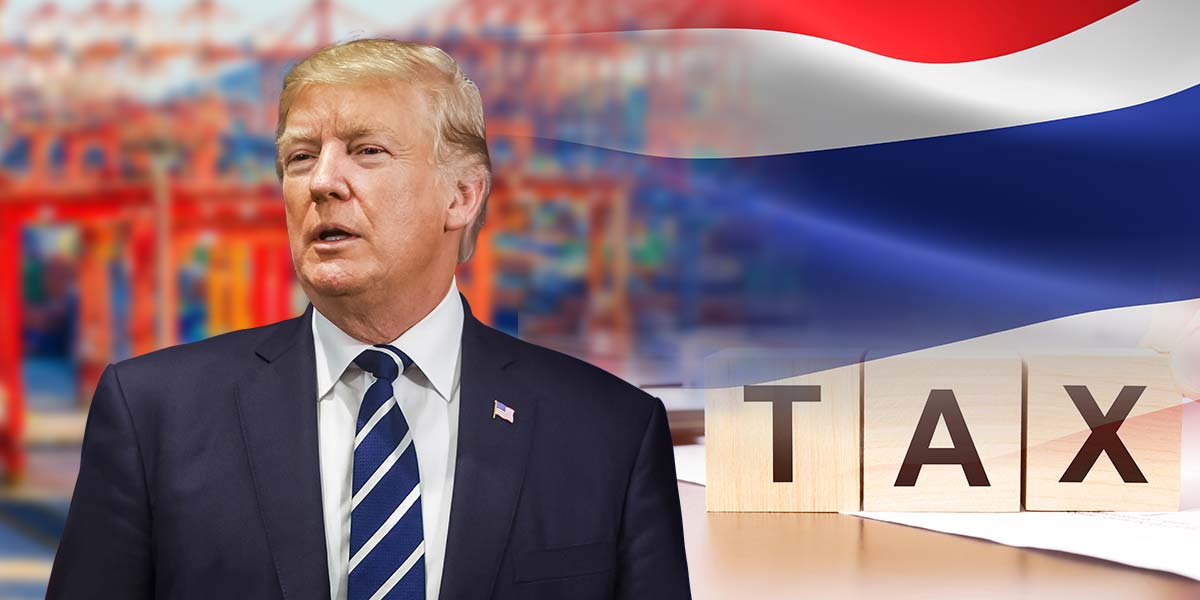
Thailand faces a proposed additional U.S. tariff of up to 18% under the Trump administration’s latest trade action targeting manufacturing overcapacity, following Washington’s determination that Thailand’s industrial policies burden American commerce. The proposed rate takes existing Section 301 duties into account and reflects commitments under the framework for a Thailand-U.S. Agreement on Reciprocal Trade (ART), according to the Office of the U.S. Trade Representative (USTR).
In an announcement on November 25, USTR said Trade Representative Jamieson Greer had determined that the policies and practices of 14 economies, including Thailand, were unreasonable and restricted U.S. commerce under Section 301 of the Trade Act of 1974. The other economies include China, the European Union, Singapore, Switzerland, Indonesia, Malaysia, Cambodia, South Korea, Vietnam, Taiwan, Bangladesh, Japan and India.
The USTR’s assessment of Thailand cited five areas of concern: industrial and economic plans targeting manufacturing and exports, persistent barriers to market access, preferential lending and other government assistance to industries, insufficient labour protections, and a failure to address global excess production, including through imports and foreign investment from non-market economies.
Washington argued that these practices reduce commercial opportunities for American businesses in Thailand and other markets, while contributing to weaker U.S. manufacturing output, exports, employment and investment. The electronics, automotive, machinery and electrical equipment industries were identified as particularly exposed.
To address the findings, USTR proposed considering additional duties of up to 18% on Thai goods, calculated net of existing Section 301 tariffs, with exemptions for selected products. The proposal also takes into consideration existing Section 232 duties, ongoing discussions with Thailand and commitments covered under the Framework for an Agreement between the two countries on Reciprocal Trade.
The announcement follows the November 17 Joint Statement signed by Prime Minister Anutin Charnvirakul and U.S. President Donald Trump, confirming that substantive negotiations on the ART had concluded. However, the Joint Statement does not constitute the final ART agreement, which still requires legal review and domestic approval procedures in Thailand before formal signing and implementation.
The Commerce Ministry previously said the trade framework would provide an important basis for Thailand to negotiate a final tariff burden that remains competitive with regional rivals. It also clarified that preliminary tariff proposals should not be treated as duties immediately payable by exporters.
USTR will accept written submissions and requests to participate in hearings until January 5, 2027, with hearings scheduled to begin on January 25. The proceedings will allow affected economies and other interested parties to present further information before Washington decides on the proposed measures.
Separately, USTR said it had not reached determinations concerning Mexico and Norway, although both were included in the original group of 16 economies investigated since March 11, 2026.
Summary of U.S. Full Report
In March 2026, the Office of the United States Trade Representative (USTR) initiated an investigation under Section 301 of the Trade Act of 1974 to evaluate Thailand’s acts, policies, and practices relating to structural excess capacity and production in its manufacturing sectors. The investigation concluded that Thailand’s practices are unreasonable and burden or restrict U.S. commerce.
Specifically, the USTR found that Thailand engages in coordinated government industrial planning—such as the 2012 Industrial Plan and the Thailand 4.0 strategy—that artificially targets export-led growth and expands manufacturing capacity beyond normal market demand. Thailand’s manufacturing sector accounted for 25.4% of its GDP from 2021 to 2025, double the OECD average. This outsized sector is sustained through preferential lending, market access barriers (like import licensing and bans), and suppressed domestic consumption, which averaged only 56.1% of GDP compared to 67.9% in the United States.
Additionally, Thailand’s inadequate labor laws and weak enforcement depress wages and worker compensation—accounting for just 16.3% of manufacturing value-added in 2021—giving Thai exporters an artificial cost advantage while undermining worker welfare.
A central finding accuses Thailand of serving as a “redirect channel” for Chinese excess capacity. Thailand has dramatically expanded imports of Chinese intermediate goods (surging by 155% between 2017 and 2025) and welcomed billions in Chinese foreign direct investment, particularly in automotive and electronics sectors. Thai manufacturers process these Chinese inputs to export finished products to the U.S. market.
Consequently, Thailand’s bilateral goods trade surplus with the United States doubled from $34.5 billion in 2021 to $71.2 billion in 2025, even as its global trade balance sank into deficit. The USTR determined these distortions unfairly displace U.S. producers, reduce domestic manufacturing employment, and create critical economic security risks through supply chain dependencies.