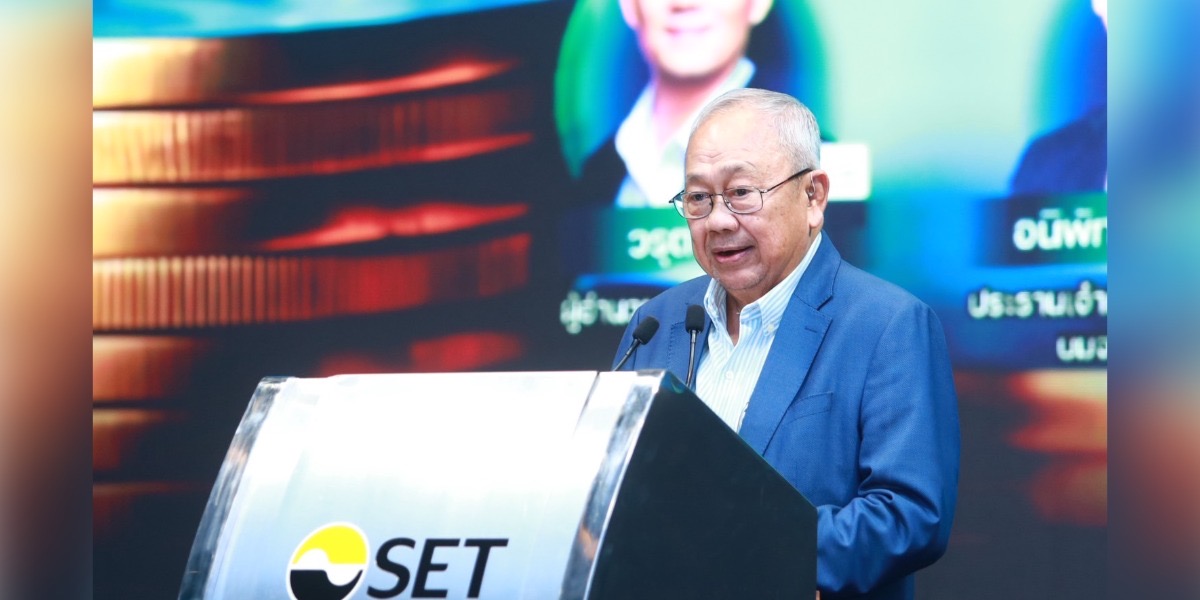
On September 19, 2026, Thai stock news outlet Kaohoon hosted the seminar “Unlocking Alternative Assets, Fulfilling Investment Opportunities” at the Stock Exchange of Thailand. Opening the event, Chanchai Sanguanwong, Director of Kaohoon, emphasized that global investors face unprecedented market volatility driven by fluctuating interest rates, currency swings, inflation, geopolitical tensions, and rapid technological transformation.
However, he stressed that expanded choice demands greater discipline, urging investors to thoroughly evaluate return profiles, risk factors, and asset allocation before entering new asset classes.
Session 1: Depositary Receipts
The first session, “Unlocking the DR Universe,” explored how Depositary Receipts (DRs) serve as a vital gateway for Thai investors to access foreign stocks, ETFs, and commodities directly through the Stock Exchange of Thailand. Speakers Tortrakun Satayaprasert (SVP and Head of Product Solutions Group at Krungthai Bank), Chetathorn Songmuang, Head of Quantitative Department at Yuanta Securities and Saran Potewiratananond (Head of Proprietary Trading at InnovestX) noted that Thailand’s DR market has grown rapidly to 60–70 billion baht in asset value across roughly 500 products referencing over 300 unique underlying securities. DRs eliminate the need to open offshore trading accounts or transfer foreign currency directly, significantly lowering barriers to global diversification.
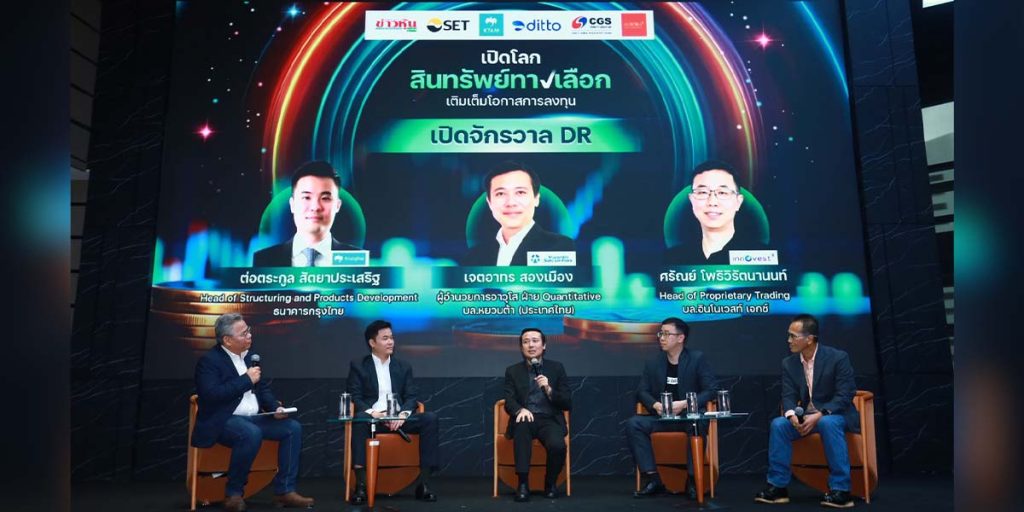
The panel highlighted key international investment themes, including AI infrastructure, data center hyper-scalers, clean energy, defense, and emerging markets like Vietnam. They explained that DRs offer enhanced flexibility through local Market Makers (MM) who maintain liquidity and allow Thai investors to trade global assets during local market hours—even when target foreign exchanges are closed. Looking ahead, experts noted that while Thai DRs currently focus on “Inside-Out” capital deployment, potential future “Outside-In” DRs referencing Thai assets could eventually drive foreign capital inflows into the local market.
Session 2: Global Mutual Funds
The second session gathered executive leaders from major asset management firms—including Chavinda Hanratanakool (Chief Executive Officer at KTAMai Asset Management), Dr. Thanavut Pornrojnangkool (Chief Investment Officer at Bualuang Asset Management), and Kulachat Chandavimol (Chief Marketing Officer at UOB Asset Management Thailand)—to discuss foreign equity strategies amidst the global AI transformation. The panel emphasized that the AI megatrend is expanding far beyond U.S. tech giants into broader technology supply chains across South Korea, Taiwan, and Japan, as well as adjacent sectors such as healthcare and power infrastructure.
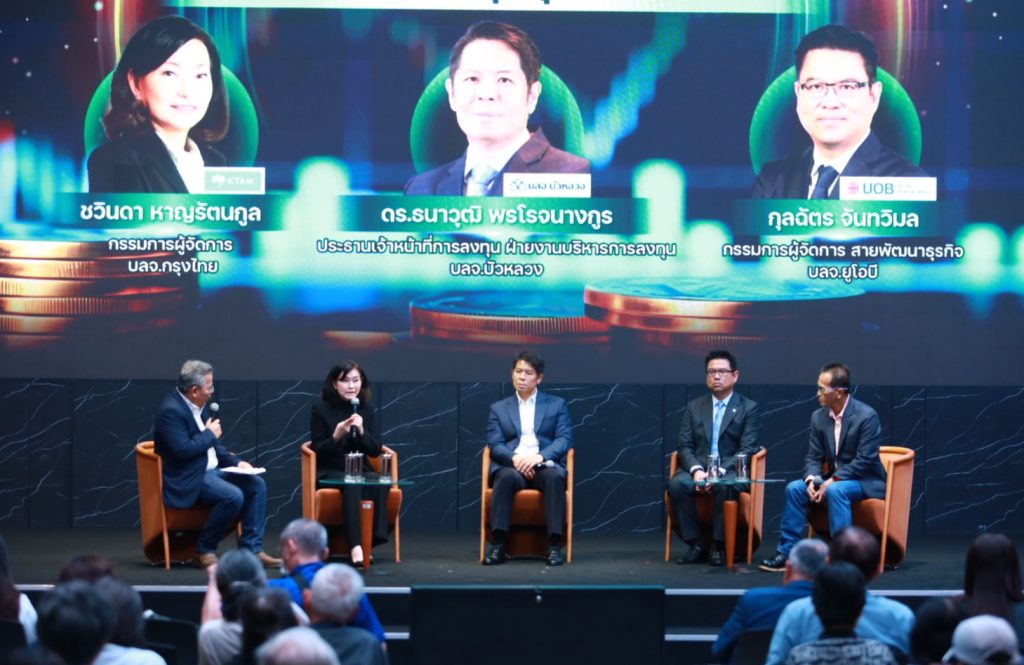
To manage macro uncertainty and exchange-rate risks, the speakers cautioned against over-concentrating capital in any single asset or theme. Instead, they recommended disciplined strategies such as Dollar-Cost Averaging (DCA), regional asset allocation, and balancing growth stocks with high-dividend assets to maintain consistent cash flow while capturing long-term upside. They affirmed that mutual funds remain a crucial vehicle for linking Thai retail investors—especially younger generations—to diversified global opportunities.
Session 3: Digital Tokens & Tokenization
The third session examined the evolution of digital tokens and blockchain-based asset tokenization, presented by Takorn Rattanakamolporn, CEO at DITTO and Wannapat Passayawan, ICO Initiatives and Capital Markets at Token X. A primary highlight was the “Blue Green Token,” an investment token backed by real-world mangrove carbon credit projects. The token offers a 7-year holding structure with principal protection and a 3% annual fixed return, alongside additional capital appreciation potential if global carbon credit prices rise under tightening mandatory climate regulations.
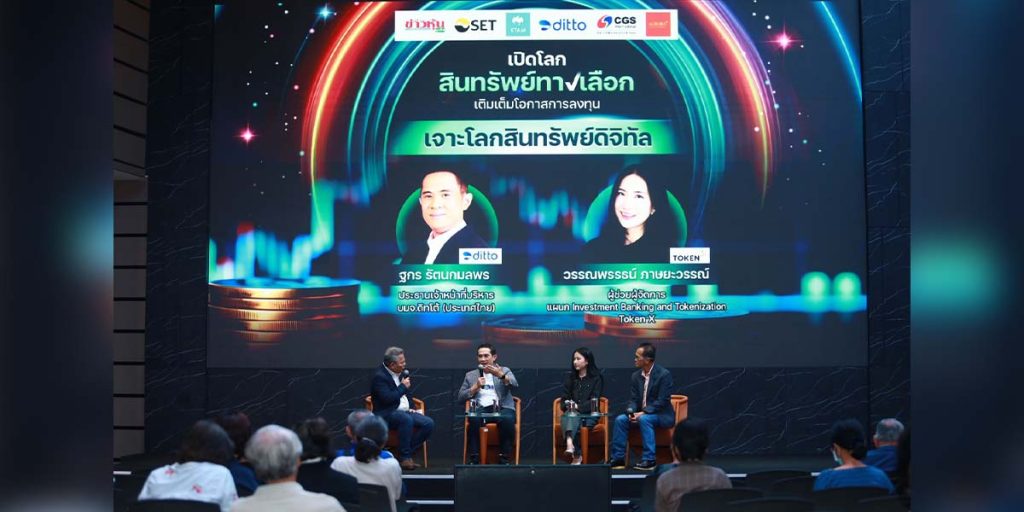
The speakers detailed how tokenisation is transitioning from real estate into broader real-world assets (RWA), including gold, carbon credits, and tokenised money market funds. By leveraging blockchain technology, tokenized assets enable T+0 or T+1 trade settlements, 24/7 trading availability, and fractionalized ownership of previously illiquid assets. They clarified that unlike speculative cryptocurrencies, asset-backed digital tokens are tied directly to tangible projects or underlying cash flows, appealing to both traditional investors and digital-native demographics.
Session 4: Gold & Derivatives
The final session, “Power of Gold,” featured Warut Rungkham (Director of Analysis and Investment at YLG Bullion & Futures) and Anipat Srirungthum (Chief Marketing Officer at AURA), who provided a bullish outlook for gold in the fourth quarter of 2026 and beyond. YLG projected that if global gold prices hold above key support at $4,200 per ounce, momentum could push prices toward $4,500–$4,800 per ounce in Q4 2026, with potential to test $5,000 per ounce in 2027. This positive trajectory is supported by central bank reserve accumulation, ETF inflows, and anticipated shifts in Federal Reserve monetary policy.
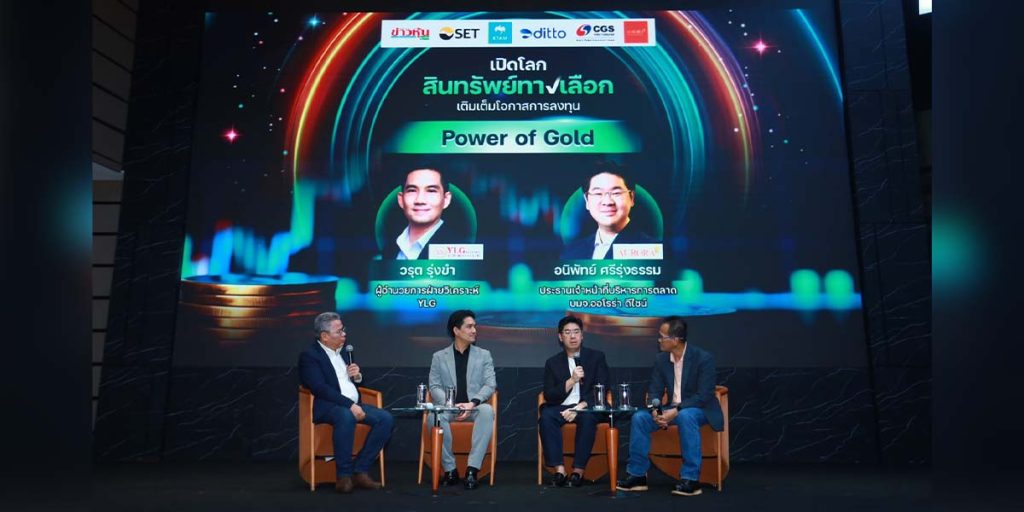
AURA highlighted Thailand’s competitive gold ecosystem, noting that local tax structures allow Thais to trade physical gold at prices close to global spot rates, compared to higher tax burdens in countries like China or India. This advantage attracts roughly 1 million new buyers annually, driven largely by younger investors entering the market. For hedging and active trading, the panel highlighted derivative instruments like Mini Gold Online Futures (MGO), which feature smaller contract multipliers and a quanto structure (eliminating direct currency risk), making leverage and risk management accessible to retail traders and small gold business operators.