
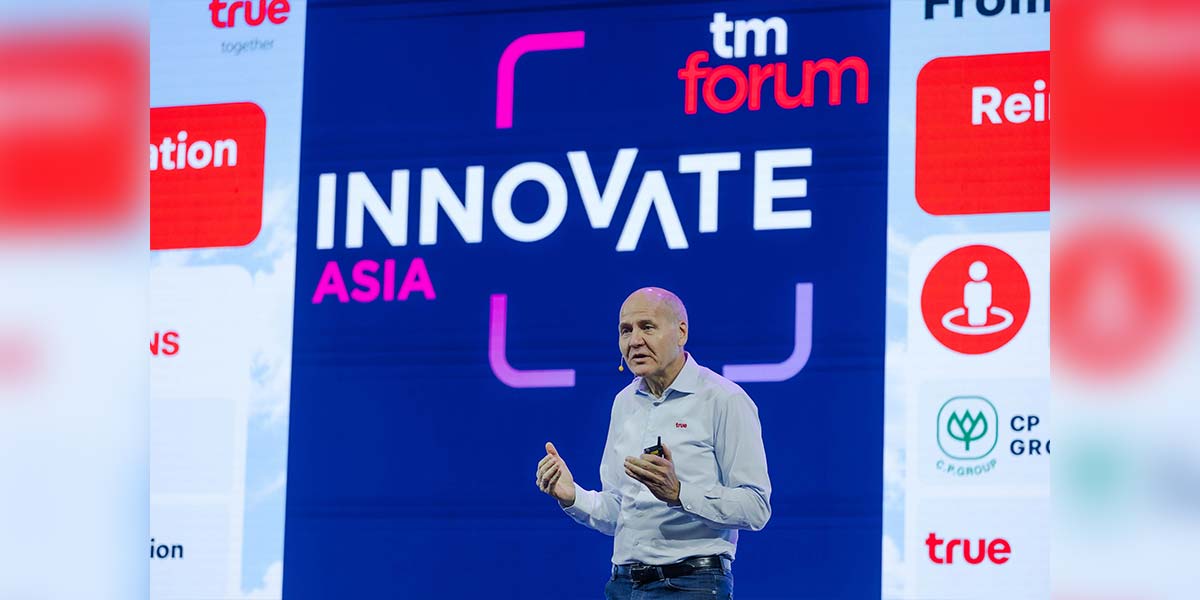
Telecom networks have become the electricity and water of the digital economy: essential, always on and easy to take for granted. True Corp. (SET: TRUE)’s Group CEO Sigve Brekke accepts the utility label. “Nothing wrong with that,” he told TM Forum CEO Nik Willetts at TM Forum Innovate Asia in Bangkok this week. “We’re actually delivering the backbone of the entire digital economy.”
The danger is comfort. Operators grow 3% to 6%, earn EBITDA margins of 40% to 50% and pay reliable dividends. “Everything is smooth,” Brekke said. “Why should such a company have a burning platform?” Yet comfort is the risk when value is shifting above connectivity.
The benchmark has moved too: global platform companies, not rival operators, now set the standard for customer relationships.
Brekke’s answer is to keep the backbone and monetize it harder. Operators once earned heavily from text messaging and ringback tones, and he asked why the industry gave so much away. Security, AI tokens, an AI-driven return of ringback tones, advertising and, above all, B2B represent areas where operators can reclaim value beyond connectivity. For Brekke, AI is both a way to regain productivity at a lower cost and a chance to build new revenue streams. However, he warns that the risks facing the industry are fundamentally different from the past. “If we lose this race, we may not survive,” he said. “That’s the reality.”
Asia, and the race to AI-native Telcos in 2030
True’s roadmap to become an AI-native telco by 2030 began in 2025 with strategy and guardrails. In 2026 it is nailing the basics; in 2027 it will scale by reinventing its operating model; by 2030 it aims to monetize at scale. Targets include AI capacity equal to 5,000 full-time employees, a 3% to 5% revenue uplift and a 30% cut in operating costs.
TM Forum sees Asia leading the race to 2030. Willetts called True’s progress over the last year “quite remarkable” and asked what sets the region apart. “For sure, it’s speed,” Brekke said. Many Southeast Asian companies are owned by families or individuals, which raises willingness to take risks. There is less legacy to unwind, proximity to Korea, Japan and China, and “a hunger here that I don’t see in many other countries or regions.”
Speed does not remove friction inside established operators. Telcos hold what no one else has: licenses, spectrum and, in most countries, superior networks. Turning those assets into new revenue beyond connectivity means overcoming three obstacles. The first is urgency in a business that feels smooth.
The second is partnership. Telcos are used to buying from vendors, but Brekke wants outcome-based deals with shared risk and reward. “We need partners who are also willing to invest and have skin in the game,” he said, citing the five-year Amazon Web Services partnership announced in August, which targets single sign-on across CP Group, more advanced AI in call centers, predictive network capabilities and automated customer journeys. The third is pace: mature industries run on risk matrices and governance, while new players take bigger risks.
He called “transformation” one of telecom’s most misused words. “This is not about implementing new technology. It’s not about changing your IT systems,” he said. “It’s about understanding how AI is changing the entire commercial part of your business and the way you operate.”
Proof of Value Across Domains
True’s 2026 mandate is to prove commercial value through three shifts: from AI activity to business value, from isolated use cases to domain reinvention, and from automation to operating-model redesign. Every initiative starts with a measurable outcome in revenue, cost, customer experience or productivity.
Four foundations carry that load. Simplification is stripping away post-merger complexity, with product simplification at 90% and 69% of process simplification designed. A single 7-petabyte data lake runs the first version of its AI Factory at 97% performance and 91% accuracy. Half of employees have been upskilled in AI, and more than 130 advanced AI builders deploy agents into daily work. AI agents equal to 135 full-time staff support customer service, and coding agents assist with 35% of coding, under a responsible AI program and AI Council.
When process, platform and people align, results show up in specific parts of the business:
- In business-to-business services, an end-to-end view of the commercial chain, from prospecting to supporting salespeople and working with partners, produced 60% more sales opportunities and a 7.1-percentage-point higher win rate after four months, an early signal.
- In personalization, AI is shifting offers from mass-market to micro-segmented. Postpaid revenue beyond connectivity is up 2.7 percentage points, and postpaid churn is down 1.2 percentage points.
- On the front line, the Nano-Cluster Model splits Thailand into 6,600 local territories, each led by a “mini-CEO” with AI tools and real-time data. Moving decisions closer to the people who see the problem has lifted new broadband subscribers 15% and new prepaid subscribers 10%.
Human Hurdle On The Road To 2030
The hardest part of scaling has little to do with algorithms. The real question, Brekke said, is how an operator would run the company if it received its telecom license today, a hard exercise for an industry built on legacy.
He cited a Boston Consulting Group finding that CEOs at AI-leading companies spend at least eight hours a week going deep into AI. Every leader should ask, he said, “Am I the right person to lead this company in the AI age? Am I hungry enough?” He asks his own leaders to show him AI use cases they built themselves, aiming to change the culture, not replace experienced leaders.
“I’m not even born digital. I’m born manual,” Brekke said.
AI transformation, in Brekke’s telling, is not a technology upgrade but a change in how leaders think and run the business. The race to 2030 will favor those who manufacture urgency before comfort turns into decline.