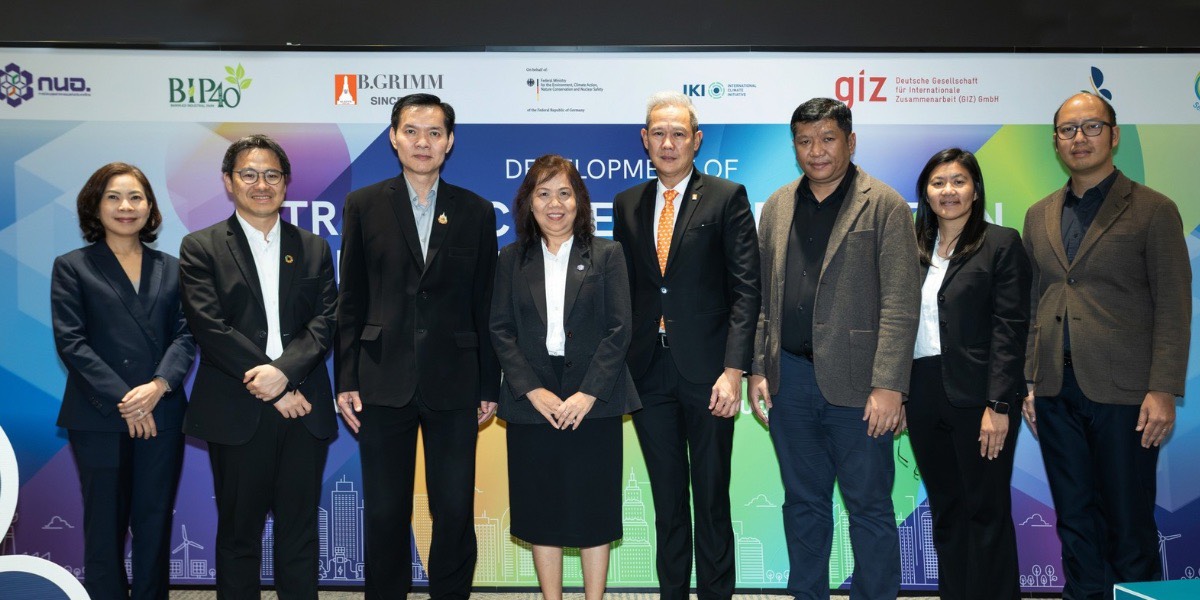
The Deutsche Gesellschaft für Internationale Zusammenarbeit (GIZ), under the Thai-German Cooperation on Energy, Mobility and Climate (TGC EMC), has joined hands with the Industrial Estate Authority of Thailand (IEAT), Bangkadi Industrial Park, B.Grimm Power Public Company Limited (SET: BGRIM), and various partners to present the findings of a strategic roadmap for energy transition and greenhouse gas reduction across Thailand’s industrial sector.
The launch event was held in two key pilot areas: Laem Chabang Industrial Estate, Chonburi, on September 15, 2026, and Bangkadi Industrial Park, Pathum Thani, on September 18, 2026. The sessions brought together representatives from public agencies, private sectors, and industrial operators to discuss how the results could be practically implemented in their respective areas.
The project’s focus is on evaluating and developing pathways for industrial energy transition and greenhouse gas reduction, with Laem Chabang and Bangkadi chosen as model sites. The initiative collected and analyzed energy consumption and emissions data, developing area-specific carbon reduction plans. These plans encompass energy efficiency enhancements, increasing the share of renewable energy, introducing low-carbon technologies, and upgrading energy infrastructure. All approaches were weighed for technical feasibility, economic viability, and environmental impact, with the goal of creating actionable and replicable greenhouse gas reduction strategies.
The study found that achieving greenhouse gas reduction at the local level requires a phased approach, starting with immediately actionable measures such as energy efficiency improvements, energy management, and increased use of renewables. It also stresses the importance of preparing for longer-term solutions that involve additional infrastructure, commercial readiness, energy sourcing, investment, and supportive policy frameworks.
B.Grimm Power plays a crucial role as an energy partner, connecting industrial operators’ needs with the energy transition. The company aims to strike a balance between energy reliability, affordability, and decarbonization through renewable energy development, efficiency improvements, and tailored solutions, while also preparing for future alternatives relevant to the long-term energy transition.
The conferences served as a forum to discuss the roadmap, covering Thailand’s climate targets, carbon reduction measures, energy efficiency, power sector transition, green electricity, funding mechanisms, and the ESCO model. Area-based collaboration—linking industrial developers, energy producers and service providers, manufacturers, the public sector, financiers, and technology providers—was highlighted as a key mechanism for overcoming operational barriers. Lessons learned from these pilot areas are intended to serve as benchmarks for broader application across Thailand’s industrial sector, supporting a shift toward a low-carbon economy.
In line with its goals, the event itself was organized as carbon-neutral, demonstrating commitment to integrating greenhouse gas reduction into operational practices.
The TGC EMC project is backed by funding from Germany’s International Climate Initiative (IKI), under the Federal Ministry for the Environment, Climate Action, Nature Conservation and Nuclear Safety (BMUKN). It supports Thailand’s ambitions for carbon neutrality by driving progress in five main sectors: renewable energy, transport, industrial carbon mitigation, biomass, and climate finance, while promoting technology transfer, policy development, and cross-sectoral innovation.