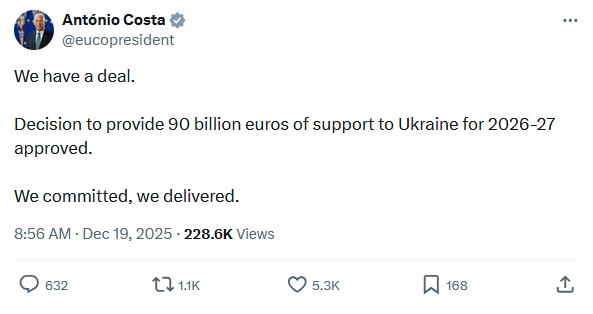
The European Union reached consensus early Friday to extend a substantial interest-free loan package totalling €90 billion ($106 billion) to Ukraine, designed to bolster both its military and economic sectors through 2026 and 2027, according to diplomats familiar with the matter. This decision follows the bloc’s inability to reach an agreement on tapping frozen Russian assets for Ukrainian aid.
Announcing the agreement on social media, European Council President Antonio Costa stated, “We have a deal. Decision to provide €90bn of support to Ukraine for 2026-27 approved. We committed, we delivered.”
German Chancellor Friedrich Merz clarified the loan repayment terms, indicating that Ukraine will only be expected to repay if Russia shells out reparations for its invasion. Furthermore, the EU has retained the prerogative to redirect immobilised Russian assets within its jurisdiction to fulfil debt obligations, should Moscow default on reparations.
According to EU estimates, Ukraine requires an additional €135 billion ($159 billion) over the next two years to remain solvent. Ukrainian President Volodymyr Zelenskyy, addressing EU leaders at the summit’s outset, urged for the use of Russian state assets, asserting it represented the most appropriate funding solution.
While the summit’s draft conclusions noted ongoing deliberations among EU governments and the European Parliament regarding a loan that would be backed by the frozen assets of the Russian central bank, significant obstacles persist. The bulk of these Russian holdings—€185 billion out of €210 billion—are located in Belgium, increasing Brussels’ exposure to potential legal and financial repercussions in the event of countermeasures from Moscow.
Belgium, along with Hungary and Slovakia, has voiced consistent opposition to repurposing Russian assets due to concerns over possible legal challenges after their release.
On Thursday, Russia’s central bank announced it would seek compensation from European banks over what it described as the “illegal blocking and use” of its assets, following its $230 billion claim against Euroclear. Security officials speaking to The Guardian indicated that Euroclear, the Brussels-based depository which safeguards a significant tranche of Russian funds, has faced sustained intimidation efforts.