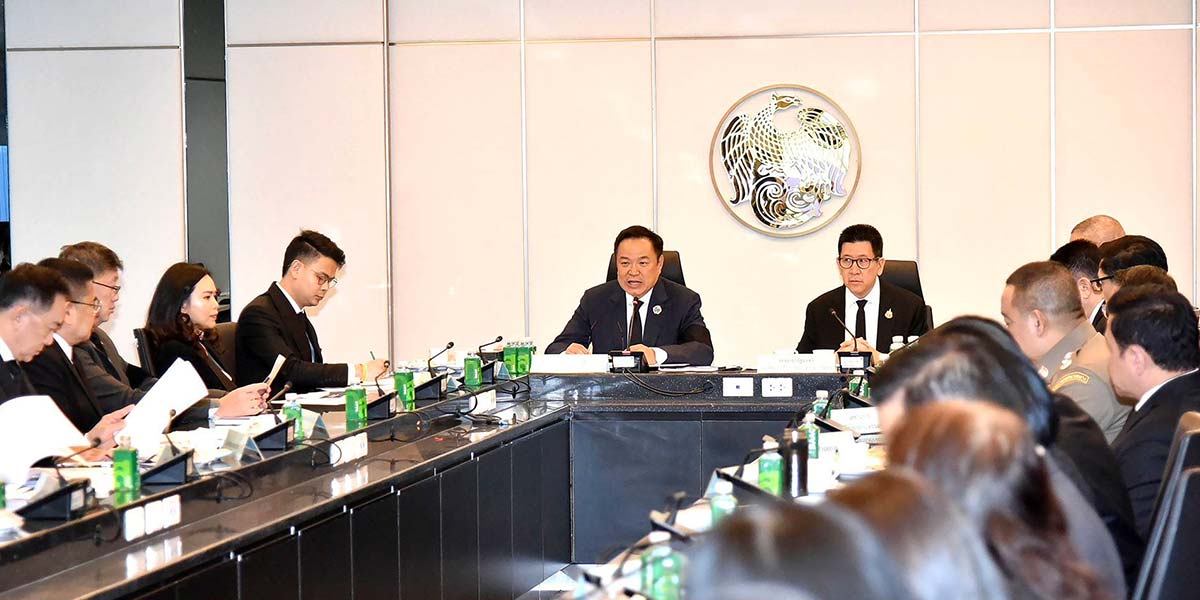
On January 9, Anutin Charnvirakul, Thailand’s Prime Minister and Minister of Interior, presided over a financial data integration meeting to enhance the monitoring and scrutiny of suspicious financial transactions under the “Data Bureau” concept, joined by Ekniti Nitithanprapas, Deputy Prime Minister and Minister of Finance.
The meeting emphasized the importance of effective financial data integration to upgrade the Central Fraud Registry (CFR) as a central hub for the comprehensive linkage of financial transaction data. In the first phase, the relevant agencies must improve the completeness of their transaction databases and connect them to the Data Hub, such as the CFR system, to enhance the tracking and scrutiny of financial transaction routes.
Furthermore, the meeting noted that certain financial intermediaries are involved not only with cash transactions but also with other assets, both regulated and unregulated, such as gold transactions. At present, there are limitations in gathering data on individual transactions, so it is necessary to upgrade operations in the second phase to ensure the Data Bureau system operates effectively and achieves its goals swiftly.
Key directives given by the meeting for relevant agencies are as follows:
1. Physical Gold Transactions.
AMLO is designated as the central agency for gathering data on physical gold transactions, as it sets regulations and anti-money laundering measures for gold traders. They are also tasked to consider further tightening these measures – for example, by lowering the transaction reporting threshold from the current THB 2 million and possibly implementing a step-down approach.
2. Online Gold Transactions
The meeting recommended revising the Ministry of Finance’s announcement on foreign exchange control to enforce that gold trading without actual gold delivery must comply with established criteria and conditions.
The Revenue Department was also tasked to consider creating a special account, requiring online gold trading providers to submit transaction information, and to explore the possibility of setting a specific business tax for such operators in cooperation with the Bank of Thailand.
3. Digital Assets
The SEC is asked to consider applying the Travel Rule principle to require all digital asset service providers to collect transaction data for trades between digital wallets created on their platforms, enabling the tracing of both senders and recipients.
Anutin said that the ultimate goal of collecting financial transaction data is to have complete, high-quality data with a robust security system, due to today’s high cyber-attack risks. All information must be interconnected to enable efficient and timely tracking and investigation of activities and transaction paths, as well as for setting criteria for risk profiling and assigning transaction limits according to risk levels.
He also called for an integrated and unified approach among all agencies to serve as a crucial mechanism in preventing and addressing technology-related crime and money laundering.
These measures are expected to enhance the efficiency of the country’s financial system and strengthen international confidence in Thailand.