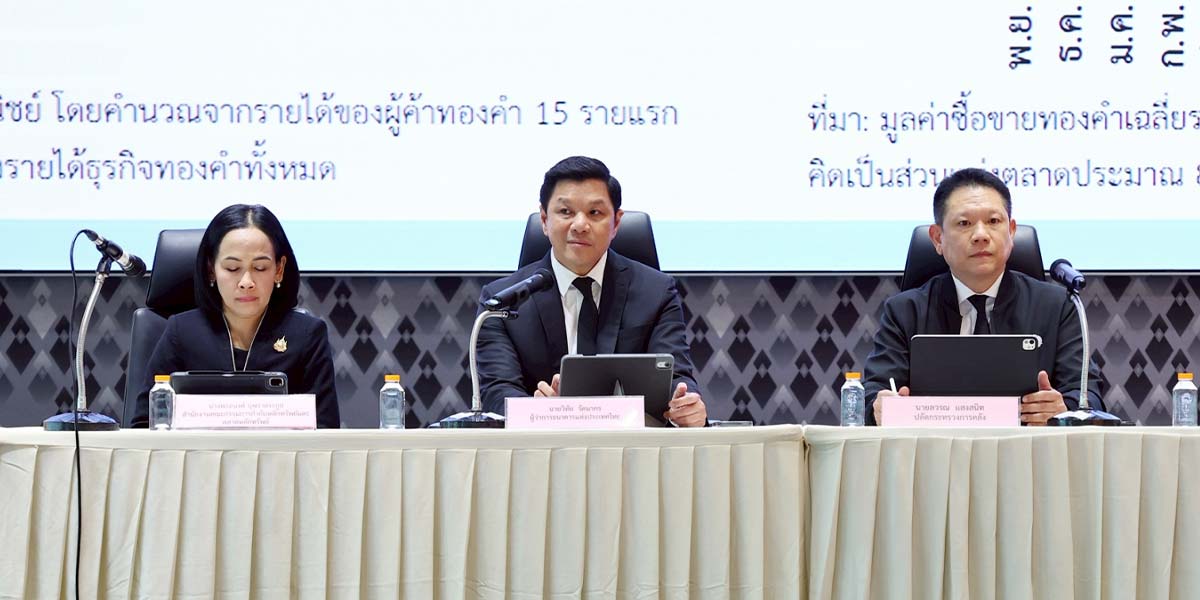
On Tuesday, Lavaron Sangsnit, Permanent Secretary, Ministry of Finance, together with Vitai Ratanakorn, Governor of the Bank of Thailand (BOT), and Pornanong Busaratragoon, Secretary-General, Securities and Exchange Commission (SEC), held a joint press conference on the widely discussed issue of the appreciating Thai baht, which is approaching a threshold of THB 31 per US dollar.
The meeting resolved to implement three key measures:
1. The Revenue Department will determine guidelines for online gold trading platform providers, requiring them to report and submit transaction data to the Revenue Department, similar to other online goods trading.
2. The Revenue Department will consider the appropriateness of imposing a specific business tax on gold trading businesses operating through online platforms.
3. The BOT will consider supervisory measures on the volume of gold trading transactions via online platforms at an appropriate level, such as a cap or transaction limit.
Lavaron stated that if online gold trading is a factor contributing to Thai baht volatility, these three measures can help address the issue.
Vitai disclosed that the baht has appreciated by 9.4% year-to-date, ranking among the strongest currencies in the region, just behind the Malaysian ringgit which appreciated by 9.5%. Most of the baht’s appreciation occurred in December, increasing by 4.2%, which is considered rapid and does not align with the prevailing economic fundamentals or data.
Additionally, the inflow of foreign currency into the country, especially the US dollar exchanged into baht, is another factor driving the baht’s strength. Previously, this was conducted under a more liberalized framework.
Moving forward, the BOT will introduce new regulations requiring financial institutions to tighten document scrutiny for money inflow, especially for significant amounts. Furthermore, the source and purpose of funds must be clearly verified as a preventive measure.
The three guidelines are expected to be implemented within two weeks.