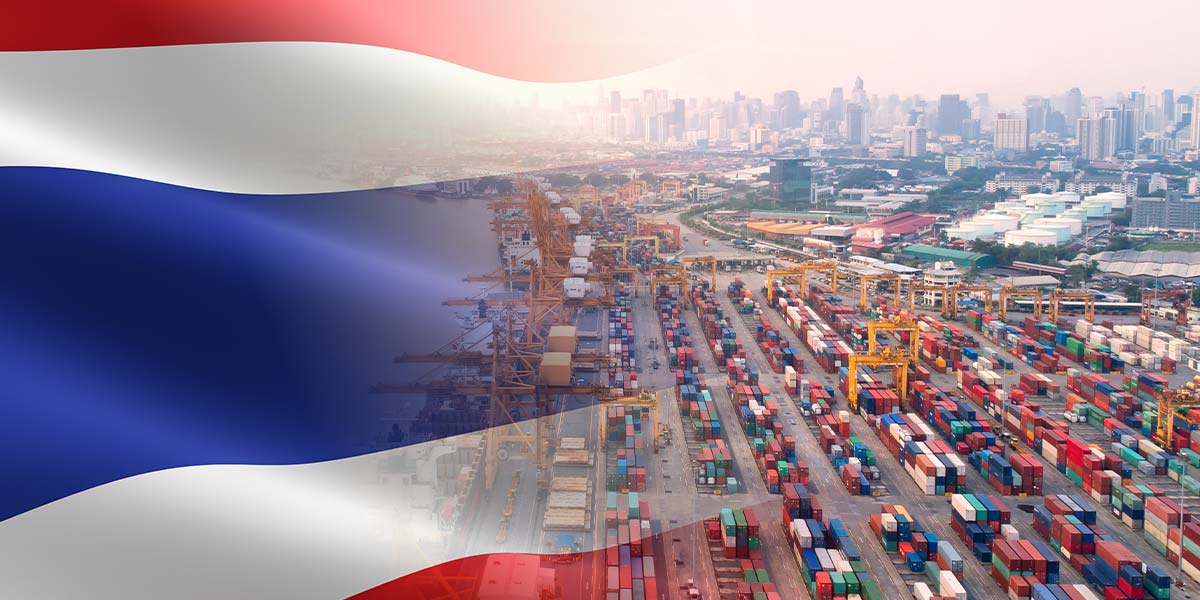
SCB EIC stated that Thai exports in 2025 expanded by a significant 12.9%, reaching a value of $339.64 billion, marking the highest growth rate in four years despite challenges from U.S. tariff measures. The key drivers included exports to the U.S. market, electronics products benefiting from an upward global cycle, and a rebound in gold exports. However, export growth in 2026 is projected to slow considerably, with the full impact of U.S. tariffs taking effect, coupled with an already high base.
In December 2025, the value of Thai exports stood at $28.84 billion, growing by 16.8% year-on-year, accelerating from November’s 7.1% and beating market expectations. The analyst firm had forecasted 10.5%, while the Reuters Poll median was 8.7%. Seasonally adjusted figures showed a return to 6.9% growth after two consecutive months of contraction.
Thailand’s exports to the U.S. in December 2025 surged by 54.3%, up from 37.9% in November, even as many products were subject to increased tariffs. Excluding electronics, which are still exempted, exports to the U.S. grew by 21.7%, reflecting sustained strong U.S. demand for Thai goods.
Structurally, 13 out of 15 of Thailand’s major export items to the U.S. posted solid growth, particularly electronics and electrical appliances such as computers and components, telephones and communication equipment, transformers, machinery, and air conditioners, which grew at rates of 123%, 117.3%, 86.6%, 48.4%, and 46.5% respectively.
Electronics exports remain a key driver, expanding by 52.8% in December, accelerating from 46.2% in November and 38.8% in October, and marking the 21st consecutive month of growth. This aligns with the upward global cycle of electronics, boosted by demand related to AI technology and investments in the electronics and Data Center industry globally.
By market, 13 out of 15 of Thailand’s main export destinations for electronics showed growth, with 10 markets expanding more than 15%, especially the U.S., Mexico, and India, with growth rates of 114.2%, 122.8%, and 152.6% respectively.
Exports of unwrought gold rebounded with 163.6% growth after sharp contractions over the previous two months, partly driven by global gold prices rising in December.
Imports in December 2025 amounted to $29.28 billion, up 18.8% and accelerating further, surpassing analyst expectations. Thailand recorded a trade deficit for the third consecutive month, though the deficit shrank to $352 million from $2.73 billion the previous month.
The strong import growth was led by vehicles and transport equipment, capital goods, and consumer goods. Imports of raw materials and intermediate goods, especially those related to the electronics industry, also grew robustly, reflecting the integration of Thailand’s export sector with the global supply chain, particularly its dependence on imports from China and Taiwan.
For the full year 2025, Thailand’s imports expanded by 12.9%, equal to the export growth rate, resulting in a trade deficit of $5.31 billion—the biggest in three years—indicating that strong export growth may provide only limited net value added to the Thai economy.
SCB EIC projects Thailand’s exports in 2026 will sharply slow down, contracting by about 1.5%, due to the impact of U.S. tariff measures under the Trump administration that begin to take full effect, the fading of front-loading effects, an expected strengthening of the baht, and the high export base in 2025.
However, some positive supporting factors remain, such as better-than-expected global trade volume, strong investment in digital and AI, and continued demand for gold as a safe-haven asset amid rising geopolitical risks, all of which might help cushion the slowdown in Thai exports from being worse than estimated.