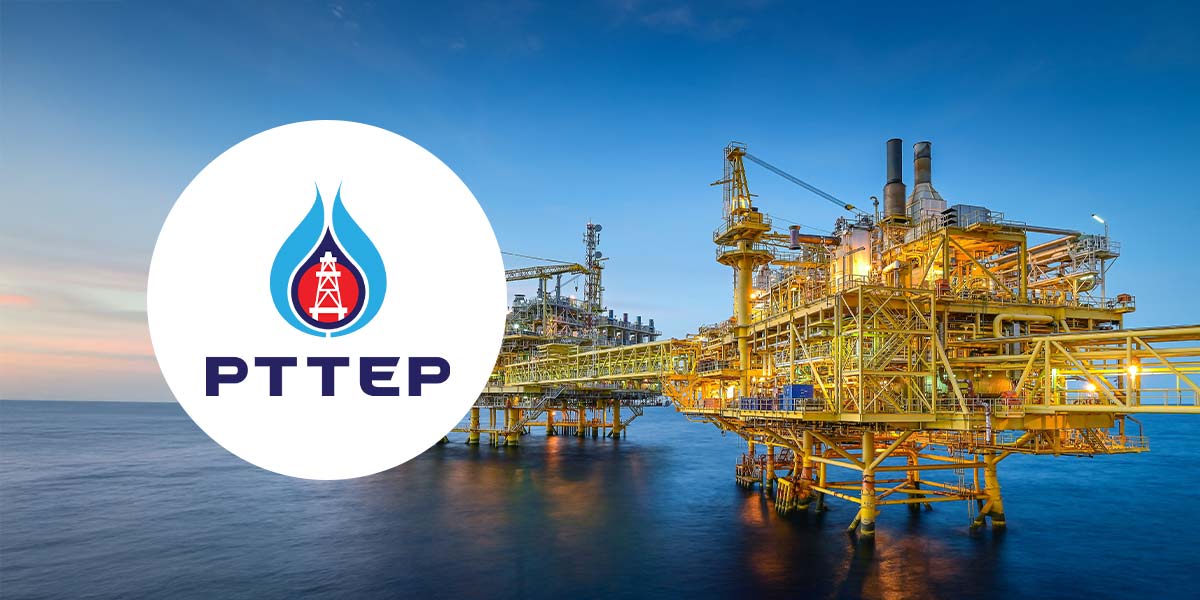
Mr. Montri Rawanchaikul, Director and Chief Executive Officer of PTT Exploration and Production Public Company Limited (SET: PTTEP), told “Kaohoon” regarding strategic direction and energy transition trends during the structural transition from domestic growth to a focus on international production expansion.
He stated that, over the next five years, PTTEP’s production increase will primarily stem from already-discovered projects (Organic Growth) overseas, particularly in Malaysia (Lang Lebah Cluster Project), the United Arab Emirates (Ghasha Project), and Algeria (Phase 2).
Currently, PTTEP’s total production volume is approximately 700,000 barrels of oil equivalent per day, with sales at about 500,000 barrels of oil equivalent per day.
Production in Thailand, especially G1/61 (Erawan Field) and G2/61 (Bongkot Field) in the Gulf of Thailand, will focus on maintaining production levels under a 10-year Production Sharing Contract (PSC), even though costs are likely to rise due to an increased number of production wells.
However, the country’s structural risks remain at the S1 source (Thailand’s largest onshore crude oil production) and the Sinphuhorm field, both of which will see concessions expire in 2031. If concession extensions cannot be secured, this may significantly impact national energy security.
Strategically, PTTEP reiterates that natural gas is “destination energy,” not just a “transition energy,” especially when combined with carbon capture and storage (CCS) technology, which can elevate natural gas to become a clean and stable energy source in the long run.
Currently, hydrogen is not commercially competitive as costs are six times higher than conventional fuels, while solar energy remains limited by scale and consistency, making it unsuitable as the main energy source presently.
The CCS project is considered the core of the Net Zero strategy. PTTEP is moving forward with a pilot project at the Arthit field, aiming to store around 1 million tons of carbon dioxide per year by 2028 to prove technical feasibility in the Thai context.
At the same time, the upper Gulf of Thailand area has high potential for large-scale carbon storage. If commercial development is achieved, it could become a key mechanism to help Thailand achieve greenhouse gas reduction targets of approximately 60 million tons.
However, the success of CCS depends on establishing an effective carbon credit market. Currently, Thailand lacks both a binding legal liability and sufficient economic incentives, resulting in a very low carbon credit price compared to the European market.
As for the consensus target price of PTTEP, it stands at around THB 126–137 per share, with most brokers maintaining a “Buy” or “Speculative Buy” recommendation, benefitting from the strong 4Q25 earnings outlook and attractive dividend.
InnovestX Securities estimates that PTTEP will achieve its highest quarterly profit of the year in 4Q25, supported by several special profit items, including oil hedging, positive foreign exchange effects, and profits from the acquisition of the Touat project in Algeria.
Core profit is expected to recover from 3Q25, in line with increased sales volume. Although the average selling price is likely to soften, the decline should be less than the average market oil price, reflecting effective price management.
Furthermore, PTTEP remains outstanding in production cost control, maintaining profitability despite volatile oil prices. This ensures the company’s potential to maintain regular dividend payments, with a forecasted dividend of THB 8 per share in 2025 (yielding about 7%) and a similar level expected for 2026 at around THB 8 per share.