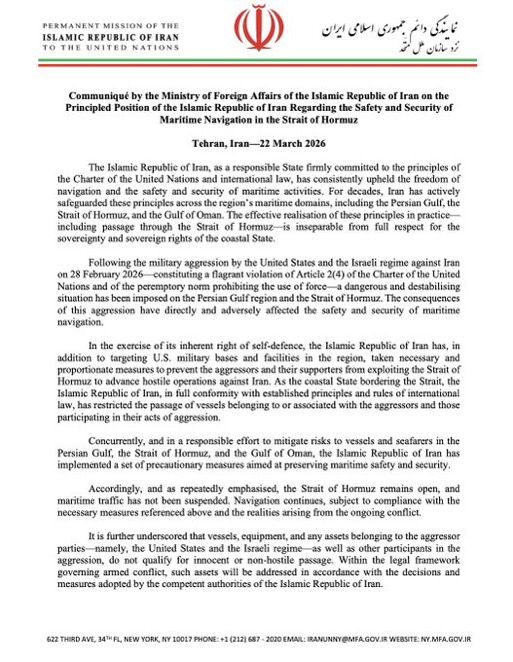
Iran’s Ministry of Foreign Affairs has issued a formal communiqué outlining the conditions under which vessels may transit the Strait of Hormuz, one of the world’s most critical maritime chokepoints, through which roughly 20% of global oil trade passes.
The document, released by Iran’s Permanent Mission to the United Nations, states that the Islamic Republic has taken “necessary and proportionate measures” to restrict passage of vessels belonging to or associated with what it terms “aggressors” — specifically the United States and Israel — following what it describes as a military attack against Iran on February 28, 2026, which it characterizes as a violation of Article 2(4) of the UN Charter.
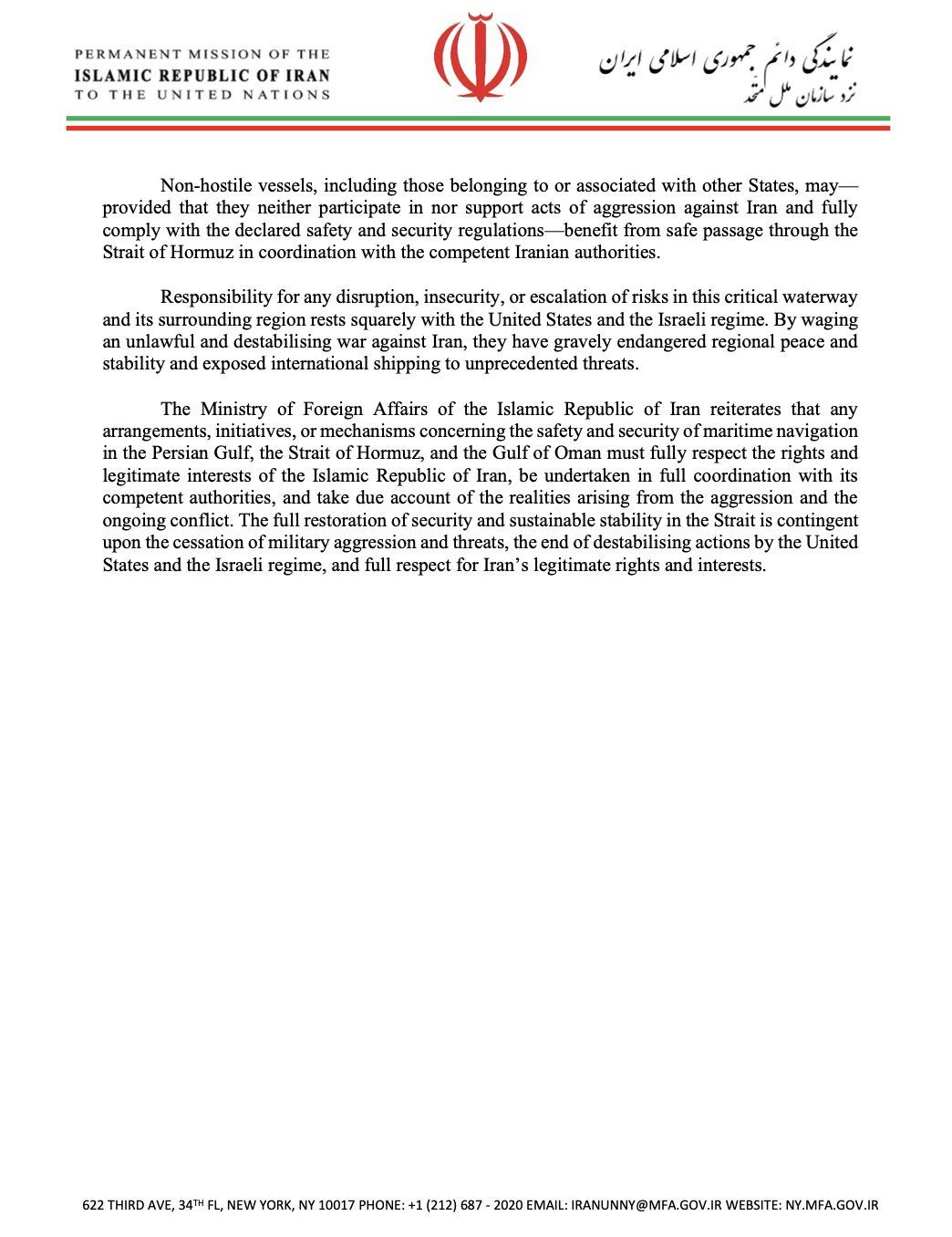
Crucially, the communiqué draws a distinction between hostile and non-hostile vessels. Ships neither participating in nor supporting aggression against Iran, and fully compliant with Iranian safety and security regulations, may benefit from safe passage — but only in coordination with Iranian authorities. This effectively places Tehran as the arbiter of who qualifies as “non-hostile.”
Iran squarely attributes responsibility for any regional instability to Washington and Tel Aviv, accusing them of “waging an unlawful and destabilising war” that has endangered international shipping. The document insists that any maritime security framework for the Persian Gulf, the Strait of Hormuz, and the Gulf of Oman must respect Iran’s sovereign rights and be coordinated with its authorities.
The statement stops short of announcing a full blockade, emphasizing that the Strait “remains open.” However, the conditions imposed grant Iranian forces broad discretionary authority over vessel passage — a development likely to unsettle global energy markets and draw sharp responses from Western naval powers already operating in the region.