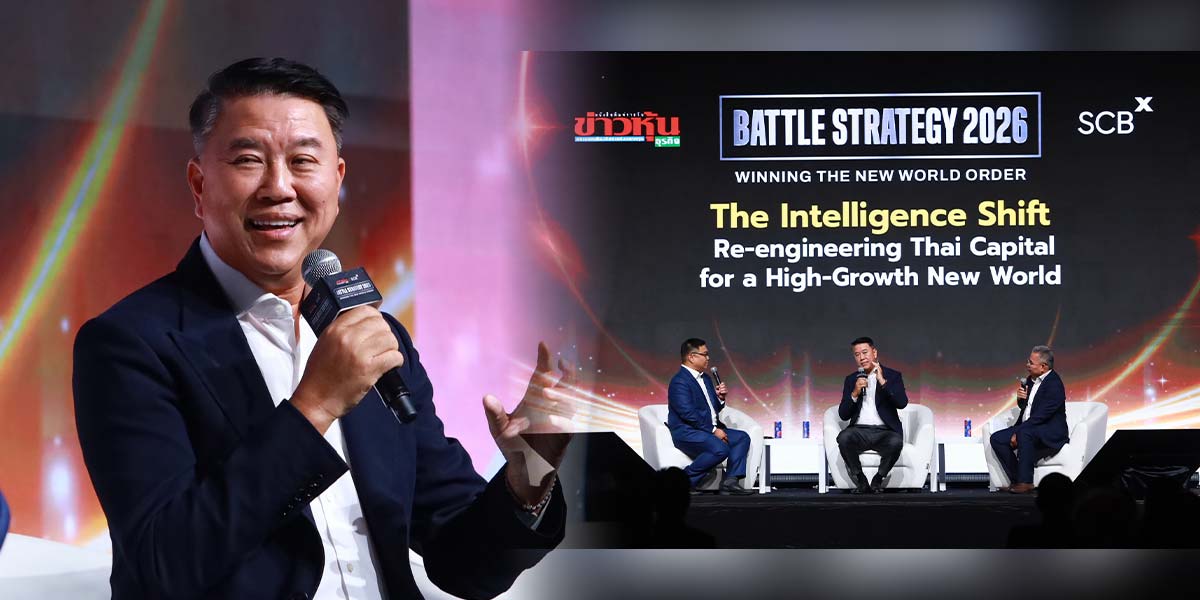
At the “Battle Strategy 2026: Winning the New World Order” forum, Mr. Arthid Nanthawithaya, CEO of SCB X Public Company Limited (SET: SCB), described the current global environment as entering a period of enduring volatility. He warned that disruptions are becoming more severe, with recovery periods now shorter than in the past.
Mr. Arthid emphasized that both businesses and the nation must confront whether the future will remain the same as previous decades. If the answer is no, he cautioned, clinging to old strategies without adaptation will erode competitiveness.
He highlighted that, for SCB X, experience from the past five years has demonstrated the importance of managing core, profit-generating businesses as stable revenue sources while simultaneously developing new lines of business or the new ‘S-curve’ to capture future growth. This approach, he said, is not only relevant for the financial sector but also for the wider Thai economy, which needs to maintain existing strengths like tourism, exports, and manufacturing, while actively fostering new growth sectors.
Thailand’s main obstacle is not a lack of vision or strategy, but challenges implementing those strategies—especially systemic barriers that have slowed necessary changes.
Looking ahead, Mr. Arthid expressed concern that targeting 3% GDP growth may not be sufficient if it does not stem from structural improvements and sustainable industries. He argued for a shift toward high-quality economic expansion focused on sectors with strong long-term prospects, such as finance, digital technology and AI, health and wellness, food, and green energy. However, he stressed the need for clear metrics and careful selection of areas where Thailand is most prepared to compete.
Mr. Arthid also said that, to attract both domestic and foreign investment, Thailand must position itself as a reliable and trusted platform, capable of articulating how new investment will provide tangible benefits for the country and its citizens.
Within the corporate sector, Mr. Arthid advised companies not to hastily discard their traditional businesses if they remain important sources of revenue. Instead, he recommended maintaining their strengths while deploying resources to experiment with new ventures that are agile, capital-light, and technology-based.
The CEO pointed out that rapid experimentation and a willingness to promptly accept failure are now critical competitive factors. Organizations resistant to change or unable to “cut losses” where necessary risk falling behind.
With regard to the Thai capital markets, Mr. Arthid cautioned that apparent signs of recovery could be misleading if underlying economic fundamentals remain unchanged. He concluded by stressing that Thailand has limited options but to urgently rebuild confidence, address persistent bottlenecks, and ensure real progress on reforms—enabling private sector and investor participation in driving forward economic growth.