Mr. Siripong Angkasakulkiat, Thailand’s Deputy Minister of Transport, has provided an update on the progress of the joint rail ticketing system aimed at easing the financial burden of daily commuters. The Ministry of Transport is currently preparing to propose a joint ticketing scheme, which would set the fare at a range of THB 17-45, gathering opinions from various state agencies on the draft before including it in the Cabinet’s agenda for consideration.
A key aspect of this proposal is to establish a fare cap, whereby passengers will pay an initial fare beginning at THB 17 and not exceeding THB 45. This entrance fee will be applied only once for each journey.
At the same time, the plan requires the Bangkok Metropolitan Administration (BMA) to transfer the debt obligations and assets related to its two rail lines—the Green Line and Gold Line—which are not yet integrated into the joint system, to the Mass Rapid Transit Authority of Thailand (MRTA). This transfer would bring these lines under single operational ownership and facilitate the integration process.
This policy is part of a broader reform of the mass transit system in Bangkok and its surrounding metropolitan area and is designed to fix long-standing problems of overlapping fares among multiple service providers, which have been a major complaint from the public for years.
Mr. Siripong further elaborated that the plan would also assign the Ministry of Finance to select an existing agency to serve as a centralized clearing house to manage revenue, thereby reducing costs without establishing a new organization. This initiative aims to allow commuters to use a single card or application to travel on all rail systems, including current lines and future extensions and connections.
Another central issue under review is the potential buyback of certain private rail concessions for routes where contracts still have several decades remaining. Mr. Siripong explained that for concessions nearing expiration, the government will allow the contracts to end as scheduled without allocating extra budget to repurchase them. However, where lengthy concessions pose obstacles to fare unification, the government may need to consider fundraising to buy back these management rights from the private sector.
Currently under study are several funding options, including using the Thailand Future Fund (TFFIF), issuing bonds through the MRTA, and adopting public-private partnership models for infrastructure investment. This is to ensure that project management does not add to the country’s long-term public debt.
The Ministry of Transport recognizes that complexity in the fare structure and management of the current system results from multiple state and private entities owning key infrastructure and holding concessions. This fragmentation leads to duplicated entry fees for passengers transferring between lines, causing average expenses per trip to exceed rates in comparable Asian cities, despite similar travel distances. Centralizing rail management under the MRTA is viewed as a critical measure to establish a fair, transparent fare benchmark and support further network expansion.
Attention has also focused on the significant outstanding debt attached to the Green and Gold Lines, which would be transferred to MRTA as part of the reform package. Resolving this debt, which totals tens of billions of baht, remains a point of discussion between public and private stakeholders. Successfully restructuring these finances could be the key to implementing the joint fare system and resolving a long-standing impasse.
The Ministry of Transport targets full-scale implementation of the joint ticketing regime by 2027. Once in place, commuters will benefit from seamless travel across interconnected lines, with payments made through a single system and a clearly defined, equitable fare cap.
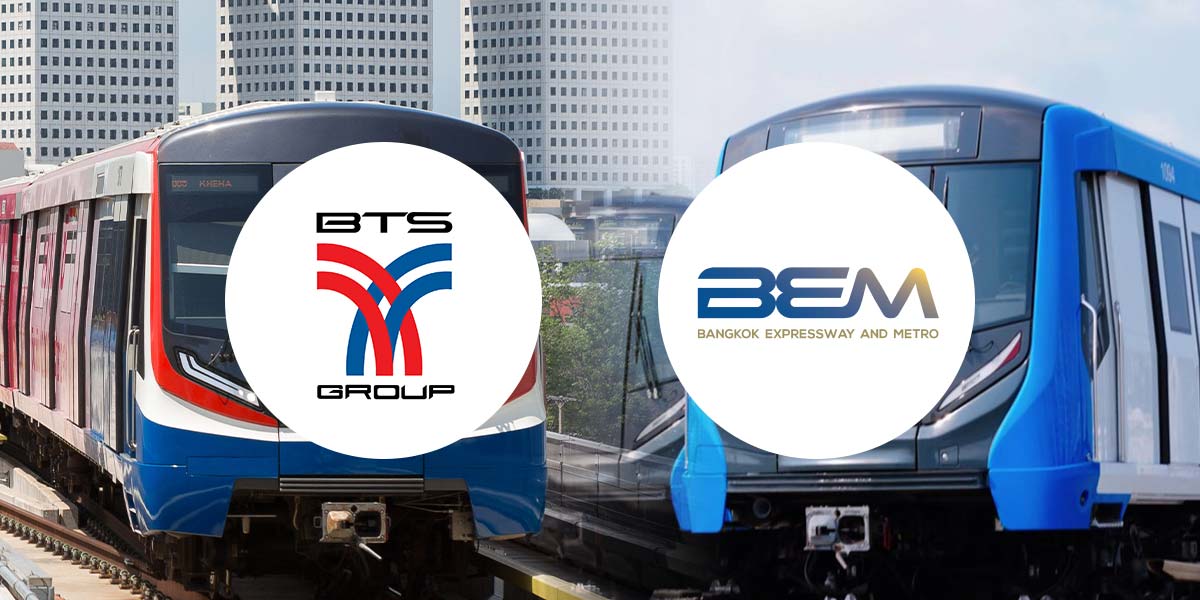
Mr. Surapong Laoha-Unya, Chief Officer of MOVE Business, BTS Group Holdings Public Company Limited (SET: BTS), also commented on the government’s plan to establish a fund dedicated to buying back rail concessions from the private sector. The administration is particularly focused on lines with long remaining concession periods, such as the Pink and Yellow lines (operated by BTS), and the Blue and Orange lines (operated by BEM).
Conversely, the Green Line is not prioritized for buyback due to the concession expiring in approximately three years. Should the government proceed with a buyback for this route, compensation must be paid to the BTS Rail Mass Transit Growth Infrastructure Fund (BTSGIF), with BTS receiving only a one-third share in its capacity as a shareholder.
Preliminary reviews indicate that the Pink and Yellow lines have 28 years left on their concessions, the Blue Line has more than 20 years, and the Orange Line—despite not yet being operational—has a similar remaining term. The government wants to see the joint ticketing system launched by 2027, necessitating that any buyback or fundraising efforts be completed ahead of this target. The policy is currently being prepared for submission to the Cabinet for approval in principle.
For financing, the government will need to utilize options such as the TFFIF or other mechanisms for sourcing capital to facilitate these buybacks. Reacquiring the concessions is vital to enable the government to unify fare control and management across the rail network, in keeping with the strategic vision for mass transit.
Following these, brokerage firms are weighing the potential impact on listed operators. Maybank Securities (Thailand) (MST) has set a strategic price target for BEM at THB 7.20 per share, seeing positive catalysts in the shift away from a flat 40-baht fare scheme to the proposed capped structure. BEM further enjoys approximately THB 0.8 per share in upside, thanks to ongoing negotiations related to a double-deck expressway project, with updates expected by August.
Krungsri Securities (KSS) notes that if the Cabinet approves the proposed fare band of THB 17-45, this will likely have positive implications for BEM and BTS, key rail network operators. The analyst recommends ‘Buy’ ratings for both stocks, citing undervaluation relative to present fundamentals, with target prices set at THB 8.20 for BEM and THB 4.00 for BTS, respectively.