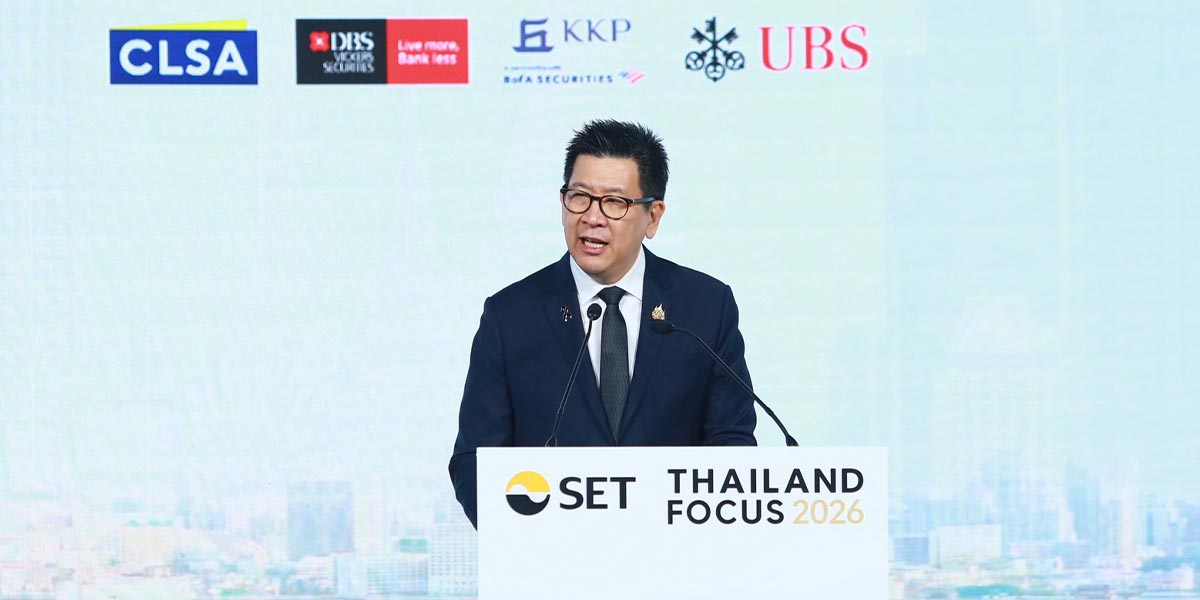
At the highly anticipated ‘Thailand Focus 2026’ conference, Deputy Prime Minister and Finance Minister Dr. Ekniti Nitithanprapas laid out an ambitious roadmap to reignite the Thai economy and safeguard it against mounting global uncertainties. He reaffirmed the government’s commitment, presenting a forward-looking, three-horizon framework: Stabilize Today, Transition Now, and Invest for Tomorrow.
Addressing a gathering of stakeholders at the Stock Exchange of Thailand (SET), Dr. Ekniti placed the global context front and center. He highlighted that Thailand, like other economies, is being reshaped by a convergence of three major global mega-shifts: rising geo-economic tensions, the business overhaul brought by artificial intelligence and digital technologies, and the growing imperative for energy transition and climate action.
These changes, he emphasized, present both significant challenges—such as Thailand’s dependency on imported energy and a shrinking working-age population—and burgeoning opportunities for investment-led renewal.
The scale of recent investment interest underscores this dual reality. In the first half of 2026, foreign direct investment requests submitted to the Board of Investment surged nearly 37% year-on-year, equaling approximately THB 1.47 trillion ($45 billion). Realized investment topped THB 500 billion, marking a 30% increase, while domestic private investment also achieved robust double-digit quarterly growth. The government has targeted a bold rise in the investment-to-GDP ratio from 23% to 30% within four years, along with maintaining public debt below 70% of GDP.
The three-horizon strategy lays out specific actions on each front. In the short-term, the government has pivoted away from blanket fuel subsidies, instead introducing targeted cash supports to cushion vulnerable households against energy-driven inflation. Programs like ‘Thai Chuay Thai Plus’ aim to boost productivity and resilience among small businesses.
For the medium term, the central plank is the $12 billion borrowing decree, partly intended to accelerate the buildout of renewable infrastructure, cleaner transport, and homegrown green industries, while regulatory reforms will allow private investment to drive more of Thailand’s power system.
Looking further ahead, building national capability is emphasized. The ‘Thailand Fast Pass’ streamlines FDI approvals, while new ‘Skillbridge’ partnerships are designed to upgrade Thai workforce skills in critical sectors such as AI, semiconductors, and electric vehicles. A parallel program encourages domestic industry upgrades and envisions more infrastructure funds listed on the SET to finance transformational projects.
Dr. Ekniti likened the plan to a football team—where the private sector leads the attack, the public-private committee serves as midfield coordinator, and disciplined government finance forms the defense. Ultimately, he stressed, Thailand’s goal is not just to attract capital, but to convert global investment into deep local capability and resilience.
As the nation gears up to host the IMF–World Bank Group Annual Meetings later this year, the message from the government is clear: Thailand is determined to capture the moment, drive structural change, and set the stage for sustainable, broad-based growth.