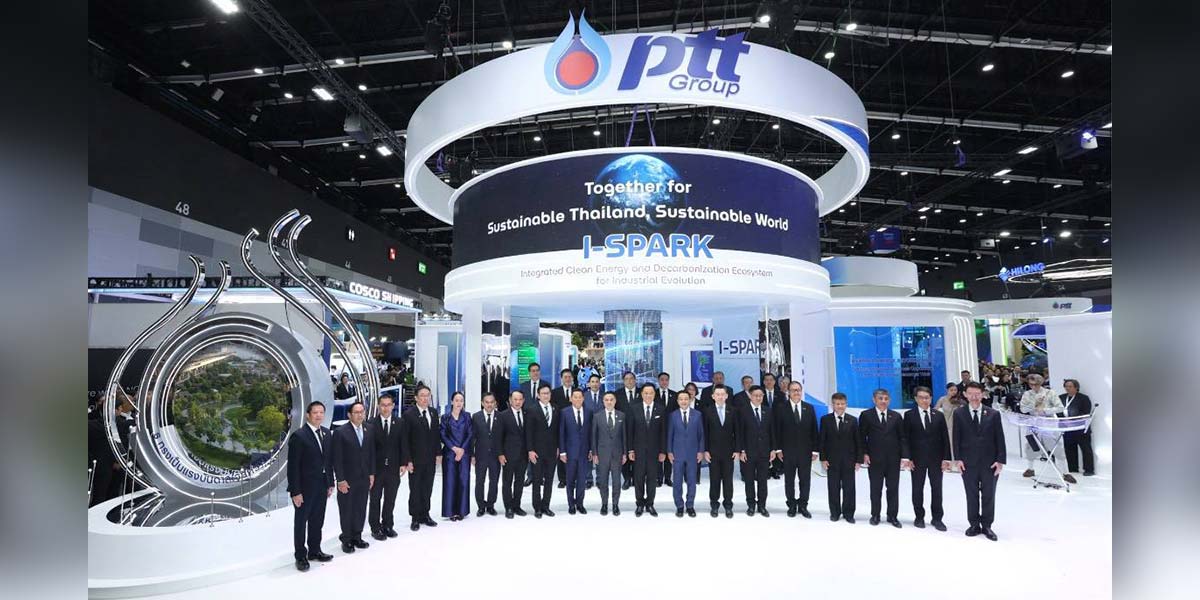
Senior executives from PTT Group, led by CEO Dr. Kongkrapan Intarajang, are taking center stage at Gastech 2026, sharing their expertise and strategic views on natural gas, LNG, energy security and sustainability with global energy leaders, underscoring the Thai energy giant’s growing role in international energy discussions while showcasing Thailand’s capabilities on the world stage.
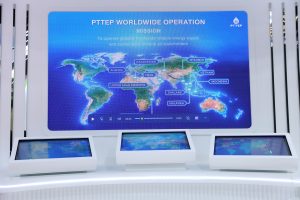
As co-host of Gastech 2026, PTT is presenting its integrated energy capabilities across the value chain, from upstream exploration and production and natural gas supply to pipeline infrastructure, LNG terminals and international trading.
The participation of multiple PTT Group executives as speakers at the global energy forum reflects the group’s expertise in navigating the increasingly complex energy landscape and its role in advancing Thailand’s position as a regional energy cooperation and connectivity hub.
This year’s edition is significant in its own right. It is the first time Gastech has returned to Thailand since 2008, with a record of tens of thousands of energy professionals, well over a thousand exhibitors, and more than a thousand speakers from some 150 countries — underscoring Bangkok’s growing importance as a hub for regional energy dialogue.
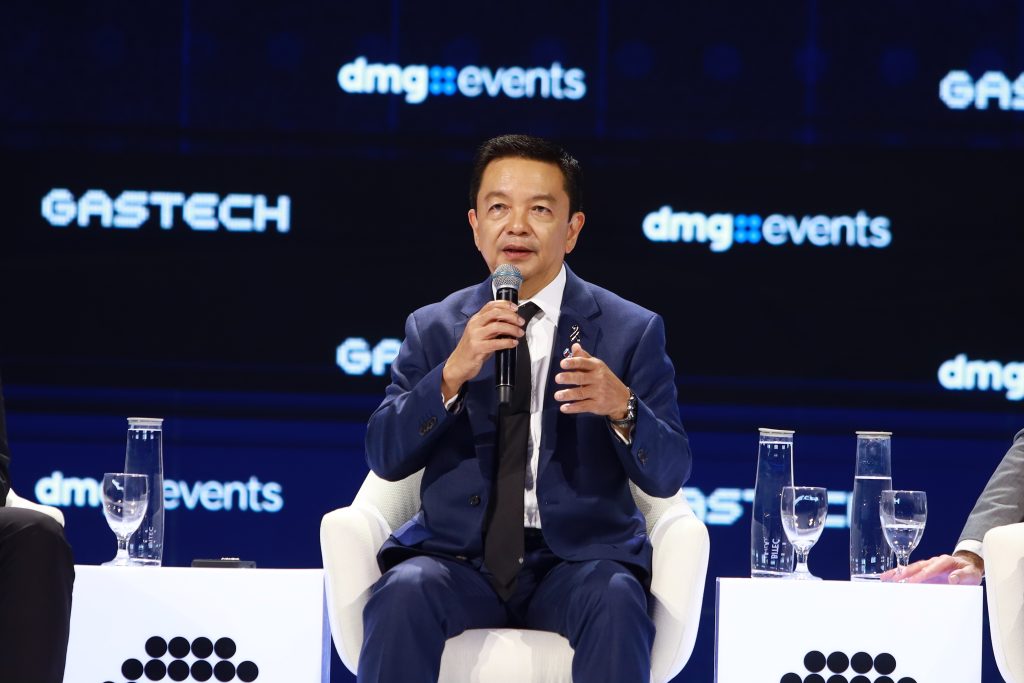
Natural Gas as the Backbone of Energy Security
A central thread running through PTT’s presence at Gastech was the role of natural gas — both pipeline gas and LNG — in keeping Thailand’s energy supply sufficient and reliable. PTT executives walked through the group’s role across the full value chain: exploration and production, supply and trading, and the pipeline networks and LNG receiving terminals that move gas from source to end user. A recurring theme was the importance of diversifying supply sources and actively managing PTT’s portfolio of contracts to absorb market volatility rather than being exposed to it.
On the trading side, PTT has set out plans to grow its global LNG trading business substantially over the coming decade, targeting roughly 10 million tonnes by 2030 and 15 million tonnes by 2035 — a multiple of its current trading volumes. Executives framed this expansion as separate from, and complementary to, the LNG PTT imports to meet Thailand’s own domestic energy security needs.
Balancing Trilemma in the Energy Transition
PTT’s messaging at Gastech leaned heavily on the idea that any credible energy transition has to hold three priorities, dubbed as Trilemma, in balance at once: energy security, prices that remain affordable for households and competitive for businesses, and long-term sustainability. Rather than prescribing a single path, PTT argued that the right mix of solutions should be shaped by each country’s own context and starting point.
Within that framing, natural gas and LNG were positioned as “destination fuels” — not simply a bridge to be phased out, but a long-term partner to renewable energy that adds continuity and flexibility to power systems. That flexibility is becoming more important as electricity demand climbs, driven in part by the growth of AI computing and data centers.
Cutting Carbon While Staying Competitive
PTT also used the platform to connect its decarbonization work to industrial competitiveness. The pitch: improving energy efficiency, cutting methane emissions, and scaling up carbon capture and storage (CCS) technology do not just reduce PTT’s own footprint — they help energy-intensive industries lower their carbon exposure, support new investment, and move the country closer to its net-zero goals.
Executives pointed to concrete examples already underway, including the Arthit CCS project, the I-SPARK model area concept, and Smart Energy Management initiatives that apply IoT, data science, and AI to how energy is monitored and used. PTT was careful to draw a line between what has already been implemented, what is in active planning, and longer-range ambitions still under study.
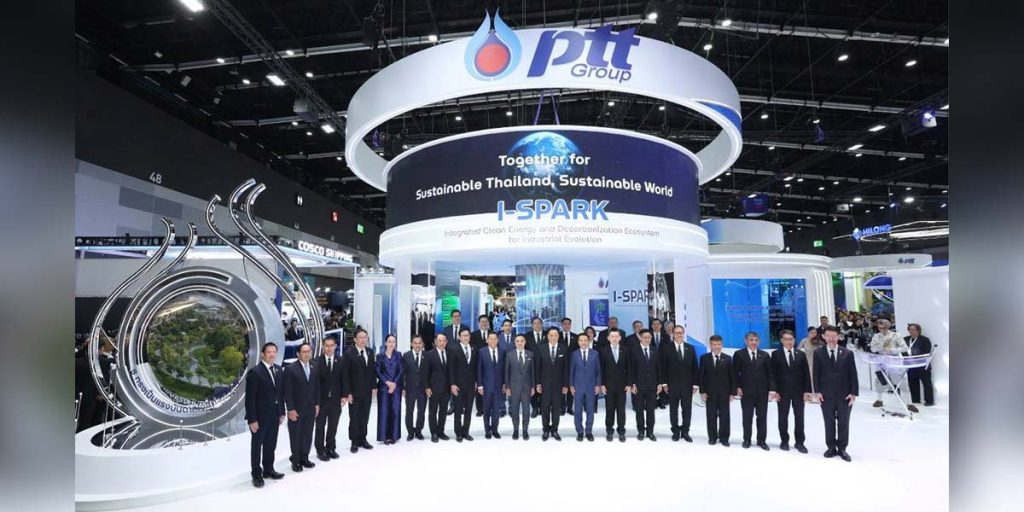
Building on Thailand’s Regional Role
Beyond the technical and commercial discussions, PTT framed Gastech as a chance to deepen cooperation with partners from around the world, drawing on the group’s capabilities across the natural gas value chain. Executives pointed to Thailand’s potential to support ASEAN energy connectivity and to serve as a regional hub for LNG trade and cooperation — a role that becomes more relevant as demand across Southeast Asia continues to grow.
Inside the Exhibition: “Flow”
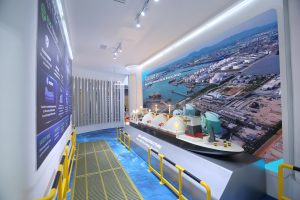
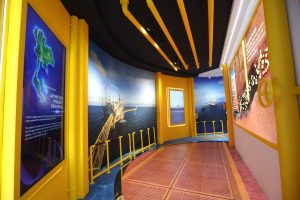
PTT Group’s exhibition at Gastech was built around the concept of “Flow” — the movement of energy, opportunity, cooperation, and sustainability that, in the group’s words, drives people, business, countries, and the world forward. Alongside displays covering energy, technology, and infrastructure across its business chain, the exhibition included accessible, human-scale examples of PTT’s work, among them a demonstration of how the cold energy released during LNG regasification is being put to use growing strawberries and other cold-climate crops — a small but tangible illustration of turning an industrial by-product into something with everyday relevance.
Looking Ahead
Taken together, PTT’s presence at Gastech 2026 was less about any single announcement and more about positioning: reinforcing the group’s credibility on the world energy stage, reaffirming natural gas’s role in a balanced transition, and advancing Thailand’s ambition to become a genuine center of regional energy cooperation and trade.