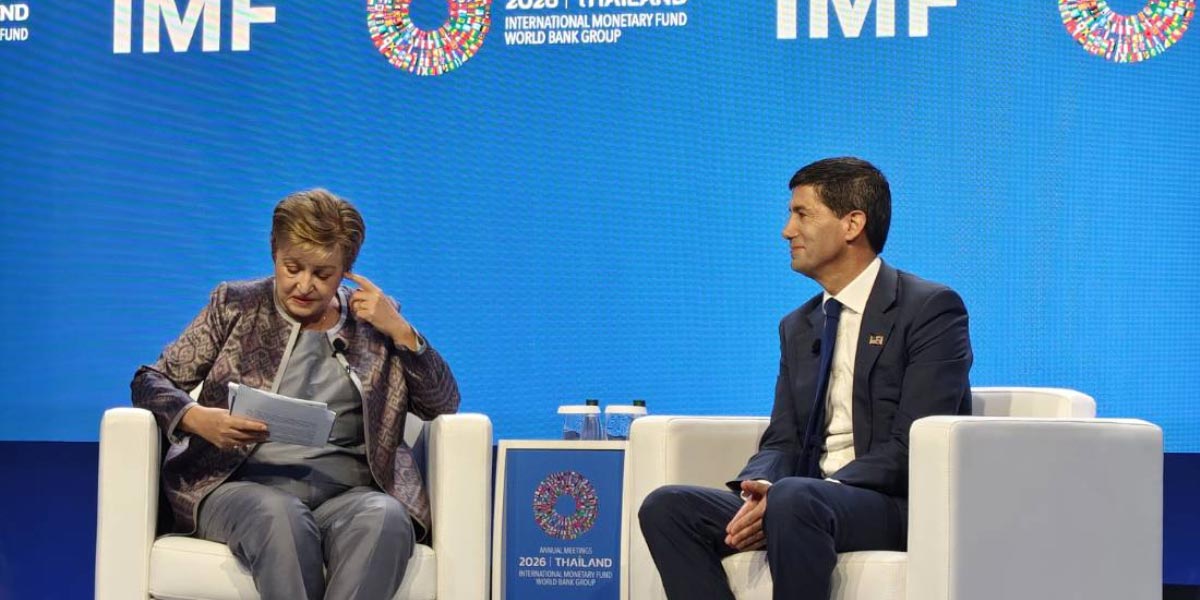
Federal Reserve Chairman Kevin Warsh described the rapid rise of artificial intelligence as the most consequential economic and technological change of his lifetime, warning central bankers that the technology will reshape both real-world macroeconomic dynamics and the internal mechanics of monetary policy decisions.
Speaking alongside IMF Managing Director Kristalina Georgieva at the IMF-World Bank Annual Meetings in Bangkok, Warsh outlined how artificial intelligence, which is now being called super intelligence, is altering traditional economic balances while offering central banks unprecedented capabilities to filter noisy data in real time.
From a macroeconomic standpoint, Warsh emphasized that central bankers must evaluate the technology through a dual lens of aggregate demand and aggregate supply. While artificial intelligence represents a fundamental positive supply shock over the medium and long term, its immediate path is generating a pronounced surge in aggregate demand as massive private sector capital flows into infrastructure, technological hardware, and corporate investment.
Warsh noted that managing this transition requires sober policy judgment, as the near-term demand expansion creates immediate price and investment pressures before the long-term supply and productivity benefits are fully realized across the broader economy.
Beyond its impact on the real economy, Warsh asserted that artificial intelligence will fundamentally transform how the Federal Reserve and other central banks conduct monetary policy. Historically, central banks have relied on “torturing data with old-fashioned models” and backward-looking official statistics to infer underlying inflation and economic trends.
Warsh envisioned a near-future operational model where central banks possess real-time global data at their fingertips, utilizing advanced analytical tools to distill vast information streams. This technological evolution will allow policymakers to “look out the window” with far greater clarity, distinguishing true, contemporaneous economic signals from lagged, noisy data subject to statistical mismeasurement.
Acknowledging that the transition to an AI-driven economy will be bumpy, Warsh highlighted ongoing uncertainties regarding future market structures, employment impacts over the next 12 to 18 months, and corporate profitability. To prepare the central bank for these structural shifts, Warsh established five external task forces, including dedicated panels on productivity and jobs as well as data collection.
The productivity task force will hold its first field hearing on November 16 in the San Francisco Bay Area to examine how new technology can enhance national productivity, with Warsh stressing that the Fed prefers adaptable analytical frameworks over rigid, mean-regressing forecasting models.