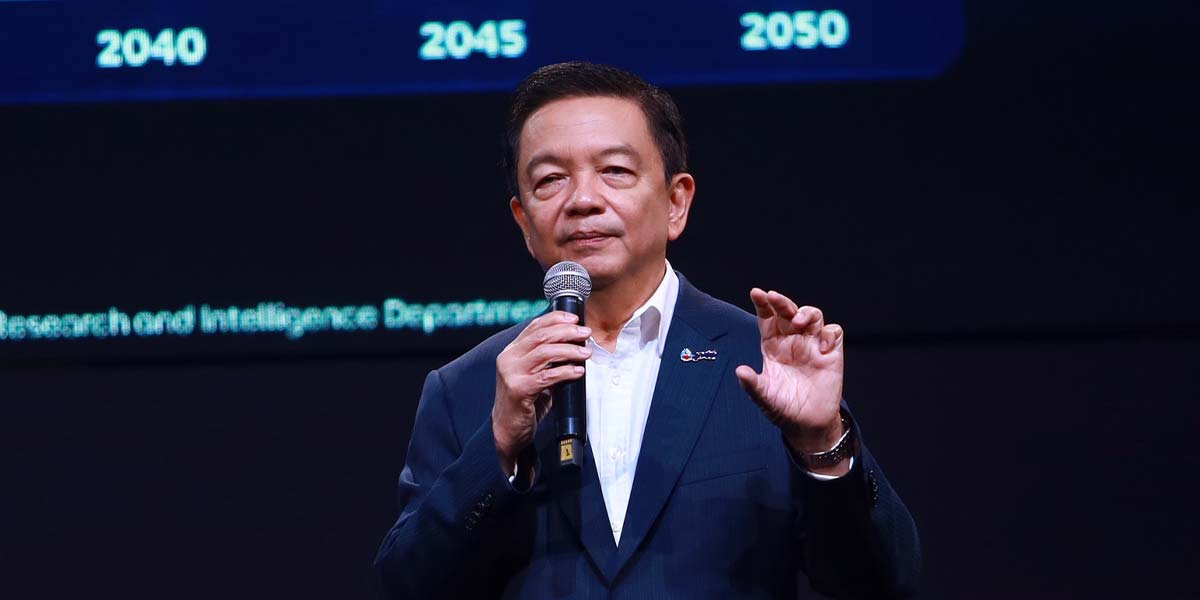
Dr. Kongkrapan Intarajang, President and CEO of PTT Public Company Limited (SET: PTT), said Thailand can turn its energy resource constraints into an economic advantage through decades of infrastructure investment, diversified energy supplies, and global partnerships.
Speaking at THE STANDARD ECONOMIC FORUM 2026 under the theme “Turning Energy Security into Thailand’s Competitive Advantage,” Kongkrapan said geopolitical tensions, including US-China rivalry, the war in Ukraine, and instability in the Middle East, have heightened volatility in global energy prices and supply chains.
Although Thailand imports nearly 90% of its crude oil requirements and relies on foreign sources for approximately 40% of its natural gas, the country has established refining capacity, gas pipelines, LNG terminals, and international trading networks that help maintain supply during crises.
He said energy policy must balance three priorities: security of supply, affordability, and sustainability. However, energy security must take precedence during crises, as shortages could disrupt industrial activity and undermine the broader economy.
Thailand currently operates two LNG terminals with combined capacity of approximately 20 million tonnes per year, while a third facility is under development. The country also sources natural gas from the Gulf of Thailand, the Thailand-Malaysia Joint Development Area, Myanmar, and international LNG markets.
Kongkrapan highlighted the importance of regional cooperation, noting that ASEAN has thousands of kilometers of gas pipelines and approximately 15 LNG terminals, enabling members to support one another during supply disruptions.
Meanwhile, PTT Group has invested more than THB111 billion over the past five years to improve refinery flexibility, strengthen operational reliability, and expand its energy trading capabilities. Its trading network in Houston, London, Singapore, and Abu Dhabi allows it to source crude oil from alternative markets when supplies are disrupted.
During the energy crisis in April, PTT reduced its reliance on Middle Eastern crude from approximately 70% to 30%, replacing supplies with crude from the United States, West Africa, and South America. This enabled Thai refineries to maintain operations near full capacity without feedstock shortages.
Kongkrapan said PTT has a dual responsibility as both a state enterprise safeguarding national energy security and a listed company generating returns for shareholders.
During the crisis, PTT Group absorbed more than THB230 billion in additional liquidity requirements, including working capital for oil and gas procurement, trading collateral, and outstanding payments from the Oil Fuel Fund. The additional financial burden increased financing costs by approximately THB600 million per month.
Looking ahead, Kongkrapan expects natural gas to remain important to the global energy mix over the next 20–30 years as renewable energy infrastructure and storage technologies continue to develop.
PTT Exploration and Production Public Company Limited (SET: PTTEP) has approved approximately THB10 billion for a carbon capture and storage (CCS) project at the Arthit gas field, targeting operations in 2028 and eventual storage capacity of up to 1 million tonnes of carbon dioxide annually.
PTT Group is also studying larger-scale CCS infrastructure in the Gulf of Thailand for 2033–2034 to support emissions reduction in hard-to-abate industries.
The group aims to achieve net-zero emissions by 2050 through a shift toward lower-carbon businesses, improved operational efficiency, and CCS technology. Kongkrapan said continued infrastructure investment, global partnerships, and effective supply management will be essential to maintaining Thailand’s energy security while supporting its transition to cleaner energy.