
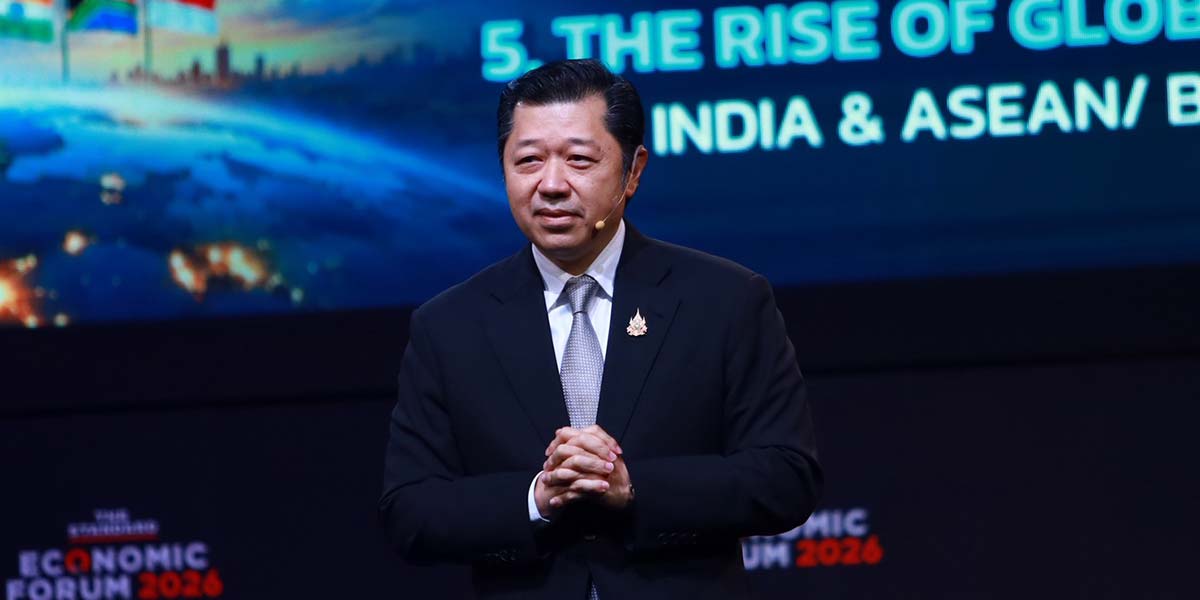
Suphachai Chearavanont, Chairman and Executive Chairman of Arise Ventures Group and Senior Vice Chairman of CP Group, has urged Thailand to accelerate economic restructuring and build a stronger investment ecosystem to improve its global competitiveness and expand its role in international supply chains, targeting annual GDP growth of 4–5%.
Speaking at THE STANDARD ECONOMIC FORUM 2026, Suphachai said the global economy was entering a new world order shaped by five major forces: geopolitical fragmentation, the rapid advancement of artificial intelligence and emerging technologies, the transition to clean energy, the expansion of the digital economy and digital currencies, and the growing influence of the Global South, including BRICS, India, and ASEAN.
He said Thailand’s strategic location at the heart of Southeast Asia offers an opportunity to become a regional economic hub, supported by five key development priorities.
The first is a New Economy Hub, attracting investment in data centers, semiconductors, cloud technology, AI, robotics, and electric vehicles while upgrading existing industries, particularly automotive manufacturing. Thailand should also help local SMEs integrate into emerging supply chains.
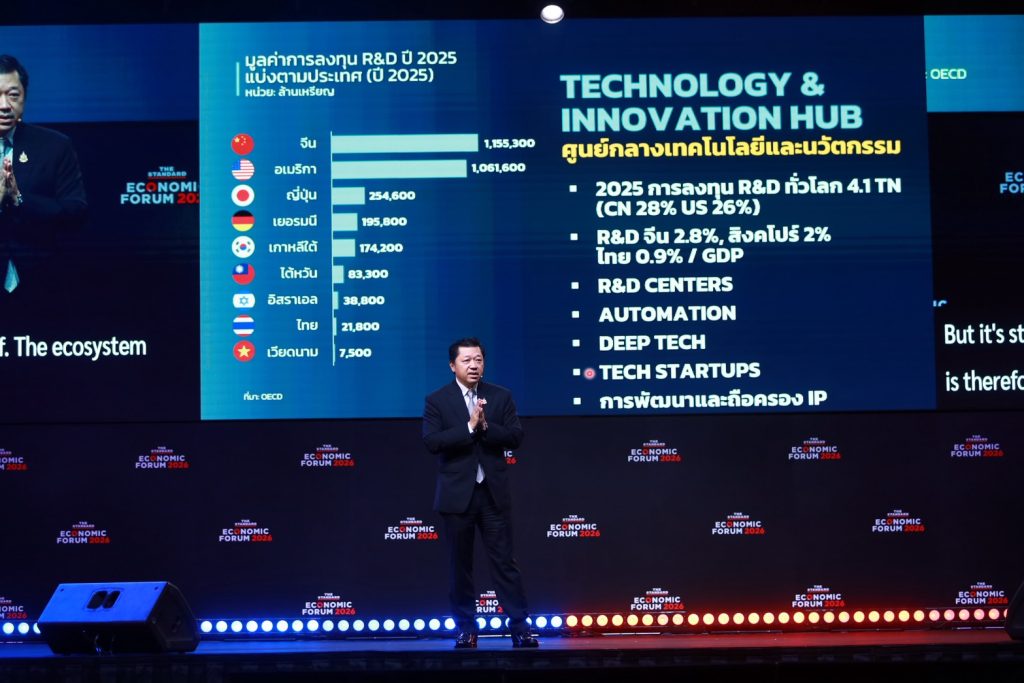
The second is a Technology and Innovation Hub, with greater investment in research and development. Thailand currently spends approximately 0.9% of GDP on R&D, compared with 2.8% in China. Suphachai called for foreign companies to establish research centers and collaborate with Thai universities, alongside tax incentives and matching funds to strengthen the startup ecosystem.
The third is a Human Capital Hub, focusing on AI skills development and technology entrepreneurship through university startups and research laboratories. Thailand has approximately 2 million university students and 500,000 graduates annually, providing a potential talent base for the next generation of technology businesses.
The fourth is a Food Security and Healthcare Hub, leveraging Thailand’s agricultural and healthcare strengths in food technology, biotechnology, smart farming, and wellness tourism. The global wellness tourism market is valued at around US$1 trillion and is projected to reach US$1.4 trillion by 2030.
The fifth is a Trade, Logistics and Financial Hub, using Thailand’s geographic position to connect China, ASEAN, and the Indian Ocean. Suphachai also proposed cooperation with Hong Kong, Singapore, and Nasdaq to attract technology companies and startups to raise capital through Thailand’s financial market.
He emphasized that foreign direct investment (FDI) is essential to achieving the 4–5% growth target. Vietnam attracted approximately US$30 billion in investment last year, compared with Thailand’s US$9 billion. To attract more capital and technology, Thailand needs geopolitical neutrality, political stability, consistent economic policies over the next four to 10 years, and stronger public-sector governance and transparency.
Suphachai also called for greater use of AI in public administration, the development of a cashless economy, and investment in cybersecurity and AI defense. He further highlighted regional infrastructure development, cross-border energy cooperation, and the potential use of Thailand’s approximately US$300 billion in international reserves to support infrastructure and new-economy investment, subject to relevant legal and risk-management requirements.
He concluded that Thailand’s ability to capitalize on the AI transition will depend on policy continuity, investment in technology and human capital, and an ecosystem capable of attracting global investment.