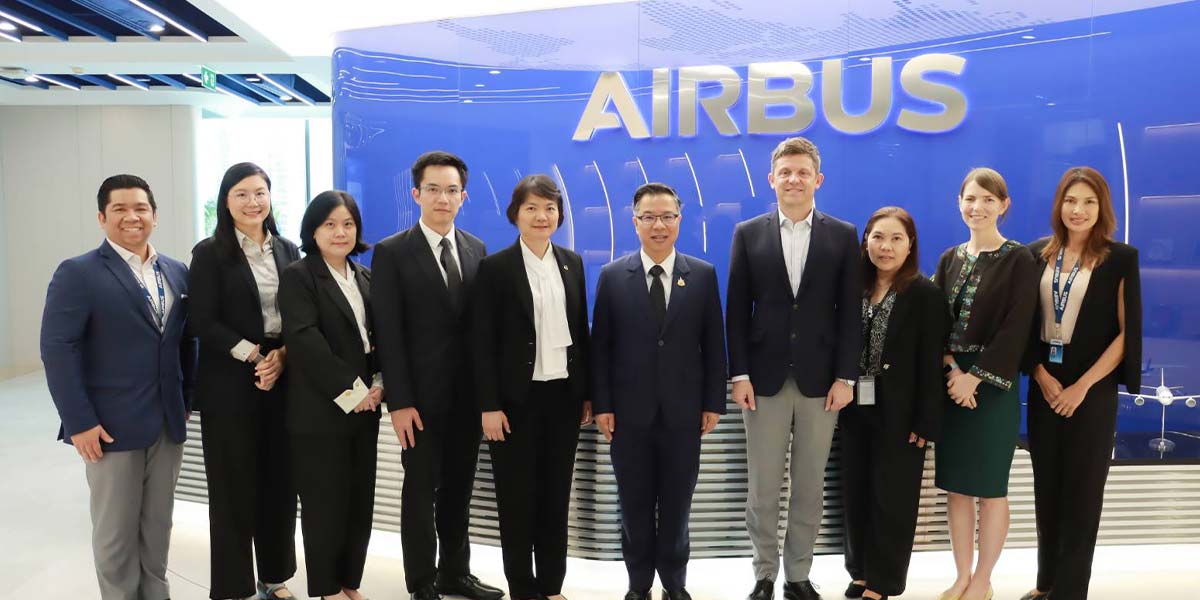
Mr. Narit Therdsteerasukdi, Secretary General of the Board of Investment (BOI), recently visited Airbus Thailand’s operations and held discussions with Mr. Bert Porteman, President of Airbus Thailand, at the Rasa Two Building in Bangkok.
Mr. Narit revealed that Airbus has identified Thailand as one of its main business bases. The company has established a regional Flight Operations Center of Excellence, under the name Skywise, in Thailand. Skywise, which is the digital division of Airbus, will use Thailand as its regional office overseeing Asia. The center will serve as a hub supporting the development of aviation systems using modern digital and aviation technologies.
Currently, Airbus employs more than 200 personnel in Thailand, a figure that has more than tripled since 2022. Around 85% of its workforce in Thailand are local employees, including aerospace engineers, software engineers, graphic designers, technicians, and other skilled professionals. The company has plans to expand further, hiring more than 40 additional staff within the year.
The BOI also discussed with Airbus strategies to elevate Thailand’s aviation industry, ranging from developing its auto parts industry into the aerospace supply chain, enhancing workforce skills for aviation maintenance (MRO), and promoting Thailand as a base for sustainable aviation fuel (SAF) production.
Airbus, Europe’s largest aircraft and defense manufacturer, has operated in Thailand for over 40 years. There are currently more than 150 Airbus commercial aircraft in use in Thailand, by clients such as Thai Airways, Bangkok Airways, Thai AirAsia, and Thai VietJet. Nearly 80 Airbus helicopters are also in operation, mostly by the military and government agencies.
Airbus has formed numerous collaborations in Thailand, including work with GISTDA on the development and launch of the THEOS-1 and THEOS-2 resource observation satellites, MRO partnerships with Thai Aviation Industries (TAI) for military aircraft, and SAF development with CP Group, which marks a significant technology transfer to Thailand.
A key highlight from the recent discussions was the expansion of Skywise’s role in Thailand. Skywise develops solutions for airlines including pilot manuals, flight data analytics, safety management, flight and crew planning, and predictive aircraft maintenance—all leveraging large-scale data platforms to enhance operational efficiency.
Airbus is currently expanding its Skywise software testing team in Thailand, making the country the sole base for global delivery of these services. The company is continually recruiting software engineers to support these activities. Moreover, Bangkok is set to be named the Skywise Asia regional headquarters, overseeing ASEAN, China, India, Japan, and South Korea.
Mr. Narit commented, “Airbus’s decision to entrust Thailand with its global digital operations, including using Bangkok as the Skywise regional hub, demonstrates Thailand’s readiness to adopt advanced technologies and further integrate into the global aviation industry.”
Airbus executives estimate that global passenger numbers and fleet size will double in the next 20 years, increasing the demand for new aircraft by over 20,000 units. Airbus currently has a backlog of more than 9,000 aircraft—equivalent to over 10 years of production capacity. However, increasing output is challenged by supply chain constraints, labor shortages, raw material costs, and geopolitical tensions.
Airbus views Thailand’s geopolitical neutrality and skilled workforce as key strengths, providing the country with opportunities to become a crucial part of the aerospace supply chain. For Thailand to move forward, it needs to define its areas of expertise and leverage existing strengths, particularly in automotive parts and precision manufacturing, to enter sectors such as aircraft structures, composites, and cabin equipment.
Joining the aerospace supply chain requires rigorous certification, strong quality and safety standards, and a highly skilled workforce—necessitating collaboration between foreign technology experts and Thai entrepreneurs. There are currently around 80 Airbus suppliers in Thailand across Tiers 1–3.
On human resources development, Airbus collaborates with Thai universities such as King Mongkut’s Institute of Technology Ladkrabang, Kasetsart University, and Chulalongkorn University to align aerospace curricula with industry needs, including digital technology, AI, and international workplace skills.
For MRO, Airbus partners with Thai Aviation Industries on military helicopters and aircraft maintenance. However, developing a large-scale commercial MRO center faces challenges such as a shortage of skilled technicians and higher training standards. The company is ready to bring its expertise to support Thai workforces.
Airbus also believes Thailand can emerge as a leader in sustainable aviation fuel (SAF) production, given its abundant agricultural residues and a strong ethanol industry. In the short term, SAF can be produced from used cooking oil, while mid-term opportunities lie in using ethanol to manufacture SAF via alcohol-to-jet processes, and long-term possibilities involve synthetic fuel production using renewable energy.
However, these technologies require significant investment and coordinated policy efforts, involving government agencies, raw material producers, energy companies, SAF manufacturers, and airlines, to ensure an integrated approach and inspire investor confidence.
“Today’s discussions reflect Thailand’s potential to expand its role in the aviation sector, from digital and software services to supply chain and workforce development, MRO capacity building, and SAF production. The BOI is committed to collaborating with Airbus and relevant stakeholders to drive tangible advances for Thailand’s aviation industry,” Mr. Narit concluded.