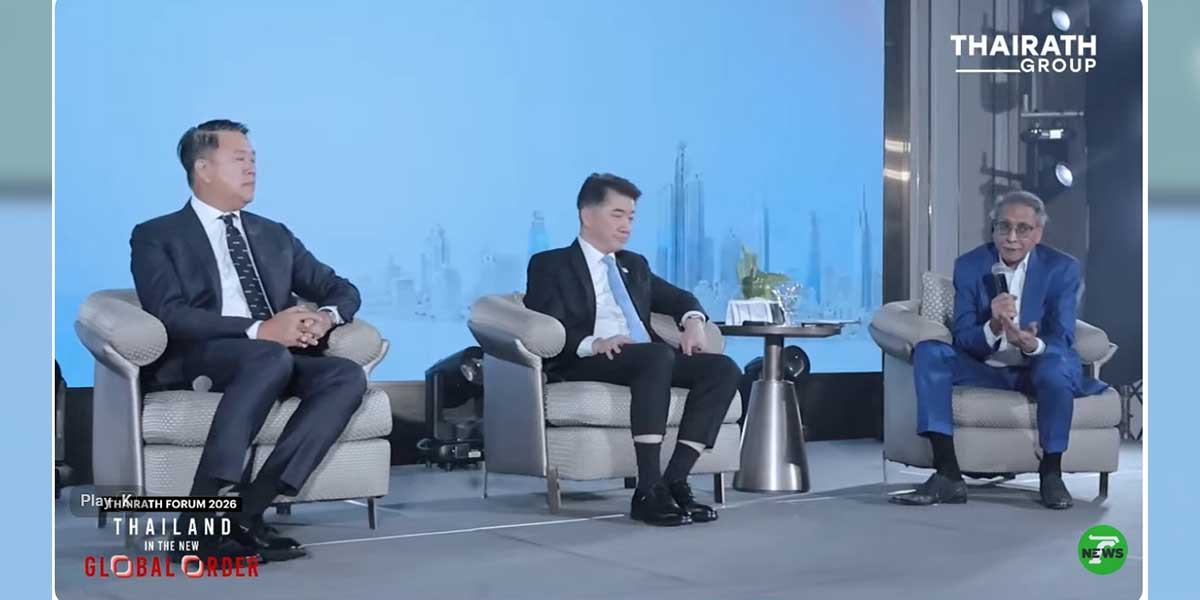
At the high-profile “THAIRATH FORUM 2026: THAILAND IN THE NEW GLOBAL ORDER,” organized by the Thairath Group, prominent business leaders shared critical insights on navigating a fragmented global economy, leveraging digital disruptions, and building long-term economic resilience.
The forum featured Arthid Nanthawithaya, Chief Executive Officer of SCB X Public Company Limited (SET: SCB); Prasit Boondoungprasert, Chief Executive Officer of Charoen Pokphand Foods Public Company Limited (SET: CPF); and Aloke Lohia, Vice Chairman and Group CEO of Indorama Ventures Public Company Limited (SET: IVL). The executives warned that Thailand’s future relies on concrete strategy execution, strong industrial ecosystems, and the empowerment of local supply chains.
Navigating Global Fragmentation and Geopolitical Friction
For international food conglomerates like CPF—which operates direct investments across 17 countries and exports to 40 to 50 nations—geopolitical tensions have shifted the global landscape from globalization to fragmentation and massive uncertainty. This has intensified concerns over food security and self-sufficiency, forcing countries with limited production bases, like Singapore, Hong Kong, and Saudi Arabia, to focus on local supply chains. In Saudi Arabia, rapid domestic developments have even enabled local shrimp exports, a sector in which CPF has actively invested.
While European corporate growth remains low, forcing businesses to focus strictly on efficiency and cost savings, ASEAN remains a highly attractive, high-growth region. To counter aggressive Chinese expansion into Southeast Asia, CPF’s core strategy is to “produce where you sell” by establishing local farming hubs rather than relying on trading. This model allows CPF to integrate and cross-apply regional technologies—such as combining swine-rearing methods from Thailand, China, Russia, and Canada—to build superior operations.
Offering a parallel industrial perspective, IVL’s Aloke Lohia highlighted his company’s 35-year history of navigating crises, including the 1997 Tom Yum Goong crisis (with interest rates at 15%) and the 2008 Global Financial Crisis, which taught the company the vital importance of risk management and market diversification.
IVL, which grew from a $10 million investment in Thailand in 1988 to over 100 global production bases, has mitigated modern geopolitical tensions like Middle East friction by organizing its assets into regional clusters across the US, Brazil, Europe, and Asia—a structure that shielded it from the worst of the 2022 Russia-Ukraine energy crisis.
Lohia noted that while India’s massive market is becoming increasingly congested, IVL is shifting its expansion focus to high-potential markets in Africa and the Middle East, while CPF is also looking to study Africa.
The Technological Wave: Infrastructure, AI, and Clean Energy
In the digital and technological sectors, the rapid rise of AI is a massive global wave that is transforming industries. To capture this investment wave, SCB X’s CEO Arthid Nanthawithaya emphasized that Thailand’s immediate priority must be establishing robust digital infrastructure. Rather than remaining passive technology users, Thailand must deploy national strategies focused on localization, local content creation, and technology transfer to create real value.
Furthermore, massive investments in advanced technologies like Data Centers demand immense energy. While Thailand possesses strong geographic and clean energy potential, the sheer scale of these investments requires the country to collaborate with regional neighbors on energy strategies to remain attractive for foreign direct investment (FDI). Supporting this push, IVL is actively bringing global partners and new technologies to Thailand, such as recycling technologies from Japan.
Empowering SMEs and Elevating ESG Standards
Both Arthid and Prasit strongly emphasized that large corporations cannot survive in isolation; they are only as strong as their supply chains. CPF relies on more than 5,000 suppliers in Thailand, of which 3,600 are small and medium-sized enterprises (SMEs). To support this network, CPF runs the “Partner to Go” initiative, which initially halved payment terms during the COVID-19 pandemic to boost SME liquidity.
Today, the focus has shifted toward sustainability through the “Quality Day together SME Excellence” program, which trains partners in lean sigma and operational efficiency. Under this initiative, if an SME partner commits to environmental goals, CPF sends its engineering team to work with them for free for six months. This program has recently expanded to include Chulalongkorn University’s Faculty of Engineering.
Furthermore, CPF offers procurement advantages (“points bonuses”) to suppliers implementing anti-corruption measures and high environmental standards. Adhering to strict Environmental, Social, and Governance (ESG) standards is now a baseline requirement, as failing an ESG audit can result in catastrophic export rejections in global markets.
SCB X’s Arthid echoed this call, urging the government, private sector, and financial institutions to support weaker, early-stage enterprises to help them integrate into high-value supply chains.
Overcoming the “Execution Deficit” and Shaping Government Policy
The most critical bottleneck for Thailand is not a lack of vision or plans, but rather a severe execution deficit. SCB X’s Arthid noted that Thailand must establish stable, clear “rules of the game” that allow projects to progress even when societal opinions differ.
Prasit argued that Thailand must abandon its historically “easy-going” approach of superficial, single-layer problem analysis. To compete globally, the state must prioritize and select specific strategic industries rather than trying to please and support every sector equally. The government should function as a highly efficient Project Management Office (PMO) and facilitator—bringing public and private stakeholders together to align on a single shared strategy, setting clear target-driven KPIs, and analyzing issues 4 to 5 layers deep to identify winning actions.
Supporting this policy direction, IVL’s Lohia urged the government to strictly control energy costs to prevent the margin squeeze that has pressured European industrial competitiveness. He proposed that state enterprises must increase operational efficiency and open up clean energy management, transportation, and aviation systems to elevate Thailand into a regional Transit Hub.
Furthermore, Lohia emphasized that the government must accelerate infrastructure investments and Eastern Economic Corridor (EEC) projects to stimulate private sector momentum. Thailand’s strong fundamental ecosystem across petrochemicals, automotive, electronics, food, medical, and hospitality, coupled with BOI benefits and a stable currency, positions Bangkok to successfully develop as a premier hub for multinational corporate headquarters.
The Future Baseline: Automation and AI
Ultimately, the baseline for future competitiveness has changed. Automation is no longer a luxury; it is a basic requirement. As CPF’s Prasit noted, corporations must proactively integrate advanced robotics, data systems, and AI into their workflows to build capabilities ahead of time, ensuring they do not get left behind as the new global order takes shape.