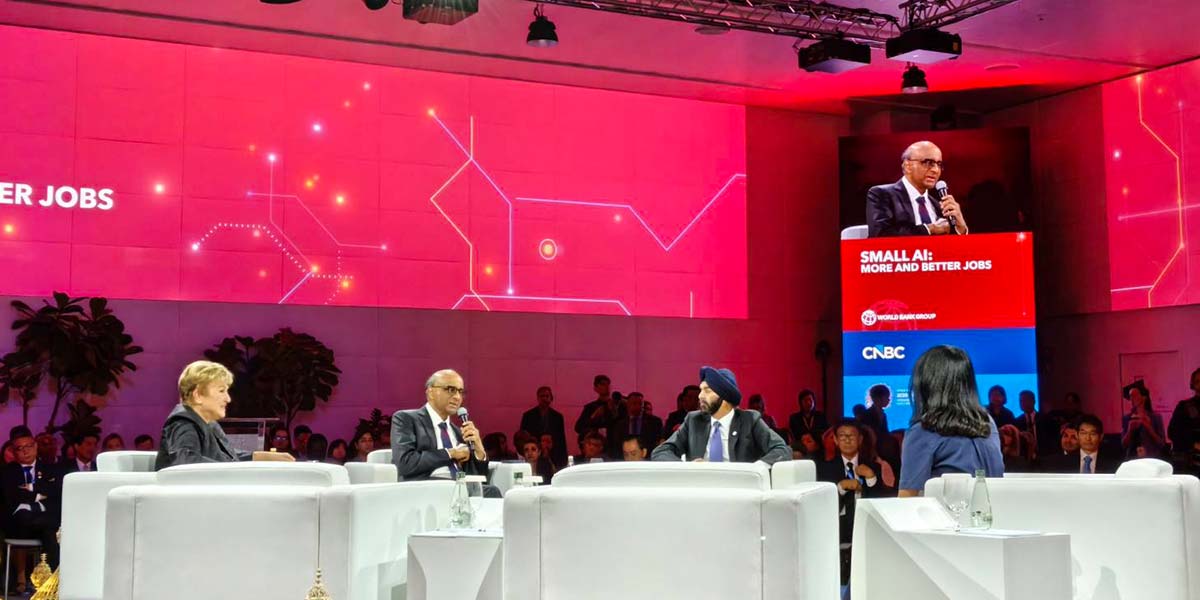
At the 2026 IMF-World Bank Annual Meetings in Bangkok, global economic leaders and host officials gathered to address how artificial intelligence can foster job creation and sustainable growth across developing and emerging economies.
The very first high-level panel, titled “In Conversation: Small AI: More and Better Jobs,” featured Kristalina Georgieva (Managing Director of the International Monetary Fund), Ajay Banga (President of the World Bank Group), and Tharman Shanmugaratnam (President of the Republic of Singapore), followed by key remarks from Ekniti Nitithanprapas (Deputy Prime Minister and Minister of Finance of Thailand).
Together, the leaders presented a unified vision: while large-scale AI models present disruption risks in advanced markets, practical “Small AI” applications—running on lightweight infrastructure and accessible mobile devices—offer transformative potential to boost productivity, expand local employment, and bridge economic divides across lower-income nations.
Kristalina Georgieva: Navigating the ‘Slow-Moving Tsunami’
IMF Managing Director Kristalina Georgieva described AI as an ongoing demand and investment shock that is currently anchoring global economic growth at around 3%. She highlighted that physical infrastructure construction—such as data center expansion in Asian economies including Thailand—has driven the initial economic lift.
Looking ahead, Georgieva emphasized that the upcoming phase of widespread adoption can be as democratic as the mobile phone, provided developing nations establish necessary preconditions: reliable electricity, digital infrastructure, worker training, and consumer protection. IMF estimates indicate AI adoption could boost growth in advanced Asian economies by 0.5 to 1.0 percentage point—more than offsetting the economic drag of rapidly aging populations—and by 0.2 to 0.8 percentage point in emerging Asia.
Addressing workforce impacts, Georgieva characterized AI as a “slow-moving tsunami” expected to impact roughly 40% of jobs globally over time (60% in advanced economies versus 23% in low-income countries). She outlined three crucial directives for policymakers:
- Analyze shifting labor dynamics: IMF research in the U.S. shows that 10% of jobs already require higher-paying AI skills, while routine repetitive roles shrink and lower-wage service and construction jobs expand.
- Reinvent education: Transition from one-time degree acquisition toward continuous lifelong learning.
- Reform fiscal strategy: As AI shifts national income from labor to capital, governments must rethink tax structures to protect revenue streams needed for social adaptation.
Ajay Banga: Harnessing Practical ‘Small AI’ for Grassroots Jobs
World Bank Group President Ajay Banga focused on how lightweight “Small AI” applications operating on edge devices like 3G smartphones can drive domestic employment without relying on traditional job outsourcing. Banga outlined five key sectors targeted for sustainable local employment:
- Infrastructure & Digitization: Building roads, power grids, water supply, and digital networks alongside human educational infrastructure.
- Agriculture: Empowering smallholder farmers through accessible technology. Banga highlighted an ongoing initiative in India where an illiterate farmer can point a standard smartphone at a diseased leaf to identify the issue, order the correct insecticide, and complete a 25-rupee transaction via digital bank accounts.
- Primary Healthcare: Expanding rural health centers staffed by nurses who use edge AI diagnostic tools on 3G phones—such as assessing skin conditions in Indonesian clinics—to connect patients with remote medical specialists, which is still very difficult to do in advanced economies.
- Tourism: Multiplying service-sector employment, highlighting host nation Thailand as a primary example.
- Value-Added Manufacturing & Creative Sectors: Developing local processing for critical minerals and expanding creative industries.
Banga stressed that while large language models (LLMs) may disrupt white-collar roles in developed countries, Small AI gives middle- and lower-income nations an unprecedented lever to expand local employment and productivity.
Tharman Shanmugaratnam: Protecting Entry-Level Pathways and Education Agility
Singapore President Tharman Shanmugaratnam noted that because AI disrupts work task-by-task rather than eliminating entire occupations overnight, workers and firms have a window of time to adapt through workplace learning.
However, Tharman issued a stark warning regarding the “first rung” of the career ladder. Demand for entry-level graduate positions is already declining, particularly in technology sectors. To avoid losing a generation of skilled youth, he urged governments to introduce structural public policies and incentives that encourage private sector firms to hire and train fresh graduates.
To align education with changing workplace demands, Tharman advocated for key institutional shifts:
- Shift to Applied Education: As the traditional wage premium for academic degrees declines, higher education must pivot toward applied learning, work attachments, internships, and dual work-study programs.
- Maintain Agility and Humility: Educational planners must avoid rigid single-track models, balancing specialized technical depth with broad interdisciplinary skills to navigate an uncertain future.

Ekniti Nitithanprapas: Thailand’s Vision for ‘AI in All, All in AI, and AI for All’
Representing the host nation, Deputy Prime Minister and Minister of Finance Ekniti Nitithanprapas outlined Thailand’s national framework to harness Small AI for widespread economic opportunity through three core pillars:
- AI in All (Improving Existing Jobs): Boosting small business productivity through targeted technology. Ekniti highlighted “Whispering Bird,” a practical AI business advisor integrated into mobile wallet apps used for subsidy distribution. Nearly 1 million small merchants currently use Whispering Bird to manage inventory, track daily sales, and automatically generate structured financial statements for bank loan applications—helping businesses without formal credit histories secure funding through institutions like Krungthai Bank.
- All in AI (Building New Capabilities and Jobs): Capitalizing on major foreign investments in data centers, semiconductors, cloud services, and advanced electronics. Through Thailand’s Skill Bridge program, the government matches educational institutions with private investors to train local workers for high-tech roles. Furthermore, Thailand is working to lower computing and token costs so startups and universities can affordably develop AI tools.
- AI for All (Inclusive Growth and Governance): Providing targeted fiscal assistance, reskilling programs, and credit access for workers adapting at different speeds. Ekniti called for international cooperation with institutions like the World Bank to govern AI responsibly and protect citizens against emerging digital risks, such as online scams and deepfakes.