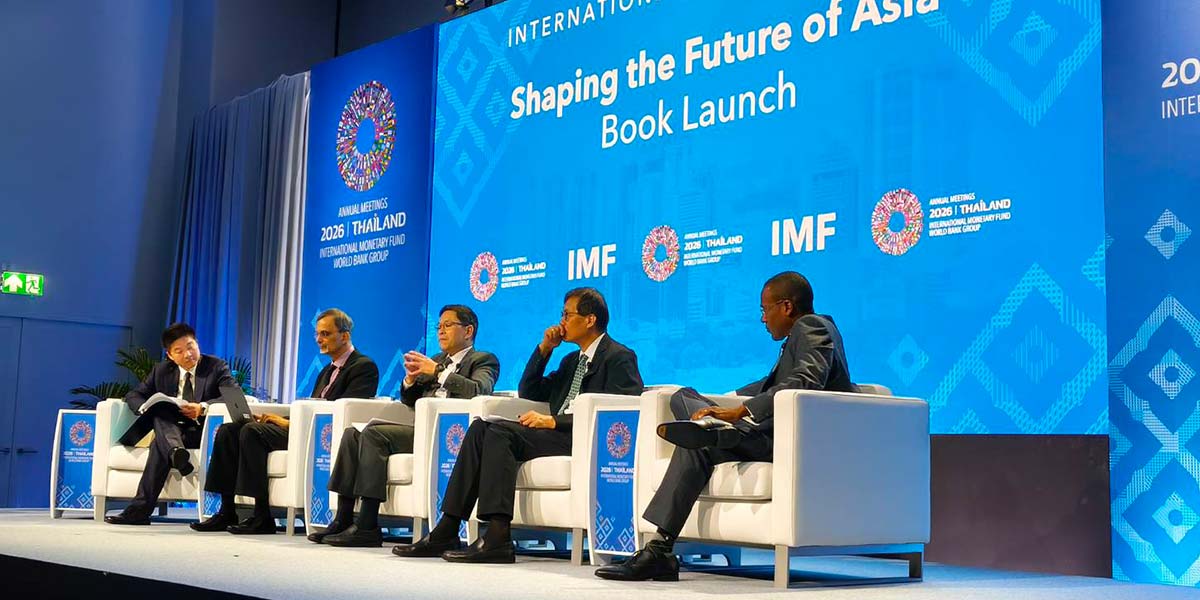
Global economic leaders and policy experts convened at the 2026 IMF–World Bank Annual Meetings in Bangkok on October 12 for a panel discussion titled “Shaping the Future of Asia Book Launch.” The session examined the structural forces transforming the region, assessing how Asian economies can navigate demographic shifts, technological disruptions, and heightened global trade fragmentation.
Asia’s Growth Engine Facing Critical Pivots
The panel highlighted that Asia remains the world’s chief economic engine, currently generating 68% of global economic growth, up from just 25% in 1990. Over the past three decades, extreme poverty across the region plummeted from over 25% to below 5%, while per capita income doubled relative to G7 economies.
According to the panel, this historic rise was built on three foundational pillars:
- High Capital Accumulation: Investment across Asia averaged 27% of GDP between 1995 and 2024.
- Demographic Dividends: Over 1 billion working-age people joined the regional labor force between 1990 and 2020.
- Global Trade Openness: Asia’s share of global trade expanded from 30% to 40%, integrating the region deeply into global supply chains.
However, the panel emphasized that the economic playbook of the past 30 years must adapt to emerging global headwinds. The discussion, this, centered on three structural forces shaping the region’s long-term economic outlook:
Accelerating Demographic Shifts: Asia is aging faster than any other region. By 2050, the proportion of people aged 65 and older will double from 11% to 20% of the total population, while fertility rates have dropped sharply from 6 to 1.6. In post-dividend economies such as Japan, South Korea, China and Thailand, the working-age population could shrink by up to 25% by 2050. To offset this demographic drag, the panel stressed key policy levers, including integrating 112 million women into the workforce and encouraging older adults to remain active in the labor market.
Artificial Intelligence and Productivity: Artificial Intelligence (AI) presents a powerful counterweight to shrinking labor forces. The panel estimates indicate AI adoption could boost annual growth by 0.5 to 1.0 percentage point in advanced Asian economies and 0.2 to 0.8 percentage point in emerging markets. The panel noted that achieving a 0.8% annual increase in Total Factor Productivity (TFP) through technology and AI could entirely offset the economic drag of aging societies. Nevertheless, the panel warned of uneven AI readiness, labor reallocation, and short-term market valuation risks.
Regional Integration Amid Global Fragmentation: Global trade restrictions have nearly tripled since 2019, posing significant risks to Asia’s trade-reliant economies. To insulate against external shocks, the panel called for deeper intra-regional integration. While Asia excels in intermediate goods trade, trade in final goods within Asia accounts for only 30% of total trade, compared to 60% in Europe. Lowering tariffs and non-tariff trade barriers through deeper trade agreements could expand regional GDP by 1.8% overall, and by up to 4 percentage points across ASEAN economies.
Addressing South Korea’s economic development and structural reforms, Mr. Changyong Rhee outlined how early national growth in the 1960s and 1970s relied on strong government integrity and anti-corruption enforcement, which directed foreign aid into infrastructure rather than private wealth, utilized capital controls to recycle export earnings into domestic investment, and implemented an early value-added tax system to preserve fiscal health.
While South Korea is currently benefiting from a massive AI-driven semiconductor cycle—with two tech giants representing half of the domestic stock market capitalization and total exports—Mr. Rhee advised using windfall tax revenues to build secondary regional hubs that relieve urban crowding rather than funding industrial loans.
He also cautioned against over-relying on immediate productivity returns from AI, noting that technological revolutions historically take two to three decades to manifest macroeconomically, while high market concentration leaves the economy vulnerable to short-term global tech valuation bubbles and financial corrections.
Thailand’s Development Journey and Strategic Priorities
Addressing Thailand’s economic trajectory, panelist Mr. Veerathai Santiprabhob (Chairman of the Board of Directors, Thailand Development Research Institute and former Governor of the Bank of Thailand) detailed the policies that drove Thailand’s past industrialization and outlined the priorities required for its next transformation.
Mr. Veerathai attributed Thailand’s successful integration into global value chains since the 1980s to several key domestic and external factors:
- Market-Driven Export Orientation: In the early 1980s, Thailand pivoted from import substitution to private-sector-led export promotion without rigid state mandates.
- Strategic Infrastructure: Major investments in the Eastern Seaboard following natural gas discoveries created an industrial hub for heavy and supporting manufacturing.
- Institutional Stability & Reforms: Pragmatic economic technocrats maintained macro-financial continuity through political cycles. Following the 1997 Asian Financial Crisis, Thailand strengthened banking supervision, capital markets, and monetary policy frameworks.
- External Catalysts: The 1985 Plaza Accord directed significant foreign direct investment (FDI) from Japan, South Korea, and Taiwan into Thai industrial clusters, while regional agreements like the 1992 ASEAN Free Trade Area (AFTA) broadened market access.
- Inclusive Structural Policies: Labor shifted from agriculture to manufacturing, supported by remittances to rural regions, rural road networks, Universal Health Care, and expanded education access.
Looking ahead, Mr. Veerathai emphasized that future growth can no longer rely solely on labor-intensive manufacturing, as modern high-value sectors generate fewer mass jobs. To ensure inclusive economic development and prevent a widening digital divide between large firms and SMEs, he outlined three core priorities:
- Policy focus must target agriculture, education, and public services—sectors that directly govern the cost of living and quality of life for the broader population.
- As SMEs represent the primary source of employment in Asia, targeted digital incentives are essential to maintain their competitiveness against imported goods.
- Policies must explicitly focus on generating high-quality employment opportunities, addressing entry challenges for youth while supporting workers aged 45 to 60 who face potential displacement from corporate AI adoption.