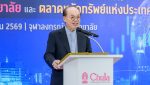
Mrs. Chavinda Hanratanakool, Managing Director of Krungthai Asset Management Public Company (KTAM), in her capacity as Chairman of the Association of Investment Management Companies (AIMC), stated that the outlook for the Thai stock market in 2026 is clearly brighter than last year. She estimates the Stock Exchange of Thailand (SET) Index target range at 1,400 points, reflecting optimism about political stability after the election and clearer economic policies from the new government.
She explained that the smooth conclusion of the election and the formation of the government will be key factors in boosting investor confidence and supporting the SET Index’s climb to the 1,400-point target. However, a main challenge remains in achieving clear economic policy direction in the second half of the year. If the government formation process is not delayed by various complaints, the economic outlook will become increasingly clear.
Mrs. Chavinda further stated that the 1,400-point index target is not just a symbolic number but serves as proof of confidence in the capital market. The core driver for the long-term advancement of the capital market is sustainable economic growth. When the underlying economy is strong and citizens have improved income and quality of life, the capital market will grow steadily and naturally.
Regarding the post-election direction of the Thai stock market, historical statistics show that the market often trends positively, even amid some concerns over potential delays in government formation. Nevertheless, the market has partially priced in expectations regarding the new government’s structure, thereby limiting downside pressure.
While the investment climate remains hopeful yet cautious, at this turning point for Thailand’s capital market, domestic institutional investors are gradually returning to accumulate stocks, without waiting for complete political clarity. At the same time, foreign investors have begun showing signs of renewed confidence through a continuous capital inflow since the start of the year, focusing on large-cap stocks that form the market’s backbone.
Stock selling observed during certain periods is mostly a result of portfolio rebalancing cycles by large institutions, such as insurance groups, the Social Security Fund, and the Government Pension Fund, and does not reflect a loss of overall market confidence. Investor interest remains concentrated on large-cap and high-dividend stocks, particularly in the commercial banking sector, which continues to offer attractive dividend yields.
Mrs. Chavinda also highlighted that the challenge is to sustain momentum throughout the year, as fundamental economic factors have not changed significantly. Investor confidence, especially among those who previously invested in Long-Term Equity Funds (LTF), will take time to recover.
She further noted that KTAM, as one of the joint managers of the Vayupak Fund 1 (VAYU1)—a major fund professionally managed—continues to play an important role in supporting and driving the Thai capital market. The Vayupak Fund, under KTAM’s management, performed well last year, generating returns above 6%, due to strategies adapted to the market environment and the fundamental value of each industry, along with sufficient liquidity and capital for future investments.