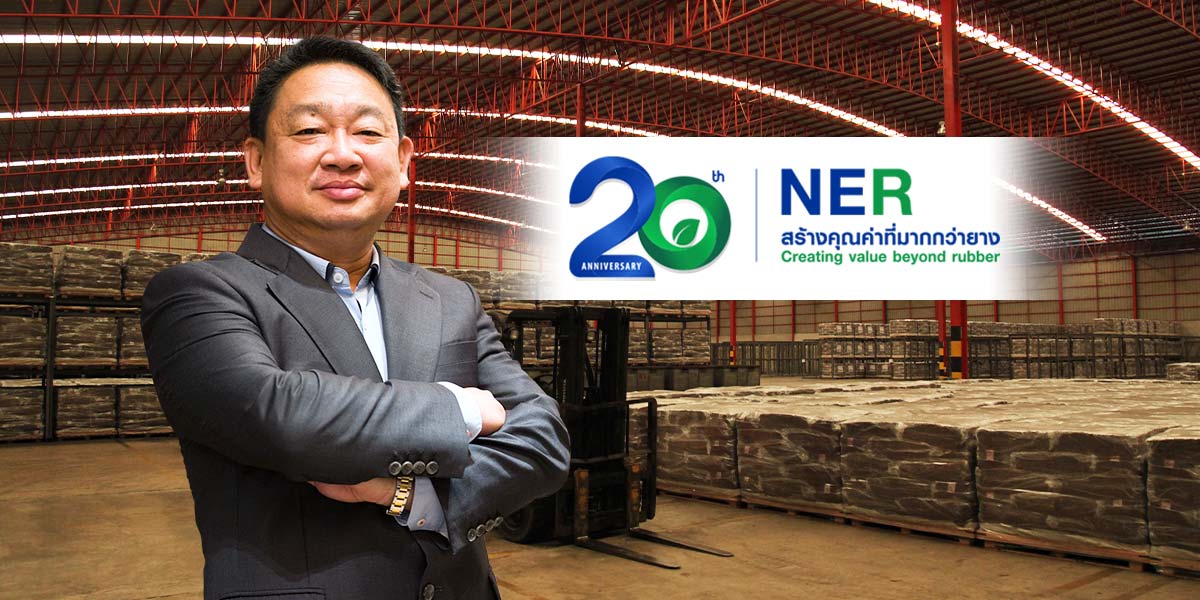
Chuwit Jungtanasomboon, CEO of Northeast Rubber Public Company Limited (SET: NER), revealed that for the fiscal year 2025 (ending December 31, 2025), the company’s total revenue reached THB 30,510 million, up THB 3,014 million or 10.96%. Net profit was THB 1,884 million, an increase of THB 232 million or 14.04%. The total sales volume was 475,430 tons, up by 36,251 tons or 8.25% from the previous year, reflecting continued growth in demand for natural rubber from both domestic and international customers.
On February 19, 2026, the board of directors approved a dividend payment from the operating results for January 1 to December 31, 2025, at the rate of THB 0.31 per share. The company had already paid an interim dividend for the period from January 1 to June 30, 2025, at the rate of THB 0.05 per share.
As a result, the remaining dividend for the period from July 1 to December 31, 2025, will be THB 0.26 per share, totaling THB 480.43 million. The ex-dividend (XD) date is set for April 23, 2026, and the dividend payment is scheduled for May 7, 2026. This dividend payment remains subject to shareholder approval at the meeting scheduled for April 10, 2026.
Looking forward to 2026, the company aims for growth, with a target production capacity of 500,000 tons per year and sales of approximately THB 32,000 million. The key strategy focuses on market expansion, especially in India, and securing long-term revenue with contracts with tire manufacturers. NER also aims to gain two new customers within this year.
Additionally, the company is steadily expanding production capacity to meet long-term market demands. Currently, construction of the third block rubber and compound rubber factory is underway, with an investment budget of about THB 2,000 million, covering both buildings and machinery, which have already been ordered. The new plant is expected to commence commercial operation (COD) in 1Q27. Currently, NER operates the world’s largest natural rubber factory in terms of production capacity in Thailand.
The new factory will add another 320,000 tons per year to the company’s production capacity, pushing NER’s total capacity to over 835,600 tons per year by 2027. Currently, the company’s orders cover production through June 2026. NER has also signed a memorandum of understanding (MOU) with the Rubber Authority of Thailand (RAOT) to manage around 200,000 tons of rubber annually for five years. The new factory will be the main production base for this project, making the capacity expansion both necessary and in line with NER’s long-term growth plans, said Chuwit.
In terms of cost and risk management, the company uses a matching strategy together with hedging to mitigate raw material price fluctuations, while also managing production costs and expenses efficiently.
On the ESG front, the company has raised its operations to follow the ESG framework, focusing on energy management, reducing environmental and biodiversity impacts, and ensuring transparent, traceable supply chain management (traceability). NER is also adopting technology and automation in production processes to enhance standards and build confidence among customers, investors, and stakeholders.
The year 2026 is expected to be a key transition year for NER as it invests and enhances production capacity, supporting increased volume and product quality in line with growing demand for natural rubber across industries. The company believes this will strengthen NER and support sustainable and stable growth, laying the foundation for NER to become a leading global operator in the natural rubber industry.