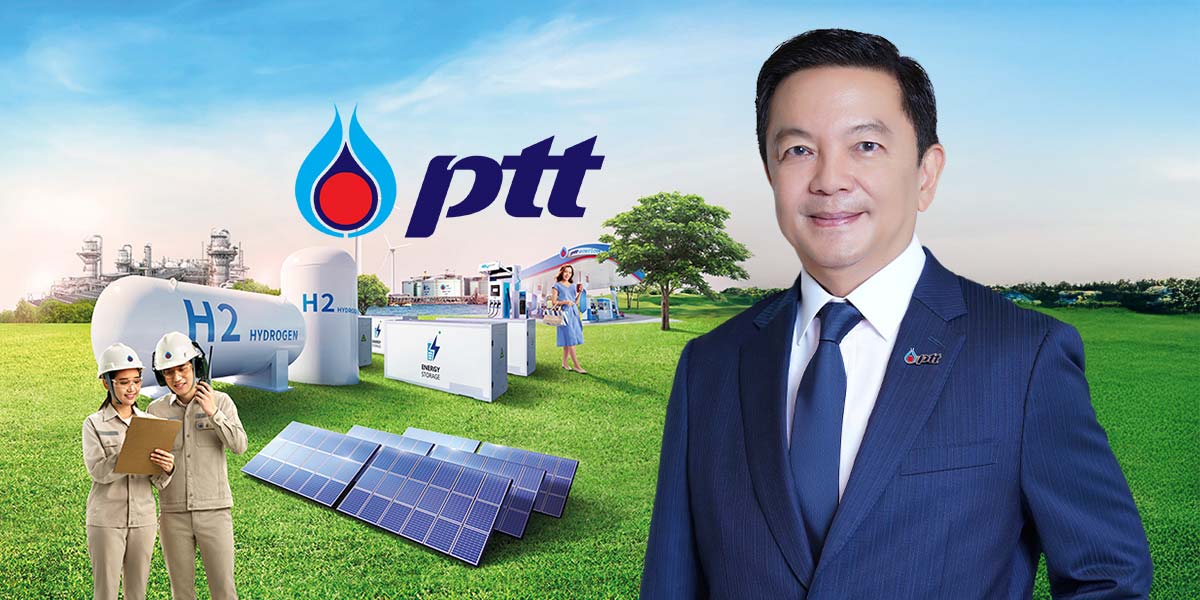
Dr. Kongkrapan Intarajang, CEO and President of PTT Public Company Limited (SET: PTT), discussed on the “Kaohoon” program the company’s response to escalating disruptions in global energy shipping caused by Middle East unrest. PTT is actively monitoring the situation and has shifted crude sourcing outside of conflict zones, despite higher associated costs, in a move to proactively safeguard Thailand’s energy security.
Thailand currently imports about 90% of its crude oil, with only 10% produced domestically. PTT Group is responsible for 60% of the nation’s imports. While the company previously sourced 60% of its crude from the Middle East, that figure has now dropped to 30%.
To strengthen adaptability, PTT is expanding its trading business globally—establishing footholds in hubs like London, the Middle East, and Singapore. This global network supports Thailand’s continuous energy supply, even as procurement costs escalate.
Dr. Kongkrapan acknowledged that surging global crude prices have significantly increased PTT’s liquidity and financial burdens, with additional margin calls, working capital needs, and obligations to the Oil Fuel Fund pushing liquidity requirements up by over THB 230 billion. These increases in turn have driven up interest costs by THB 600 million monthly, or THB 7 billion per year. The company hopes this exceptional pressure will ease within a year.
Despite these extraordinary costs, consumers will not see the impact at the pump, as PTT is absorbing these expenses to reduce Thailand’s risk of an oil shortage—a move deemed critical during heightened geopolitical uncertainty.
PTT’s refineries are running at over 100% capacity, mainly producing diesel to match domestic demand, though this demand has started to soften. Petrochemical plants also remain fully operational. Thailand manufactures about 60% of its plastic pellets for local use, exporting the remaining 40%. Any temporary reduction or shutdown in plants could cut overall capacity by 15%, but supply remains largely stable, aside from minor impacts in specific plastic grades.
During the crisis, PTT’s priority is national energy security. At the same time, as a listed company, it must protect shareholder interests. Dr. Kongkrapan highlighted efforts to improve operational efficiency and manage risk across the company’s entire value chain—upstream, midstream, and downstream. PTT is targeting an EBITDA increase of THB 30 billion over three years (2025-2027), seeking gains from diverse segments and pursuing early bond redemptions.
Surplus refined oil has resulted from maximum refinery utilization, leading to a mix of products with varying demand. The company is working with the Ministry of Energy to lift restrictions on jet fuel exports to manage storage limitations. PTT sees opportunities to export excess supply—especially jet fuel—once local demand is satisfied and regulatory barriers are removed.
PTT supports the potential joint venture between PTT Global Chemical Public Company Limited (SET: PTTGC) and SCG Chemicals Public Company Limited (SCGC), under The Siam Cement Public Company Limited (SET: SCC), in olefins and polyolefins. This aligns with industry trends and is expected to boost the entire Thai supply chain through collaboration, following successful models in Japan and South Korea.
Finally, Dr. Kongkrapan reaffirmed that PTT Group’s portfolio remains robust across all business segments, with upstream units like PTT Exploration and Production Public Company Limited (SET: PTTEP) benefitting from higher oil and gas prices and midstream entities such as Thai Oil Public Company Limited (SET: TOP) anticipating improved refinery margins in 2026. PTT continues to target operational improvements, emphasizing both energy security and shareholder returns, supporting its reputation as a stable dividend stock.