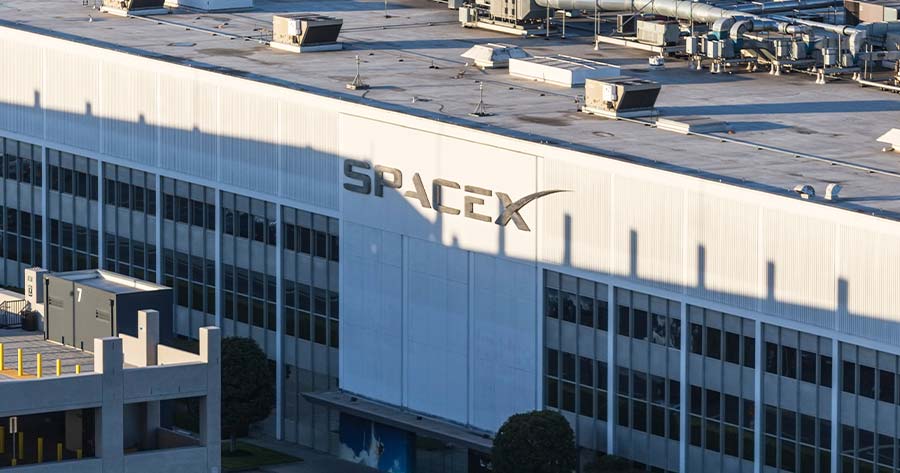
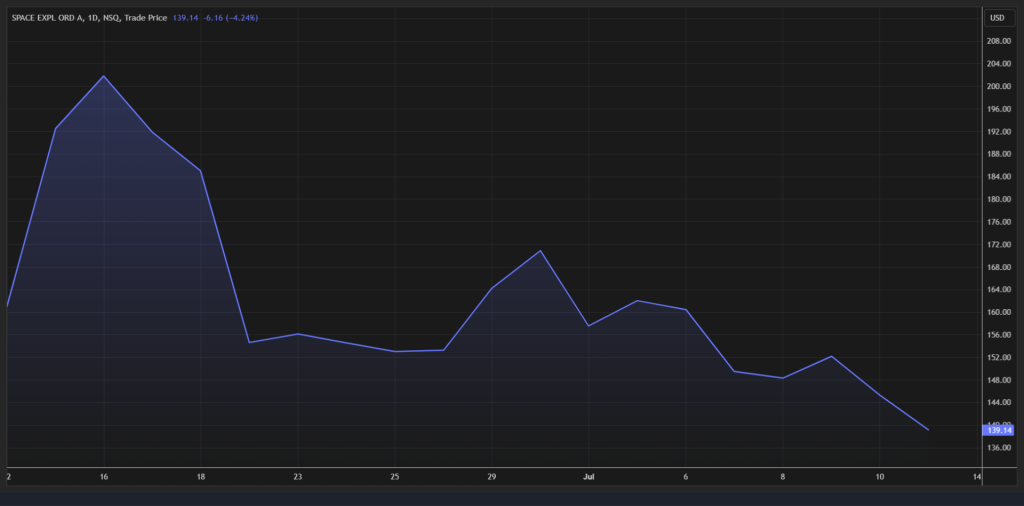
SpaceX‘s stock fell sharply on Monday, touching a new low since its public debut and moving closer to its initial public offering price of $135. The pullback adds to the recent turbulence since joining the Nasdaq-100, intensifying investor scrutiny of the newly public company.
The company’s shares declined 4.51% on Friday, followed by another 4.24% drop on Monday. Since its first day of trading on June 12, SpaceX shares have been volatile, falling from its high of $225 a piece on June 16.
SpaceX was recently added to the Nasdaq-100, bringing increased participation from index-tracking funds last week as portfolios adjusted to match the updated benchmark. The addition resulted in heightened trading activity but also contributed to notable price fluctuations.
Separately, on Monday, the U.S. Federal Aviation Administration completed its review into the failure of a SpaceX Starship booster during a May flight test. This approval allows the company to proceed with its next Starship test launch from Texas as early as Thursday. The May 22 flight represented the twelfth Starship test since April 2023 and showcased a new model that SpaceX intends to serve as the foundation for its commercial launches, satellite services, and moon missions.
Earlier this month, Morgan Stanley initiated coverage of SpaceX with an Overweight rating and a price target of $300, highlighting the company’s unmatched position at the intersection of space infrastructure, global connectivity, and artificial intelligence. The firm details a bullish scenario of $600 and a bearish scenario of $75, reflecting the range of possible outcomes for the company’s ambitious growth plans.
Morgan Stanley forecasts SpaceX revenue will surge from about $45 billion in 2026 to roughly $319 billion in 2030 and a staggering $3.3 trillion by 2040. Starship’s advanced reusability is predicted to drive launch costs down to around $500/kg by 2030, dropping below $200/kg by 2035, significantly expanding the economic viability of satellite and AI ventures.
The Stock Exchange of Thailand (SET) is expanding its foreign investment options with the launch of new Depository Receipts (DRs) tracking SpaceX. Starting July 13, 2026, Thai retail investors can invest in the commercial space technology company directly through local brokerage accounts using Thai Baht.
The simultaneous rollout features five distinct DR tickers issued by leading Thai financial institutions, allowing investors to choose based on their preferred broker or liquidity preferences:
- SPACEX01: Issued by Bualuang Securities (BLS)
- SPACEX03: Issued by Pi Securities
- SPACEX06: Issued by Kiatnakin Phatra Securities (KKPS)
- SPACEX23: Issued by InnovestX
- SPACEX80: Issued by Krungthai Bank (KTB)