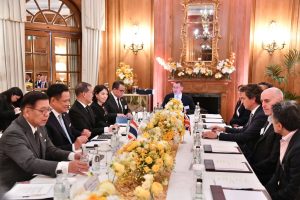
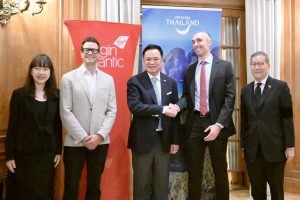
Thai Prime Minister and Interior Minister Anutin Charnvirakul began his visit to the United Kingdom by meeting with government and private-sector representatives, including MP Matt Western, the UK Trade Envoy, as well as executives from Virgin Atlantic and Rolls-Royce.
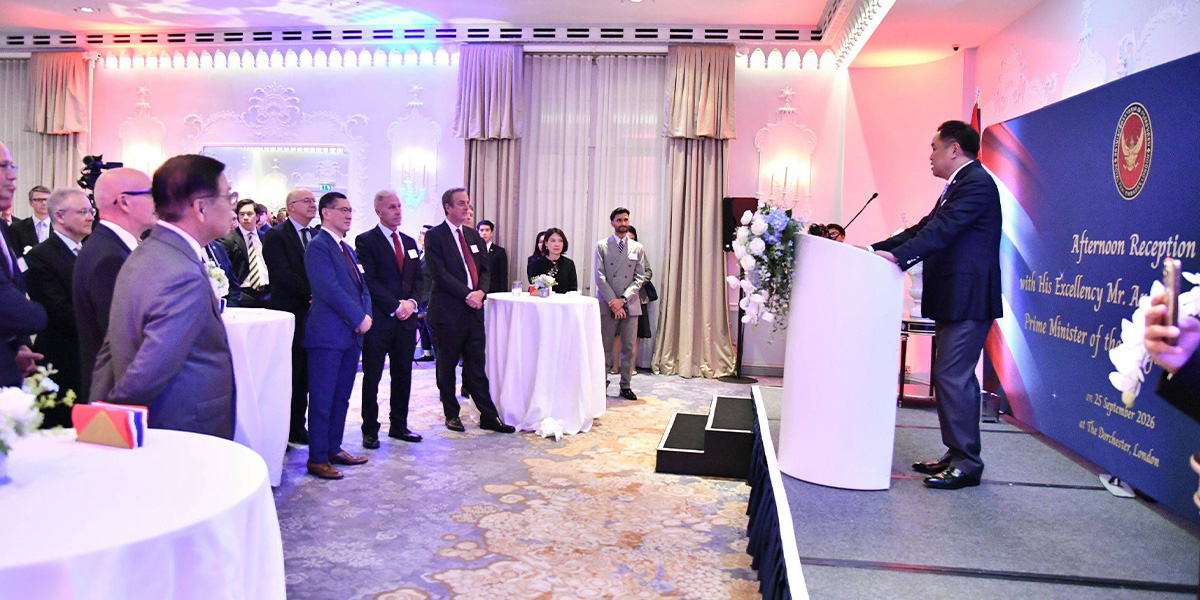
The Prime Minister also met with leading UK institutional investors at an event jointly hosted by the Stock Exchange of Thailand (SET) and UBS, where he delivered a keynote address at a reception attended by more than 50 representatives from the UK government and private sector.
Anutin noted that Thailand and the UK celebrated the 170th anniversary of diplomatic relations last year, highlighting the longstanding ties between the two countries at the royal, governmental and people-to-people levels. He said Thailand and the UK also share common values, including a commitment to the multilateral trading system, free trade, and international principles and rules.
Turning to Thailand’s investment opportunities and potential, Anutin said foreign direct investment into Thailand increased 37% over the past year. The government is also pursuing free trade agreements (FTAs) with various countries and advancing Thailand’s accession to the Organisation for Economic Co-operation and Development (OECD), which he said would help strengthen the country’s business environment.
On investment ties, several Thai companies have expanded their investments in the UK, while UK investors remain major participants in the Stock Exchange of Thailand. Virgin Atlantic has also launched a direct London–Phuket route and expanded cooperation with Bangkok Airways and the Tourism Authority of Thailand to help attract more international visitors to the country.
Executives from Rolls-Royce thanked the Thai government for supporting investment and technology cooperation aimed at upgrading Thailand’s aviation industry toward higher-value activities. They also noted that investing in Thailand provides access to the broader ASEAN market, which has a population of more than 700 million and remains one of the world’s high-growth regions.
Anutin also highlighted Thailand’s energy security, saying the government is promoting alternative energy sources such as wind and solar power while studying the feasibility of Small Modular Reactors (SMRs).
The government is also supporting the transition from fossil fuels to clean energy in both the industrial and household sectors. Under the policy, households can sell surplus electricity back to the government.
In addition, the government is promoting future industries to drive economic growth, including artificial intelligence, science, technology and innovation, as well as healthcare. For data center investments, the government has established a Data Center Business Policy Committee to oversee and regulate investments to ensure they are appropriately developed.
The government also places emphasis on investment in human capital. Through the Student Loan Fund, which provides education loans at low interest rates, the government aims to expand access to education for Thai students while developing a highly skilled workforce capable of supporting future industries.
Anutin called on UK investors, private-sector companies and leading businesses attending the discussions to increase bilateral trade and investment, noting that trade and investment between Thailand and the UK remain below the potential of both countries.
He also invited UK institutional investors to consider investing in Thai equities, other asset classes and direct investment opportunities. Anutin said one of Thailand’s advantages is political stability, which supports policy continuity and enables the government to pursue strategic initiatives, including a serious crackdown on scammers and online threats.
He added that several international credit rating agencies have assessed Thailand’s credit outlook positively or maintained a stable outlook, reinforcing the view that the country still has significant economic opportunities.
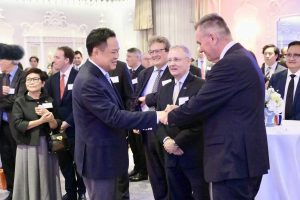
Meanwhile, Soravis Krairiksh, Senior Executive Vice President (Chief Markets Officer) at the Stock Exchange of Thailand, said the London roadshow jointly organized with UBS provided an opportunity for Anutin to present Thailand’s strengths and economic policy direction directly to leading UK institutional investors, helping strengthen confidence in the Thai capital market.
The institutional investors attending the event included senior executives from eight asset management firms, including BlackRock and Schroders, with combined assets under management of approximately $16 trillion.
Investors focused on three key areas. The first was political security and stability, which investors identified as one of their top considerations when assessing Thailand.
The second was the emergence of a new investment cycle, reflected in record-high applications for investment promotion through the Board of Investment (BOI). This represents the supply side of the investment equation, with Thailand placing greater emphasis on the quality of investment rather than simply the volume of projects.
The third was the government’s ability to translate policies into tangible outcomes, which investors viewed as a key indicator of their long-term confidence in Thailand.