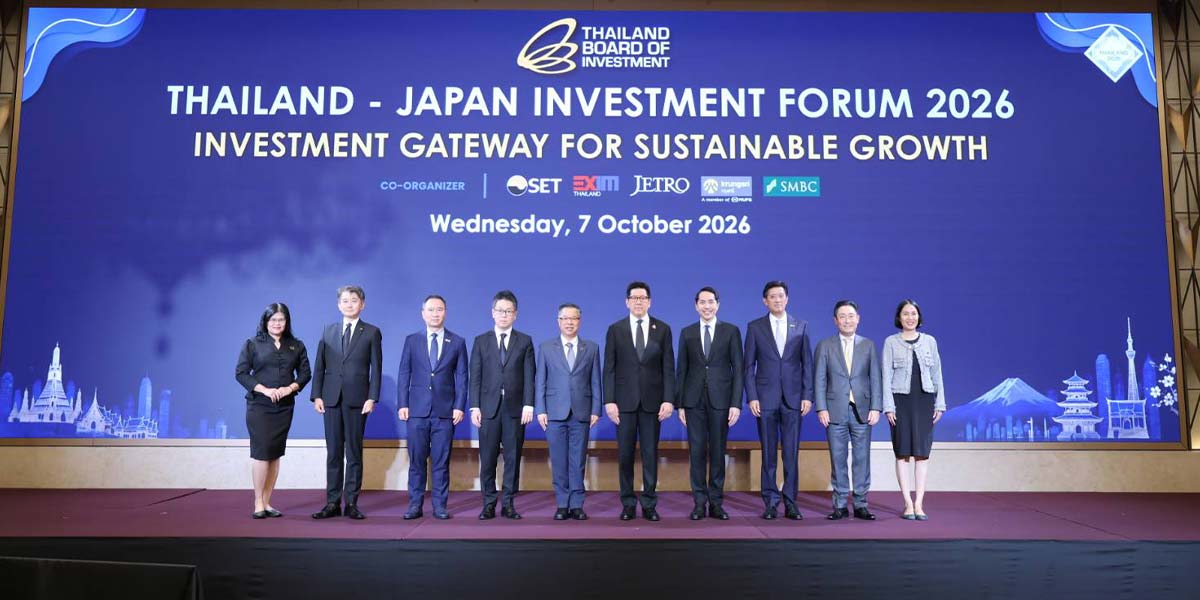
Thailand has attracted more than $11.72 billion (approx. 396.5 billion baht) in investment applications to its Board of Investment (BOI) from Japanese firms across 1,380 projects between 2021 and mid-2026, deepening a decades-long industrial partnership as both nations reconfigure supply chains around semiconductors, next generation vehicles, and clean energy.
The capital inflow underpins Bangkok’s pivot toward “Investment-led Growth,” prioritizing high-value capital deployment to drive long-term competitiveness. Speaking ahead of the 2026 IMF–World Bank Annual Meetings in Bangkok, Deputy Prime Minister framed the bilateral alliance as a joint strategic response to four global structural shifts: macroeconomic volatility, rapid technological advances, the clean energy transition, and demographic aging.
“Thailand and Japan are long-standing economic partners ready to scale up investment cooperation to navigate global economic headwinds, technological leaps, the energy transition, and aging societies,” said Mr. Ekniti Nitithanprapas, Deputy Prime Minister and Minister of Finance, speaking to more than 700 executives and investors at the Thailand–Japan Investment Forum 2026 in Bangkok. “Thailand’s core strength lies in acting as a trusted connector, anchoring economic expansion through quality, investment-led growth. Our objective is to ensure Japanese enterprises continue to grow securely within Thailand while utilizing the country as a springboard for sustainable regional expansion.”
Under this framework, Thailand and private-sector partners are channeling joint investment into seven priority sectors: smart agriculture and food processing, smart electronics, future automotive, wellness and healthcare, quality tourism, retail and logistics, and the creative economy.
The new chapter of cooperation is expanding into critical hardware and infrastructure, including artificial intelligence computing, optical data transmission, advanced chips, and renewable power. The framework also pushes the development of a bilateral carbon credit market alongside a dedicated “BOI to IPO” program offering fast-track listing incentives to encourage Japanese operating subsidiaries to tap the Thai capital market.
“We are focusing on high-growth sectors: semiconductors, advanced electronics, robotics, and clean energy,” said Mr. Narit Therdsteerasukdi, Secretary General of the Thailand Board of Investment. “At the same time, we are supporting existing factories to upgrade to our ‘Smart & Sustainable Industry’ standards by adopting automated systems, reducing emissions, and expanding clean energy use.”
Japanese business leaders emphasized that Thailand’s established industrial base offers vital supply-chain resilience amid shifting geopolitical currents.
“Japanese companies continue to invest for long-term sustainability in Thailand, especially in renewable energy, power grid upgrades, and advanced electronics,” said Mr. Abe Ichiro, President of the Japan External Trade Organization (JETRO) Bangkok.
Abe noted that Japanese automakers are executing a “multi-pathway” strategy in Thailand, maintaining hybrid and internal combustion lines while scaling up battery electric vehicles for regional export. He added that sustaining cross-border capital flows requires “a predictable operating environment, fair competition, and continued productivity gains” across digital and automation transformations.
To integrate Japanese joint ventures and domestic suppliers into the broader financial system, the Board of Investment partnered with the stock exchange on the “BOI to IPO” corridor, opening direct access to public capital across the SET, mai, and LiVEx boards.
“Capital markets must serve as an active bridge for high-potential businesses and new-economy industries to scale up,” said Mr. Asadej Kongsiri, President of the Stock Exchange of Thailand. “Through initiatives like ‘BOI to IPO’ and standardized carbon-tracking platforms like SETCarbon, we are ensuring that companies across the local supply chain can readily access growth capital and meet international ESG benchmarks.”
State-backed export finance is expanding alongside private capital markets to fund the industrial transition. EXIM Thailand has mobilized $429 million (14.5 billion baht) in thematic debt—comprising $251 million (8.5 billion baht) in green bonds, $89 million (3 billion baht) in blue bonds, and $89 million (3 billion baht) in sustainability bonds—to finance decarbonization projects, transition facilities, and credit risk guarantees.
“Access to sustainable finance is no longer optional—it is a baseline requirement to compete in global trade,” said Mr. Charat Rattanaboonniti, President of the Export-Import Bank of Thailand (EXIM Thailand). “By deploying green and blue bonds alongside transition loans, we are providing businesses with the financial tools they need to decarbonize operations and de-risk cross-border investments.”
As regional supply chains modernize, Thailand is relying on green finance, power infrastructure, and regulatory certainty to ensure its foundational economic tie with Japan evolves from low-cost assembly to advanced technology co-development.