
Every two years, the United States holds congressional elections. Every four years, those elections are midterms – a political ritual that reshuffles the balance of power in Washington and sends ripples across global markets. But how much do these events actually matter for markets 13,000 kilometres away in Bangkok?
An analysis of Thailand’s SET Index performance across the 10 most recent US midterm elections – spanning from 1986 to 2022 – suggests that while there is a discernible short-term pattern around election day, the longer-term trajectory of the Thai market has been shaped far more by domestic economic forces and regional dynamics than by who controls the US Congress.
The Short-Term Pattern
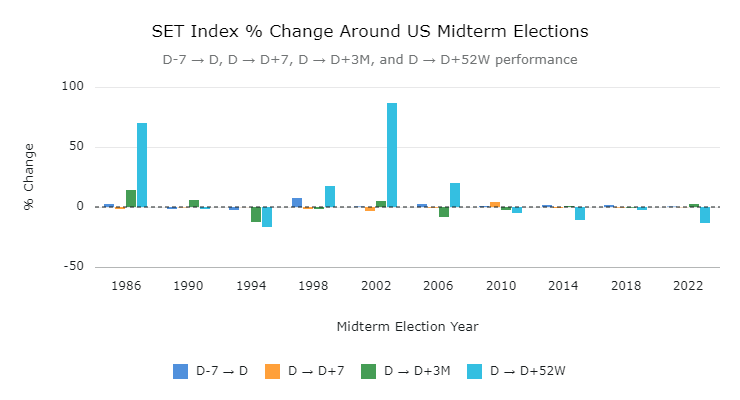
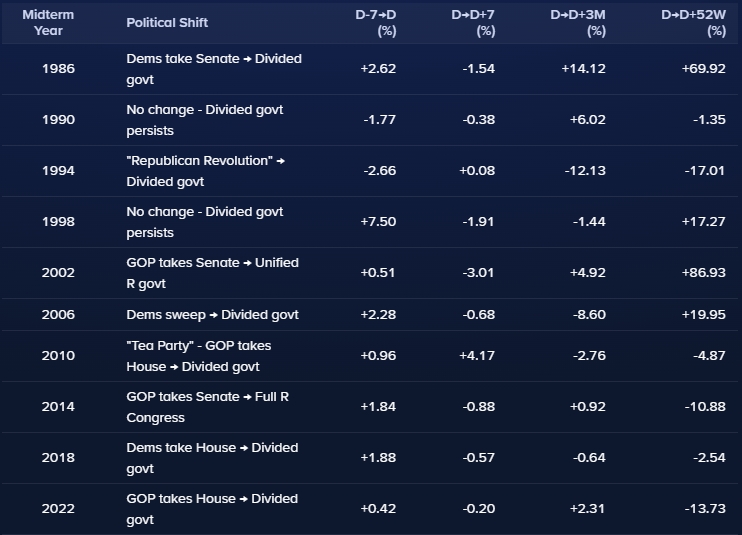
Looking at the week surrounding each midterm election day, a subtle but consistent pattern emerges. In 8 out of 10 cycles, the SET Index posted gains in the seven trading days leading up to the vote, averaging a +1.36% advance. The strongest pre-election rally came in 1998, when the index surged +7.50% in a single week – though that had more to do with Thailand’s recovery from the 1997 Asian Financial Crisis than with American ballot boxes.
The week after the election tells a different story. The SET declined in 8 out of 10 post-election weeks, averaging a modest -0.49% pullback. Only in 2010, during the aftermath of the US “Tea Party” wave, did the SET post a notable post-election gain of +4.17%.
The three-month window yielded nearly flat results on average (+0.27%), split evenly between five gains and five losses – offering little in the way of a tradeable signal.
52-Week Returns Tell a More Complex Story
It is in the 52-week window where things get interesting – and where two extraordinary outliers distort the averages.
The mean 52-week return following a US midterm is +14.37%. But strip out the two largest surges – 1986 (+69.92%) and 2002 (+86.93%) – and the median drops to -1.95%. In the most recent five cycles (2002-2022), the SET was higher 52 weeks after the midterm in only two instances.
1986-1987: Thailand’s Economic Transformation
The 69.92% surge in the 52 weeks following the November 1986 midterm had almost nothing to do with the Democrats recapturing the US Senate from Ronald Reagan’s Republican Party. Instead, it was the opening chapter of one of the most explosive bull markets in Southeast Asian history.
In September 1985, the Plaza Accord among the G5 nations had triggered a dramatic appreciation of the Japanese yen. The stronger yen made Japanese manufacturing at home more expensive, prompting a wave of foreign direct investment into lower-cost Southeast Asian economies – Thailand chief among them. Japanese capital poured into Thai factories, real estate, and infrastructure, catalysing an economic metamorphosis from an agrarian economy into a manufacturing and export powerhouse.
The SET Index data tells the story vividly: from a base of 139 in January 1986, the index rose to 186 by election day in November, then accelerated to 428 by September 1987 – a tripling in less than two years. Even the October 1987 global crash – Black Monday, which saw equity markets around the world plunge – only temporarily derailed the rally. The SET fell from an intra-month peak of 472.86 to 299.83 during October 1987, but the fact that a global market meltdown could only briefly interrupt the Thai surge speaks to the sheer force of the domestic tailwinds.
The global context, in this case, was a double-edged sword: the same international monetary realignment (the Plaza Accord) that was fuelling Thailand’s boom also created the conditions for speculative excess that would eventually culminate in the 1997 Asian Financial Crisis a decade later.
2002-2003 Recovery
The 86.93% post-midterm return in 2002-2003 was, if anything, even more dramatic – and equally disconnected from the US political shift that gave Republicans unified control of Congress under President George W. Bush.
By November 2002, Thailand’s SET Index was still languishing in the 350-370 range – roughly 75% below its pre-crisis peak from 1996. The 1997 Asian Financial Crisis had devastated the Thai economy, and the subsequent 2001 global technology bust and September 11 attacks had snuffed out earlier recovery attempts. The market was, by most measures, deeply depressed.
Two forces converged to trigger the breakout. Domestically, Thailand had launched an ambitious economic stimulus programme to center on infrastructure spending, a debt moratorium for farmers, village-level micro-lending, and aggressive support for domestic consumption. These policies channelled liquidity directly into the real economy and restored confidence in Thai growth prospects.
Globally, the resolution of uncertainty around the Iraq War in early 2003, combined with ultra-loose monetary policy from the US Federal Reserve, ignited a broad risk-on rally across emerging markets. Thailand, with its beaten-down valuations and improving domestic fundamentals, was a prime beneficiary.
As a result, the SET surged from 364.90 in November 2002 to 639.45 by October 2003, and continued climbing to 772 by December 2003 – more than doubling in 13 months. Global capital flows into emerging markets accelerated throughout 2003, providing a powerful external tailwind to the domestically driven recovery.
Looking Ahead
The historical record offers a few takeaways for investors watching the Thai market ahead of the next US midterm cycle:
- Expect a mild pre-election drift higher – the SET has risen in the seven days before 8 of the last 10 midterms.
- The post-election week tends to be soft – a small pullback has been the norm, though the magnitude has been modest.
- The 52-week outlook depends on local fundamentals, not Washington – the two biggest post-midterm rallies were driven entirely by Thai domestic economics and regional capital flows. The US political outcome was coincidental.
- Divided government is the norm – 8 of 10 midterms produced divided government in Washington. The SET showed no consistent pattern in response to this outcome.
In short, while US midterm elections provide a useful temporal marker, Thailand’s SET Index has consistently marched to the beat of its own drum. For investors in Thai equities, the message from four decades of data is clear: watch Bangkok, not Washington.